Artware Fineart has dated this piece to the 1800s.
signed and dated
Oil on Canvas
30 x 25in. ( 76 x 64 cm.)
Losh, James (1763–1833), barrister, was born on 10 June 1763 in Woodside, Wreay, near Carlisle, the fourth child and fourth of the eight sons (one of whom died shortly after birth) and one daughter of John Losh, gentleman, of Woodside, and his wife, Catherine, daughter of John Liddell of Moorhouse, Burgh by Sands, Cumberland. Educated privately, he went to Trinity College, Cambridge, in 1782, and graduated BA in 1786.
On a visit to Paris in 1792, Losh narrowly escaped from the city during the September massacres, possibly owing his escape to the influence of Jean-Paul Marat, who had practised as a veterinary surgeon in Newcastle. Ill health later led him to spend some time in the Bristol area, where he cemented his friendship with William Wordsworth, whom he had met in 1795 at a gathering of radical friends (including George Dyer, William Frend, William Godwin, and John Horne Tooke). He also became a friend of Samuel Taylor Coleridge and Robert Southey. In 1799 he settled as a barrister in Newcastle upon Tyne, rapidly acquiring an enviable reputation as a man of strict integrity and sound judgement, whether in the courts or as an arbitrator in industrial disputes. As a Unitarian he was debarred from holding civic appointments or public office, but, following the repeal of the Test and Corporation Acts in 1828, for the annulment of which he had campaigned, the corporation of Newcastle in 1832 invested him with the highest judicial function in their gift, the recordership, and shortly afterwards with the honorary freedom of the city. Losh was an active reformer and philanthropist. Among the causes which he espoused with fervour were the abolition of the slave trade, Catholic emancipation together with total religious freedom, and, above all, parliamentary reform. A friend of both Charles (later second Earl) Grey and Henry Brougham, he used his influence in the northern counties to speed the passing of the Reform Bill. In the smaller world of Newcastle, Losh did valuable work towards the relief of indigence and the betterment of social conditions and educational standards; he was a leading figure in the improvement of services in the infirmary and the fever hospital, and the establishment of Sunday schools, infant and secondary schools, and mechanics' institutes. Always forward-looking, and abreast of industrial developments, he was a prime mover, as chairman of the directors, in the construction of the Newcastle and Carlisle Railway. Very widely read and a lover of drama and music, Losh was for some thirty years one of the most influential members of the famous Literary and Philosophical Society of Newcastle upon Tyne. In 1791 he published an edition of Areopagitica by John Milton, and in 1831 a translation of Benjamin Constant's Collection complète des ouvrages publiés sur le gouvernement représentatif et la constitution actuelle de la France (1818–20), as Observations on the Strength of the Government in France, and some of his reforming speeches were printed. He had a fine presence and was a forceful speaker. He was a devoted family man, and a friend to men of all religious creeds and political persuasions. In 1798 Losh married Cecilia, daughter of the Revd Roger Baldwin of Aldingham, Lancashire. They had five sons and three daughters. Losh died in Greta Bridge, Yorkshire, on 23 September 1833. T. S. Dorsch, rev. Oxford DNB On the staircase of the elegant neo-classical Lit and Phil building in Newcastle stands the imposing sculpted figure of James Losh, who lived at The Grove in Jesmond after 1802, having settled in Newcastle in 1798. His legal chambers were in Mosley St. Losh was
Artware Fineart has dated this piece to the 1800s.
You can view the stock and full dealer information on the Artware Fineart Profile Page
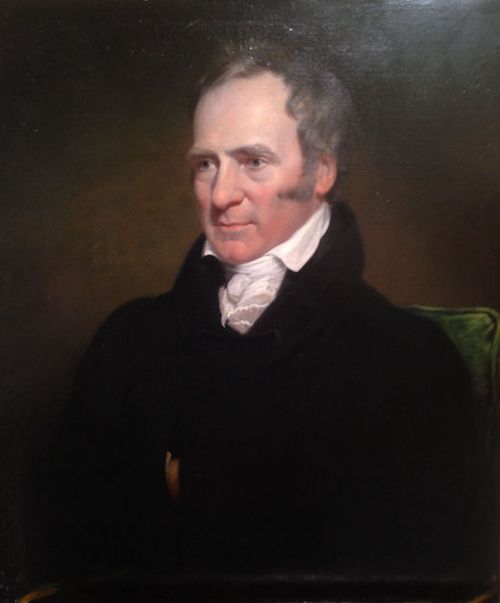
James Ramsay 1786-1854 Portrait of James Losh 1763-1833