18,938  PAGES BROWSED TODAY PAGES TODAY 109 ANTIQUES UPLOADED TODAYNEW ARRIVALS
109 ITEMS ADDED TODAY
Sort Order
Items Per Page
Browse Categories
Sort order
Items per page
ID #SA256681
SOLD
Email Phone WhatsApp
Save
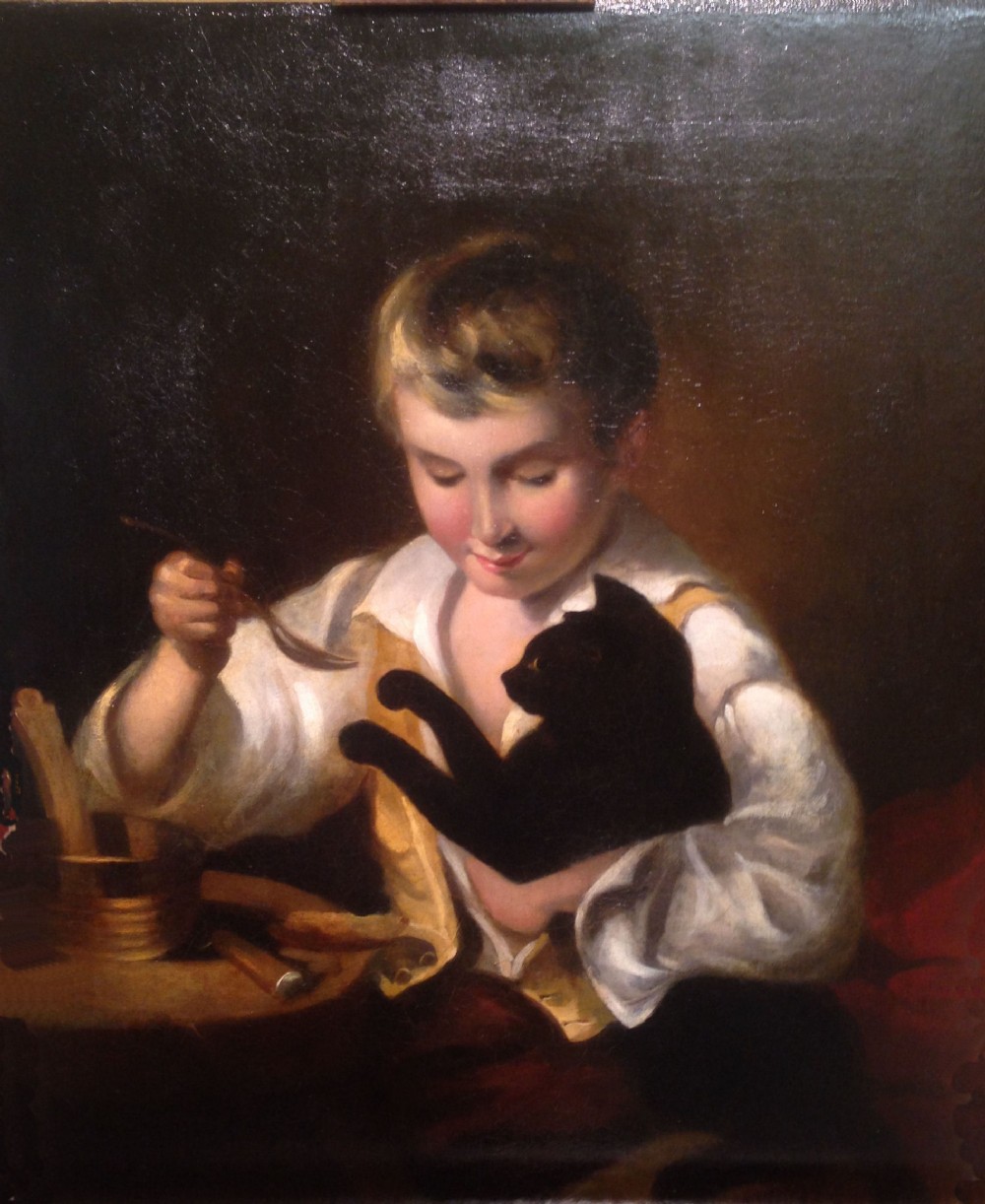
John Opie 1761-1807, a Young Boy Teasing His Cat
Sold by Artware Fineart
sold SA256681
Sorry, but this item has been sold.

Artware Fineart

Sellingantiques Verified Since Sep 2008
Id #SA256681
PDF SHARE
SAVE

John Opie 1761-1807, a Young Boy Teasing His Cat

18th century
Description

John Opie 1761-1807

A Young Boy Teasing his Cat

Oil on Canvas

30 x 25in. ( 76 x 64 cm.)

Opie was born in Trevellas, near Truro in Cornwall, the son, and youngest child of five, of Edward Opie, a master carpenter, and Mary (née Tonkin). He showed a precocious talent for drawing and mathematics; by the age of twelve he had mastered Euclid and opened an evening school for poor children where he taught reading, writing and arithmetic. His father, however, did not encourage John's abilities, and instead apprenticed him to his own trade of carpentry. Opie's first recorded sketch was made at the age of ten and his work eventually came to the attention of local physician and satirist, Dr John Wolcot (Peter Pindar), who visited the teenage artist at his place of work - a sawmill - in 1775. Recognising a great talent, Wolcot became Opie's mentor, buying him out of his apprenticeship and insisting that he come to live at his home in Truro. Wolcot provided invaluable encouragement, advice, tuition and practical help in the advancement of Opie's early career, including obtaining many commissions for work. In 1780, Opie travelled with Wolcot to London, where they shared a residence together, having entered into a formal profit-sharing agreement; Wolcot introduced the "Cornish wonder" to other artists, including the great Sir Joshua Reynolds, who went on to compare him to Caravaggio and Velazquez, and to prospective patrons. This business arrangement with Wolcot lasted for a year, after which Opie informed the doctor that he now wished to go it alone, leading to the estrangement of the two former partners. Opie was introduced, prior to March 1782, at the court of King George III, who purchased one of his pictures and commissioned him to produce a portrait of Mary Delaney. He also received commissions to paint the Duke and Duchess of Gloucester, Lady Salisbury, Lady Charlotte Talbot, Lady Harcourt and other ladies of the court. Opie's residence at "Orange Court", Castle Street, Leicester Fields, was said to be "crowded with rank and fashion every day" and he was the talk of the town. In 1782 he first exhibited at the Royal Academy and in December of that year was married to Mary Bunn - though the match proved to be an unhappy one and they were eventually divorced in 1796 after her elopement. Following a sharp decline in his popularity, Opie began to work on improving his technique, meriting the praise of his rival James Northcote: "Other artists paint to live; Opie lives to paint." At the same time he sought to supplement his early education by the study of Latin, French and English literature, and to polish his provincial manners by mixing in cultivated and learned circles. In 1786 he exhibited his first important historical subject, the Assassination of James I, and in the following year the Murder of Rizzio, a work whose merit was recognized by his immediate election as associate of the Royal Academy, of which he became a full member in 1788. He was employed on five subjects for John Boydell's Shakespeare Gallery; and until his death, his practice alternated between portraiture and historical work. He married Amelia Alderson in May 1798 (see Amelia Opie) and they lived at 8 Berners Street, where Opie had moved in 1791. Opie painted many notable men and women of the day including Mary Wollstonecraft, Samuel Johnson, Francesco Bartolozzi, John Bannister, Joseph Munden, Charles James Fox, William Betty, Edmund Burke, John Crome, James Northcote, Henry Fuseli, Thomas Girtin, Robert Southey, Samuel Parr, Elizabeth Inchbald and Mary Shelley; 508 portraits in all, most in oil, and 252 other pictures. In 1805, Opie was elected a Professor at the Royal Academy and from May 1806 gave a series of 4 lectures which were later published as a book after his death, with a memoir by his widow Amelia Opie, in 1809. His students there included H

Physical Dimensions
Height
76cm (29.92")
Width
64cm (25.20")
Depth
3cm (1.18")
Declaration

Artware Fineart has dated this piece to the 1750s.

Reference Numbers
Sellingantiques Reference
SA256681
Dealers Internal Reference
3592
Description
John Opie 1761-1807

A Young Boy Teasing his Cat

Oil on Canvas

30 x 25in. ( 76 x 64 cm.)

Opie was born in Trevellas, near Truro in Cornwall, the son, and youngest child of five, of Edward Opie, a master carpenter, and Mary (née Tonkin).
Artware Fineart

He showed a precocious talent for drawing and mathematics; by the age of twelve he had mastered Euclid and opened an evening school for poor children where he taught reading, writing and arithmetic. His father, however, did not encourage John's abilities, and instead apprenticed him to his own trade of carpentry. Opie's first recorded sketch was made at the age of ten and his work eventually came to the attention of local physician and satirist, Dr John Wolcot (Peter Pindar), who visited the teenage artist at his place of work - a sawmill - in 1775. Recognising a great talent, Wolcot became Opie's mentor, buying him out of his apprenticeship and insisting that he come to live at his home in Truro. Wolcot provided invaluable encouragement, advice, tuition and practical help in the advancement of Opie's early career, including obtaining many commissions for work. In 1780, Opie travelled with Wolcot to London, where they shared a residence together, having entered into a formal profit-sharing agreement; Wolcot introduced the "Cornish wonder" to other artists, including the great Sir Joshua Reynolds, who went on to compare him to Caravaggio and Velazquez, and to prospective patrons. This business arrangement with Wolcot lasted for a year, after which Opie informed the doctor that he now wished to go it alone, leading to the estrangement of the two former partners. Opie was introduced, prior to March 1782, at the court of King George III, who purchased one of his pictures and commissioned him to produce a portrait of Mary Delaney. He also received commissions to paint the Duke and Duchess of Gloucester, Lady Salisbury, Lady Charlotte Talbot, Lady Harcourt and other ladies of the court. Opie's residence at "Orange Court", Castle Street, Leicester Fields, was said to be "crowded with rank and fashion every day" and he was the talk of the town. In 1782 he first exhibited at the Royal Academy and in December of that year was married to Mary Bunn - though the match proved to be an unhappy one and they were eventually divorced in 1796 after her elopement. Following a sharp decline in his popularity, Opie began to work on improving his technique, meriting the praise of his rival James Northcote: "Other artists paint to live; Opie lives to paint." At the same time he sought to supplement his early education by the study of Latin, French and English literature, and to polish his provincial manners by mixing in cultivated and learned circles. In 1786 he exhibited his first important historical subject, the Assassination of James I, and in the following year the Murder of Rizzio, a work whose merit was recognized by his immediate election as associate of the Royal Academy, of which he became a full member in 1788. He was employed on five subjects for John Boydell's Shakespeare Gallery; and until his death, his practice alternated between portraiture and historical work. He married Amelia Alderson in May 1798 (see Amelia Opie) and they lived at 8 Berners Street, where Opie had moved in 1791. Opie painted many notable men and women of the day including Mary Wollstonecraft, Samuel Johnson, Francesco Bartolozzi, John Bannister, Joseph Munden, Charles James Fox, William Betty, Edmund Burke, John Crome, James Northcote, Henry Fuseli, Thomas Girtin, Robert Southey, Samuel Parr, Elizabeth Inchbald and Mary Shelley; 508 portraits in all, most in oil, and 252 other pictures. In 1805, Opie was elected a Professor at the Royal Academy and from May 1806 gave a series of 4 lectures which were later published as a book after his death, with a memoir by his widow Amelia Opie, in 1809. His students there included H

Height
76cm (29.92")
Width
64cm (25.20")
Depth
3cm (1.18")
Date of Manufacture

Artware Fineart has dated this piece to the 1750s.

Reference Numbers
Sellingantiques Ref
SA256681
Dealers Internal Ref
3592
Artware Fineart
Sellingantiques verified Since Sep 2008
Dealer Profile

You can view the stock and full dealer information on the Artware Fineart Profile Page
PDF SHARE
SAVE
John Opie 1761-1807,  A Young Boy Teasing his Cat
1 / 2
Archive I John Opie 1761-1807,  A Young Boy Teasing his Cat

John Opie 1761-1807, a Young Boy Teasing His Cat

Archive II John Opie 1761-1807,  A Young Boy Teasing his Cat View II
Enlarged Archival View
Telephone 07958 699 645
Location
18 La Gare
51 Surrey Row
London
SE1 0BZ
United Kingdom
Verified Since Sep 2008
Items For Sale 243
Items Sold 223
Artware Fineart
Verified Since Sep 2008
View Dealer Info
Location: 18 La Gare , 51 Surrey Row , London , SE1 0BZ , United Kingdom
Verified
Sep 2008
For Sale
243
Sold
223
John Opie 1761-1807,  A Young Boy Teasing his Cat
John Opie 1761-1807, A Young Boy Teasing his Cat
Ref: SA256681
John Opie 1761-1807,  A Young Boy Teasing his Cat
Detail View 1
Archival Detail
Every single antique dealer on our platform is individually approved by our internal team. We verify their professional trade history, ethical standards, and photographic quality to ensure a secure, high-standard buying environment. Upon joining, every dealer agrees to a strict 9-point code of conduct. While issues can occasionally arise, our dealers typically resolve them swiftly and directly with the buyer. In fact, since our founding in 2002, Sellingantiques has only had to step in to help resolve an issue on roughly five occasions—a true testament to the quality of our dealers and their dedication to your happiness.
Our dealers are highly experienced in packing and shipping fragile, high-value antiques. Because you are in direct contact with the dealer, you will be able to easily go through all available shipping and insurance options together to ensure your item arrives safely.
Antiques are the ultimate green purchase. By choosing historical pieces over newly manufactured goods, you completely eliminate the carbon footprint of modern mass production while preserving exceptional, timeless craftsmanship.
items
Add keywords to the filter
Price
£100
£250000
Era
Movements
Material
Origin
Stock Location
Freshness
Online Payments
Categories