
Artware Fineart has dated this piece to the 1800s.
oil on canvas
30 x 25 in. (76 x 64 cm.)

Francesco Renaldi was an English-born painter of Italian heritage about whose life little is known. He entered the Royal Academy Schools in London in 1776, aged twenty-one. For two years after 1781 Renaldi traveled in Italy, initially with Thomas Jones, the Welsh landscape painter and pupil of Richard Wilson.
Evidently on at least one occasion Jones exploited Renaldi’s name to pass himself off as an Irish catholic in order to gain access to the prior of a monastery at Caserta near Naples—which would normally have been inaccessible to him on sectarian grounds—but Renaldi seems to have accepted this with good grace, even affability. Years later, in 1798, he exhibited at the Royal Academy a workmanlike but affectionate group portrait of the Jones family, which is now in the collection of the National Museum of Wales in Cardiff; it may contain the artist’s discreet but cheerful self-portrait.
Upon returning to London in 1783, Renaldi attempted without success to establish himself as a portrait painter at 2, Portugal Street, a modest house tucked behind Lincoln’s Inn Fields, on the Thames side. On November 3, Jones was pleasantly surprised to bump into Renaldi in Fleet Street, and the two dined together not long afterwards.
In 1785, perhaps frustrated by commercial sluggishness, even sensing the prospect of professional failure in a highly competitive metropolitan market for portraits, Renaldi applied to the East India Company for permission to travel to Bengal. He supplied the names and addresses of two guarantors—Mr. Job Hart Price of Aldershot House, and Robert Codd of the 59th Regiment of Foot. These sureties were obviously acceptable to the company, because the following February Renaldi was given formal approval to go. He sailed aboard the Hillsborough, and reached Calcutta in August 1786.
For ten years Renaldi lived in Calcutta, Lucknow (working, it is believed, for Asaf ud-Daulah, the Nawab Wazir of Oudh), and in Dacca (now the capital city of Bangladesh). He was therefore one of only a relatively small number of European painters—among them William Hodges, Johan Zoffany, Tilly Kettle, and Ozias Humphry (all of whom are represented in the collection of the Yale Center for British Art)—who spent extended periods painting portraits of and for the nabobs (English, Scottish, and Anglo-Irish gentlemen of the East India Company whose tendency was to “go native”) and their more or less official Indian mistresses, or bibis.
By 1796 Francesco Renaldi was back in England. To the following year’s summer exhibition at the Royal Academy he sent paintings of two Industany ladies, and one Mogul lady—all three were presumably bibis, possibly including this one—and also listed his address as 69, Margaret Street, Cavendish Square, very close to what is now Oxford Circus. In 1798 he may have exhibited a portrait of his own family, about whom we know nothing.
Thereafter he vanishes from view, but completely.
Artware Fineart has dated this piece to the 1800s.
You can view the stock and full dealer information on the Artware Fineart Profile Page
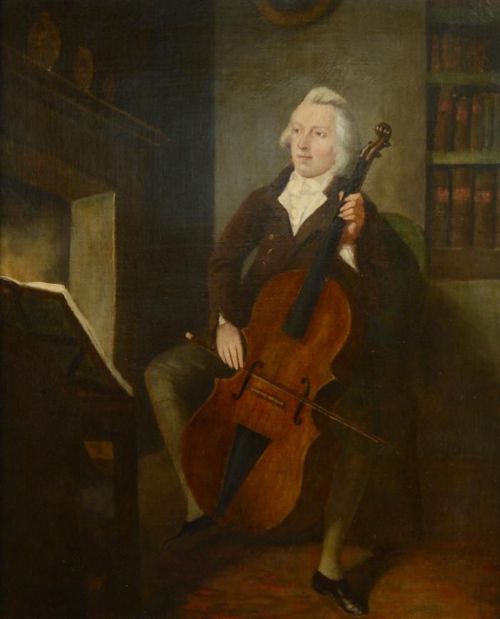
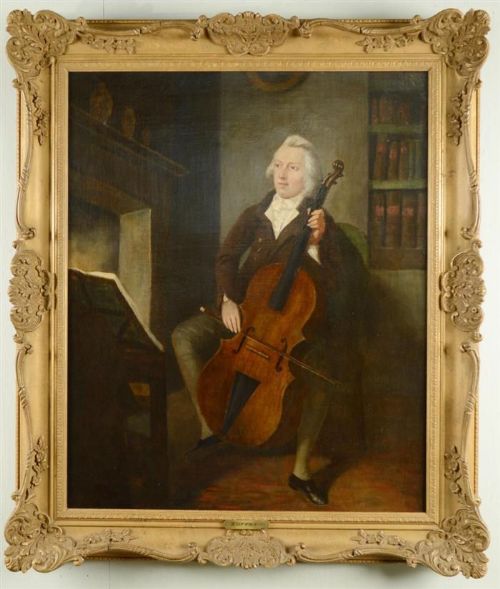
Circle of Francesco Renaldi 1755 - 1798 Portrait of a Young Gentleman Playing His Cello in an Interior