Artware Fineart has dated this piece to the 1800s.
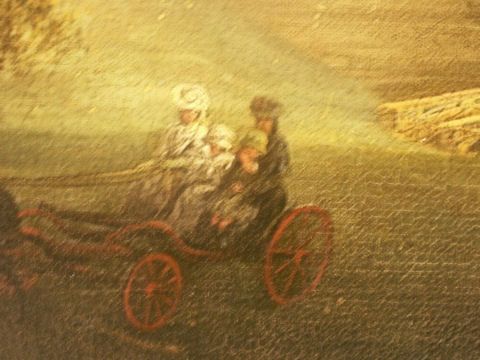
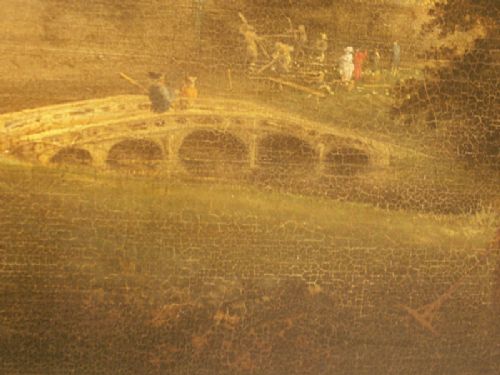
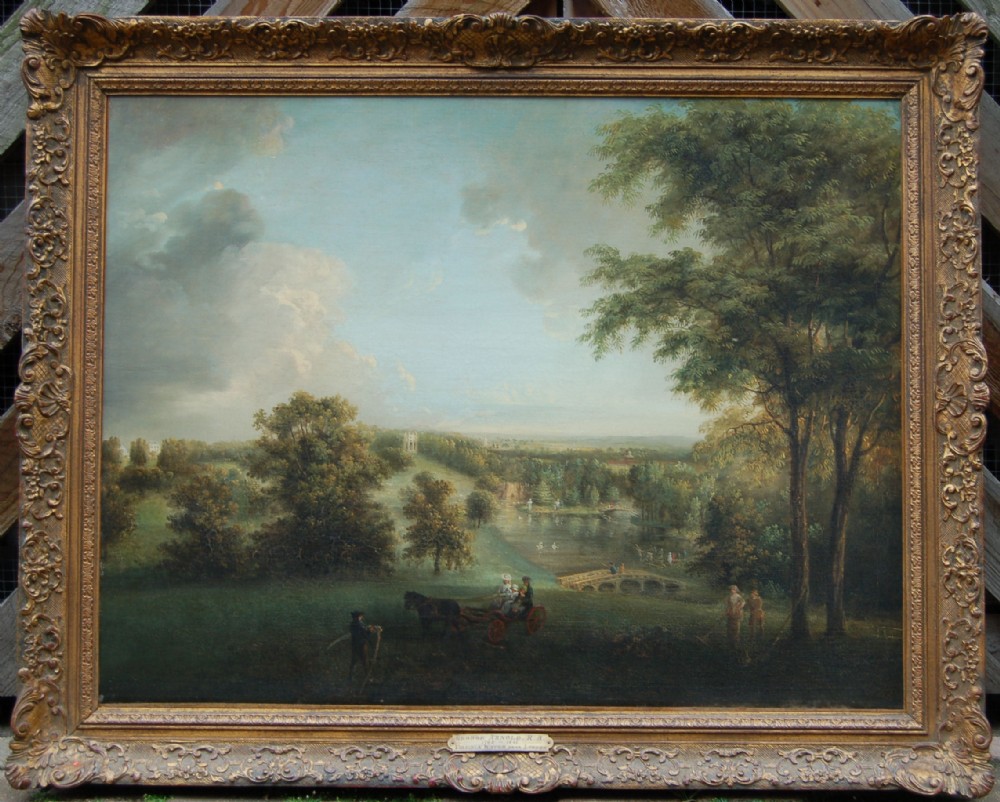
The first lake dates back to 1753 when a dam was created, the resulting lake was at the time the largest man –made body in the British Isles. Work started on the Lake we know to today by William, Duke of Cumberland, third son of George II, who, as Ranger, transformed the Surrey bog into glorious parkland. Also involved was the Deputy Ranger, Thomas Sandby, brother to the famous watercolourist and topographer Paul Sandby, R.A. The two brothers lived together at Windsor, and both painted many pictures of the area including Virgina Water. Few details are recorded of the building of the lake, however it has been suggested that prisoners-of-war from the recent Jacobite risings, who were encamped at the nearby Breakheart Hill, were involved. The original lake was much smaller than the current form, and was destroyed in a flood in 1768. In 1780 Paul and Thomas Sandbybegan construction of a much larger lake at the site, and went on to add an artificial waterfall, Meadow Pond and Obelisk Pond. Their creation of Virginia Water, led the new fashion for garden design - a trend for natural, picturesque landscapes, with specific elements of interest dotted throughout it. Many of these elements can be seen in George Arnald’s painting which would have been painted in the mid to late 1780’s, the elegant wooden bridge in the foreground, the folly in the centre ground and the well ordered planting of woodland, glades and forest rides. The Virginia Water project was continued by Henry, brother of George III. The lake is 130 acres in area, and its total length is slightly over two miles long and one third of a mile wide at its widest point. Its circumference is about seven miles. It was at the time one of the largest artificial lakes in England. The artist George Arnald ARA was a British painter who specialise in landscapes, including topographical views to illustrated county histories. He was born in Berkshire in 1763. He is best known for his celebrated painting depicting the Battle of the Nile.There is little information about Arnald's early years, but it is believed that he began his working life as a domestic servant before turning to the study of art. He was a student of the landscape painter and engraver William Pether (c. 1738–1821). Arnald first exhibited at the Royal Academy in 1788, and eventually had 176 works exhibited there. He also exhibited 63 works at the British Institution. He was elected an associate member of the Royal Academy on 5 November 1810, but was never admitted to full membership. Speaking to Sir George Beaumont, who was influential in the founding of the British Institution and the National Gallery, William Wordsworth lamented Arnald's lack of literary education, stating that he "... would have been a better Painter, if his Genius had led him to read more in the early part of his life. . . . I do not think it possible toexcel in landscape painting without a strong tincture of the Poetic Spirit. Probably his best-known and most acclaimed work was a departure from his usual subject-matter. The Destruction of L'Orient at the Battle of the Nile, 1 August 1798 is Arnald's only known maritime work, and was one of four paintings commissioned for £500 each as part of a British Institution competition for paintings to hang in the Painted Hall of Greenwich Hospital. It was exhibited at the British Institution in 1827 and is now displayed at the National Maritime Museum in Greenwich, London. It features as a "picture within a picture" in a work by Thomas Davidson, hanging alongside the famous Lemuel Abbott portrait of Lord Nelson i
Artware Fineart has dated this piece to the 1800s.
You can view the stock and full dealer information on the Artware Fineart Profile Page
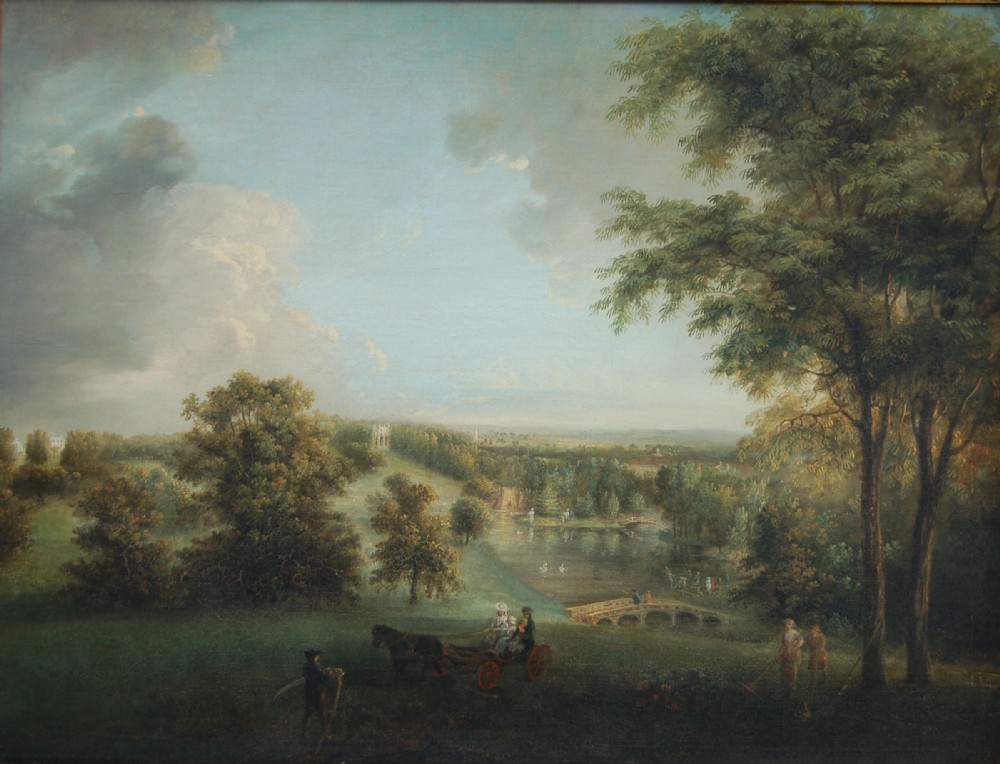
George Arnold 1763 - 1841 a Panoramic View of Virgina Water with Elegant Ladies & Children in a Horse Drawn Carriage