
Artware Fineart has dated this piece to the 1750s.
He is often remembered for his observation following Britain's success in the Seven Years War and subsequent territorial expansion at the Treaty of Paris that Britain now controlled "a vast Empire, on which the sun never sets".
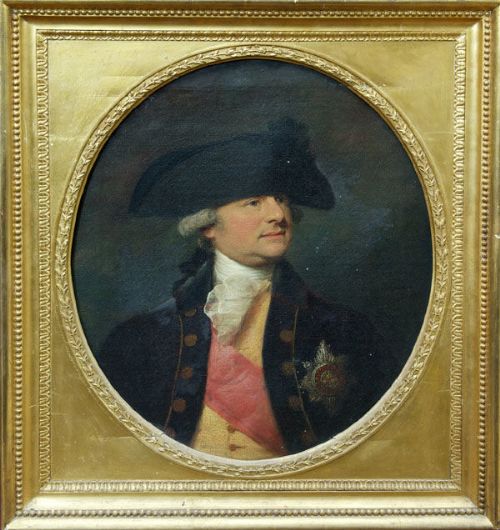
By direct family descent Macartney-Porteous
George Macartney was an Irishman descended from an old Scottish family, the Macartneys of Auchinleck, who had settled in 1649 at Lissanoure, in Loughguile, Ballymoney, County Antrim, Ireland, where he was born. After graduating from Trinity College, Dublin, in 1759, he became a student of the Temple, London. Through Stephen Fox, elder brother of Charles James Fox, he was taken up by Lord Holland.
Appointed envoy extraordinary to Russia in 1764, he succeeded in negotiating with Catherine II an alliance between Great Britain and that country. He was returned in 1768 to the Irish House of Commons as Member of Parliament for Armagh Borough, in order to discharge the duties of Chief Secretary for Ireland. On resigning this office he was knighted. In 1775 he became governor of the British West Indies was created Baron Macartney in the Peerage of Ireland in 1776. He was elected to a seat in the British parliament (Bere Alston) from 1780 to 1781.
Mccartney was the Governor of Madras (now known as Chennai) from 1781 to 1785. During his's tenure as governor, renovation and strengthening of the walls of Fort St. George was commenced after the siege of Lally and completed in 1783. It was also during this time that most of the buildings and barracks in the western portion of the Fort were erected. The Palace Street, the Arsenal, the Hanover square and the Western Barracks were constructed during this time. The streets in the eastern side of the Fort were also altered.
It was also during this time that idea of a police force for Madras was thought of. Popham, the brainchild of the steer which would bear his name (Popham's Broadway) submitted a plan for the establishment of a regular police force for Madras and for the building of direct and cross drains in every street. He also advocated measures for the naming and lighting of streets, for the regular registration of births and deaths and for the licensing of liquor, arrack and toddy shops. A Board of Police assisted by a Kotwal was subsequently formed. The Kotwal was to be the officer of the markets under the Superintendent of Police.He negotiated the Treaty of Mangalore which brought an end to the Second Anglo-Mysore War in 1784. Mccartney declined the governor-generalship of India (then the British territories administered by the British East India Company) and returned to Britain in 1786.
After being created Earl Macartney in the Irish peerage (1792), he was appointed the first envoy of Britain to China (his visit followed more than a hundred years after the first visit to England by a Chinese man, Michael Shen Fu-Tsung in 1685). He led the Macartney Embassy to Beijing in 1792 with a large British delegation on board a 64-gun man-of-war, HMS Lion. The embassy was ultimately not successful. This was not due to Macartney's refusal to kowtow in the presence of the Qianlong Emperor, as is commonly believed. It was also not a result of the Chinese reliance on tradition in dictating foreign policy but rather a result of competing world views which were uncomprehending and incompatible. After the conclusion of the embassy, Qianlong sent a letter to King George III, explaining in greater depth the reasons for his refusal to grant the requests of the embassy. The Macartney Embassy is historically significant because it mar
Artware Fineart has dated this piece to the 1750s.
You can view the stock and full dealer information on the Artware Fineart Profile Page

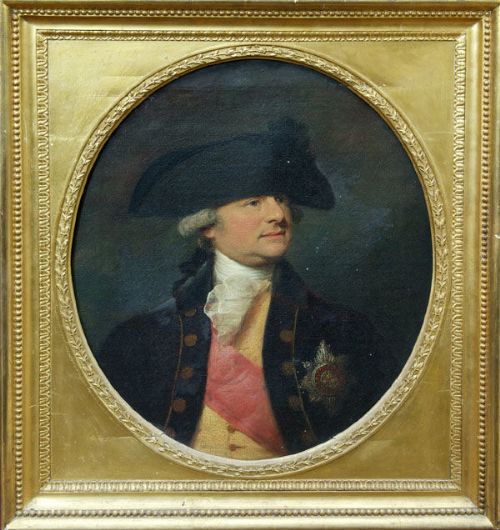
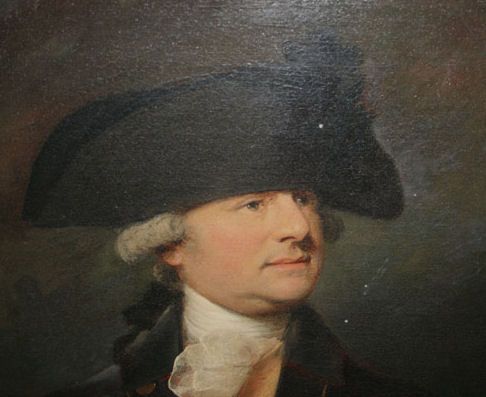
Lemuel Francis Abbott 1760-1802 Portrait of George Macartney, 1st Earl of Macartney, Kb 1737-1806 Wearing a Tricorn Hat and the Order of the Bath