17,672  PAGES BROWSED TODAY PAGES TODAY 109 ANTIQUES UPLOADED TODAYNEW ARRIVALS
109 ITEMS ADDED TODAY
Sort Order
Items Per Page
Browse Categories
Sort order
Items per page
ID #SA171570
SOLD
Email Phone WhatsApp
Save
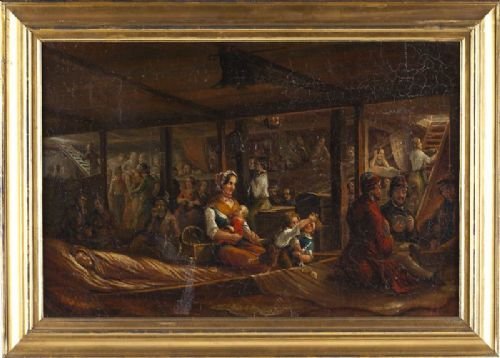
English School 19th Century, Immigrants Bellow Deck on Their Passage to North America.
Sold by Artware Fineart
sold SA171570
Sorry, but this item has been sold.

Artware Fineart

Sellingantiques Verified Since Sep 2008
Id #SA171570
PDF SHARE
SAVE

English School 19th Century, Immigrants Bellow Deck on Their Passage to North America.

19th century
Description

English School 19th Century,

Immigrants bellow deck on their passage to North America

oil on canvas

16 x 24 in. (41 x 61 cm.)

According to Pieter Van der Merwe and Amy Miller from the Royal Maritime Museum in Greenwich London, they have dated the painting to be circa 1860. The overhead clearance seems rather high and its clear that the space in the hold in which accomodation levels have been built, which we know is what happened on ships running to the NE American seaboard including Canada: they were really in the timber (pine) importing trade and emigrants so accomodated made a profitable outward cargo.
The move towards large-scale scientific farming greatly increased output but made many agricultural workers redundant. Some moved to the fast-growing industrial areas in search of work, whereas others decided to emigrate to Australia, New Zealand, Canada, South Africa and the United States. After 1830 the numbers of people leaving Britain increased dramatically. This was particularly true of those farmers and labourers who had lived in counties that had been hardest hit by the agricultural depression such as Kent, Sussex, Hampshire, Dorset, Cornwall, Yorkshire, Derbyshire, Cheshire and Cumberland.Liverpool now became the most popular emigrant port in Europe. In 1830 around 15,000 people sailed from this port to North America. By 1842 this had reached 200,000, which accounted for more than a half of all emigrants leaving from Europe.Unlike other groups of emigrants such as the Irish and Italians, a large number of the English people who went to America stayed in agriculture.The United States also attracted people from England with technological skills. Samuel Slater, who had learnt his trade under Jerediah Strutt and Richard Arkwright, pioneers of the revolution in textile machinery, arrived in the United States in 1789. Four years later Slater established America's first cotton factory at Pawtucket, Rhode Island.
Immigrants with the skills developed in the English textile industry tended to settle in mill towns in Massachusetts such as Fall River, New Bedford and Lawrence. Established by a group of capitalists in Boston in 1845, Lawrence was especially popular with the English. One visitor noted that so many of the manager, loom-fixers, wool-sorters, shopkeepers and saloon owners spoke with a Yorkshire accent that he felt he was still in England. By 1860 one-third of Lawrence's 18,000 inhabitants were employed in the textile industry and the town had become known as the "Bradford of America". In October 1845 a serious blight began among the Irish potatoes, ruining about three-quarters of the country's crop. This was a disaster as over four million people in Ireland depended on the potato as their chief food. The blight returned in 1846 and over the next year an estimated 350,000 people died of starvation and an outbreak of typhus that ravaged a weaken population. Despite good potato crops over the next four years, people continued to die and in 1851 the Census Commissioners estimated that nearly a million people had died during the Irish Famine. The British administration and absentee landlords were blamed for this catastrophe by the Irish people.

Physical Dimensions
Height
47cm (18.50")
Width
68cm (26.77")
Depth
3cm (1.18")
Declaration

Artware Fineart has dated this piece to the 19th Century.

Reference Numbers
Sellingantiques Reference
SA171570
Dealers Internal Reference
3556
Description
English School 19th Century,

Immigrants bellow deck on their passage to North America

oil on canvas

16 x 24 in. (41 x 61 cm.)

According to Pieter Van der Merwe and Amy Miller from the Royal Maritime Museum in Greenwich London, they have dated the painting to be circa 1860.
Artware Fineart

The overhead clearance seems rather high and its clear that the space in the hold in which accomodation levels have been built, which we know is what happened on ships running to the NE American seaboard including Canada: they were really in the timber (pine) importing trade and emigrants so accomodated made a profitable outward cargo.

fig 1. English School 19th Century, Immigrants bellow deck on their passage to North America.
fig 1. English School 19th Century, Immigrants Bellow Deck on Their Passage to North America.

The move towards large-scale scientific farming greatly increased output but made many agricultural workers redundant. Some moved to the fast-growing industrial areas in search of work, whereas others decided to emigrate to Australia, New Zealand, Canada, South Africa and the United States. After 1830 the numbers of people leaving Britain increased dramatically. This was particularly true of those farmers and labourers who had lived in counties that had been hardest hit by the agricultural depression such as Kent, Sussex, Hampshire, Dorset, Cornwall, Yorkshire, Derbyshire, Cheshire and Cumberland.Liverpool now became the most popular emigrant port in Europe. In 1830 around 15,000 people sailed from this port to North America. By 1842 this had reached 200,000, which accounted for more than a half of all emigrants leaving from Europe.Unlike other groups of emigrants such as the Irish and Italians, a large number of the English people who went to America stayed in agriculture.The United States also attracted people from England with technological skills. Samuel Slater, who had learnt his trade under Jerediah Strutt and Richard Arkwright, pioneers of the revolution in textile machinery, arrived in the United States in 1789. Four years later Slater established America's first cotton factory at Pawtucket, Rhode Island.

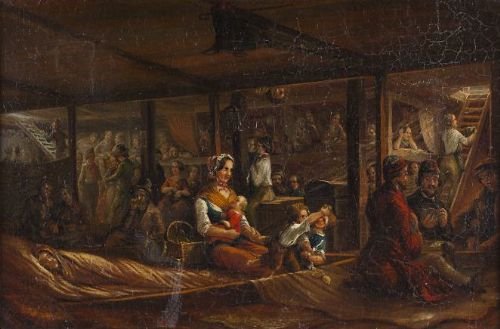
fig 2. English School 19th Century, Immigrants bellow deck on their passage to North America.
fig 2. English School 19th Century, Immigrants Bellow Deck on Their Passage to North America.

Immigrants with the skills developed in the English textile industry tended to settle in mill towns in Massachusetts such as Fall River, New Bedford and Lawrence. Established by a group of capitalists in Boston in 1845, Lawrence was especially popular with the English. One visitor noted that so many of the manager, loom-fixers, wool-sorters, shopkeepers and saloon owners spoke with a Yorkshire accent that he felt he was still in England. By 1860 one-third of Lawrence's 18,000 inhabitants were employed in the textile industry and the town had become known as the "Bradford of America". In October 1845 a serious blight began among the Irish potatoes, ruining about three-quarters of the country's crop. This was a disaster as over four million people in Ireland depended on the potato as their chief food. The blight returned in 1846 and over the next year an estimated 350,000 people died of starvation and an outbreak of typhus that ravaged a weaken population. Despite good potato crops over the next four years, people continued to die and in 1851 the Census Commissioners estimated that nearly a million people had died during the Irish Famine. The British administration and absentee landlords were blamed for this catastrophe by the Irish people.

Height
47cm (18.50")
Width
68cm (26.77")
Depth
3cm (1.18")
Date of Manufacture

Artware Fineart has dated this piece to the 19th Century.

Reference Numbers
Sellingantiques Ref
SA171570
Dealers Internal Ref
3556
Artware Fineart
Sellingantiques verified Since Sep 2008
Dealer Profile

You can view the stock and full dealer information on the Artware Fineart Profile Page
PDF SHARE
SAVE
English School 19th Century, Immigrants bellow deck on their passage to North America.
1 / 5
Archive I English School 19th Century, Immigrants bellow deck on their passage to North America.

English School 19th Century, Immigrants Bellow Deck on Their Passage to North America.
Archive II English School 19th Century, Immigrants bellow deck on their passage to North America. View II
Archive III English School 19th Century, Immigrants bellow deck on their passage to North America. View III
Archive IV English School 19th Century, Immigrants bellow deck on their passage to North America. View IV
Archive V English School 19th Century, Immigrants bellow deck on their passage to North America. View V
Enlarged Archival View
Telephone 07958 699 645
Location
18 La Gare
51 Surrey Row
London
SE1 0BZ
United Kingdom
Verified Since Sep 2008
Items For Sale 243
Items Sold 223
Artware Fineart
Verified Since Sep 2008
View Dealer Info
Location: 18 La Gare , 51 Surrey Row , London , SE1 0BZ , United Kingdom
Verified
Sep 2008
For Sale
243
Sold
223
English School 19th Century, Immigrants bellow deck on their passage to North America.
Ref: SA171570
English School 19th Century, Immigrants bellow deck on their passage to North America.
Detail View 1
Detail View 2
Detail View 3
Detail View 4
Archival Detail
Every single antique dealer on our platform is individually approved by our internal team. We verify their professional trade history, ethical standards, and photographic quality to ensure a secure, high-standard buying environment. Upon joining, every dealer agrees to a strict 9-point code of conduct. While issues can occasionally arise, our dealers typically resolve them swiftly and directly with the buyer. In fact, since our founding in 2002, Sellingantiques has only had to step in to help resolve an issue on roughly five occasions—a true testament to the quality of our dealers and their dedication to your happiness.
Our dealers are highly experienced in packing and shipping fragile, high-value antiques. Because you are in direct contact with the dealer, you will be able to easily go through all available shipping and insurance options together to ensure your item arrives safely.
Antiques are the ultimate green purchase. By choosing historical pieces over newly manufactured goods, you completely eliminate the carbon footprint of modern mass production while preserving exceptional, timeless craftsmanship.
items
Add keywords to the filter
Price
£100
£250000
Era
Movements
Material
Origin
Stock Location
Freshness
Online Payments
Categories