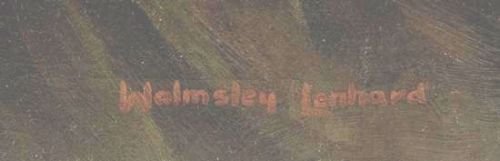
Artware Fineart has dated this piece to the 1910s.
USA
Oil on Canvas
signed lower right
38 x 28 in.
Mortimer Park Crane was born in Philadelphia on 4 February 1894, the only child of Theron Insco Crane and Charlotte Augusta (West) Crane, Mortimer took final entrance examinations for Yale in the fall of 1913. He did quite well, passing six of seven subjects and “nearly” passing ancient history. “While much gratified, I confess to having been surprised at such a result, and it is evident that his preparatory work was more advanced that we had reason to believe,” was how Theron expressed it to Dr. McPherson with obvious astonishment. Entering Yale’s class of 1917, Mortimer was known as “Mort” and, of course, nicknamed “Ichabod.” But he was gone from Yale after two years, spent a year at Lafayette College in Easton, PA, another at the University of Virginia, then went to work for one of his father’s companies, the Northern Ore Company, which Pilling & Crane operated in the zinc-mining area of Edwards, the terminus of a spur of the New York Central and Hudson R.R. in St. Lawrence County, New York. What inspired his military decisions may never be known.
Among the pamphlets collected at that time by Hampton L. Carson of the Historical Society of Pennsylvania is one written in 1917 by R. Wherry Anderson titled “The Romance of air-fighting.” And romance is indeed depicted: the epitome of young British manhood exhibiting skill, daring, bravery, and an almost chivalrous regard for opponents. The invitation to Americans was clear, and many young men accepted it even after the United States entered the war. One newspaper later reported that Mortimer had been “filled with patriotic enthusiasm,” enlisting “soon after a state of war was declared by the United States,” while another noted that he had volunteered for U.S. military service but, seeking quicker assignment to the front, received a discharge in order to fly with the Canadians and British. So, Mortimer crossed into Canada and joined the Royal Flying Corps (predecessor of the Royal Air Force) at Toronto, where his training was led by Lord Alistair Innes-Kerr and Vernon Castle. In January 1918, he was commissioned and sailed for England. In an incident eerily presaging his pupil’s fate, Castle was killed during a training mission on 15 February 1918 when a student’s plane collided with his. Mortimer, meanwhile, had been assigned to the Central Flying School in Upavon, Wiltshire, the oldest aviation school in England, established in the spring of 1912 on 425 acres of Upavon Down. His unit patrolled the British skies, and only a shortage of equipment prevented the well-thought-of American from being sent to the front. At last, by May, all was in readiness. Mortimer, praised by his squadron’s commandant for “splendid keenness in his work,” was promoted to First Lieutenant and ordered to France. But during a maneuver on 15 May 1918 the plane to his left clipped his, tearing away the bottom wing on that side. A Court of Inquiry decided that “the cause of the accident was in our opinion due to an error of judgement on the part of the pilot Lieut. M. P. Crane in the fact that he turned and ran into Lieut L. J. Cox from underneath while flying in formation.” Mortimer’s plane crashed to earth near Amesbury, Wiltshire, on the River Avon, and he died instantly of a fractured neck. mystery, but, as he was in the plot of the family of Benjamin Talbot, credited with “the construction of the first furnaces for continuous steel production,” in 1899 in Pennsylvania, there is a possible connection with Theron Crane.
Artware Fineart has dated this piece to the 1910s.
You can view the stock and full dealer information on the Artware Fineart Profile Page

Lenhard Walmsley 1891-1966