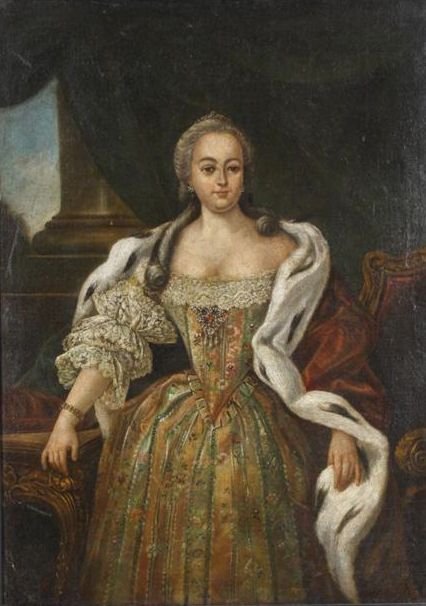
Artware Fineart has dated this piece to the 1750s.
Germany
Oil on Canvas
40 x 30in. (102 x 78 cm.)
From 1746, he was court painter to Elizabeth. Elizaveta Petrovna (Russian: (29 December [O.S. 18 December] 1709–5 January 1762 [O.S. 25 December 1761] ), also known as Yelisavet and Elizabeth, was the Empress of Russia (1741–1762) who took the country into the War of Austrian Succession (1740–1748) and the Seven Years' War (1756–1763). On the eve of her death in 1762, the Russian empire spanned almost 4 billion acres[citation needed] (more than 16 million square kilometres), but her successor, Tsar Peter III, an admirer of the Prussian military, recalled the winning Russian forces from Berlin — effectively causing Russia to switch sides in the war, which likely resulted in his assassination in the following months. Her domestic policies allowed the nobles to gain dominance in local government while shortening their terms of service to the state. She encouraged Lomonosov's establishment of the University of Moscow and Shuvalov's foundation of the Academy of Fine Arts in Saint Petersburg. She also spent exorbitant sums of money on the grandiose baroque projects of her favourite architect, Bartolomeo Rastrelli, particularly in Peterhof and Tsarskoye Selo. The Winter Palace and the Smolny Cathedral remain the chief monuments of her reign in Saint Petersburg. Generally, she was one of the best loved Russian monarchs, because she did not allow Germans in the government and not one person was executed during her reign.
Artware Fineart has dated this piece to the 1750s.
You can view the stock and full dealer information on the Artware Fineart Profile Page

Georg Christoph Grooth 1716-1749