39,028  PAGES BROWSED TODAY PAGES TODAY 277 ANTIQUES UPLOADED TODAYNEW ARRIVALS
277 ITEMS ADDED TODAY
Sort Order
Items Per Page
Browse Categories
Sort order
Relevant Links
Items per page
ID #SA1232877
FOR SALE
£6,800
Email Buy
Save
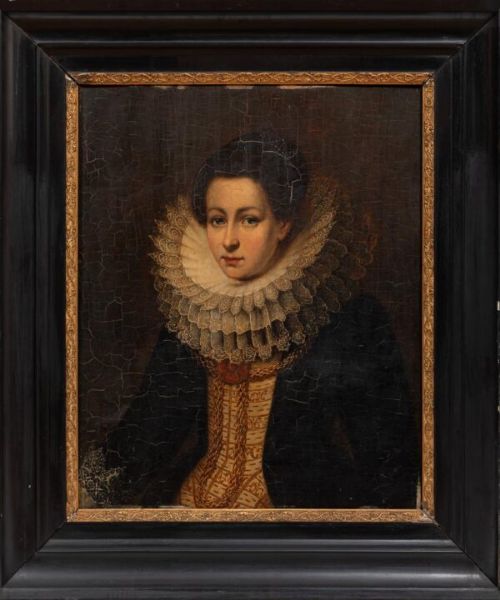
John Hayls - 17th Century Oil Portrait Painting of a Noblewoman C. 1655.
Period Portraits
for sale €7,956     $8,636
£6,800
Period Portraits

Period Portraits

Sellingantiques Verified Since Jan 2017
View Dealers Stock Page
  • About Us
    Specialist dealer in portraits from the 17th century to the 20th century. Our stock includes quality oil paintings, drawings, and mezzotints
Id #SA1232877
PDF SHARE
SAVE

John Hayls - 17th Century Oil Portrait Painting of a Noblewoman C. 1655.

17th century
For Sale by Period Portraits
Description

A fine and sensitively rendered 17th century oil on panel portrait of a beauty by John Hayls (1600-1679).

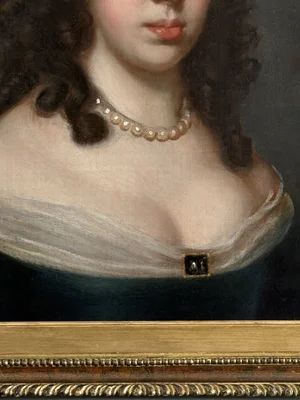
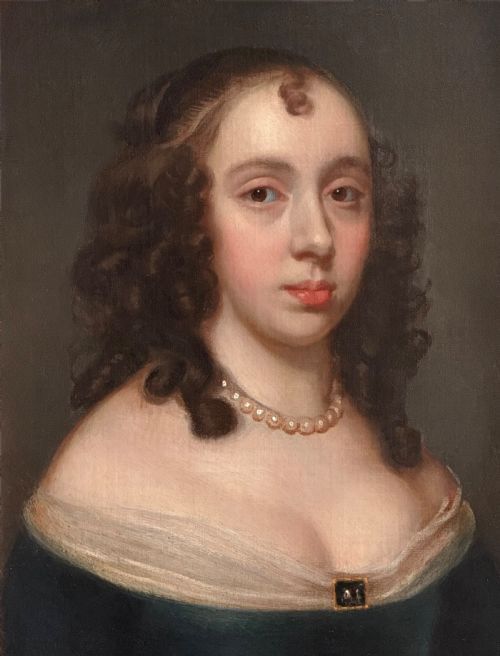
The as yet unknown noble sitter is depicted bust length dressed expensively dressed in the high status silk clothing of the period. Her costume has a low and wide neckline that reveals her décolletage., and it is held in place with a single gem set brooch at her bosom. Her luxuriant locks are pinned back, with a single curl at the centre of her forehead whilst others tumble across her shoulder. Her look is completed by a large single strand pearl necklace.
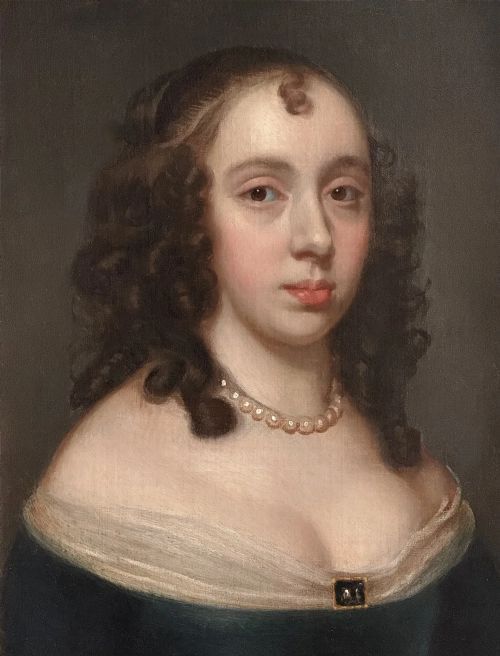
The clothing worn by the lady in this portrait is clearly derived from Van Dyck’s model of dressing his ladies in a manner described by William Sanderson as a ‘careless romance’. In other words, the plain satin fabric is clasped together in a manner unlike that worn in daily dress. This is ‘the norm’ for portraits from the 1640s onwards, as continued into the 1660s by Sir Peter Lely, to impart an air of timelessness and aristocratic ease.
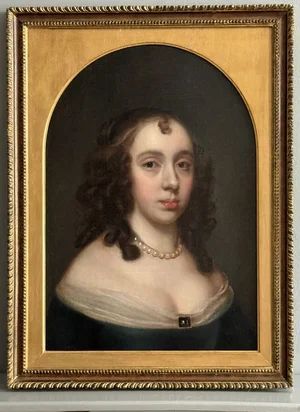
Although this sitter shares the same relatively bold eyebrows, dark eyes, long nose, rouged cheek and full cupid-bow lips as the fashionable ideal. The depiction of her eyes is unlike Lely’s characteristic sleepy and seductive heavy-lidded almond shape. The rather rounded oval eyes, and very dark pupil are of course much more characteristic of Lely’s contemporary John Hayls.
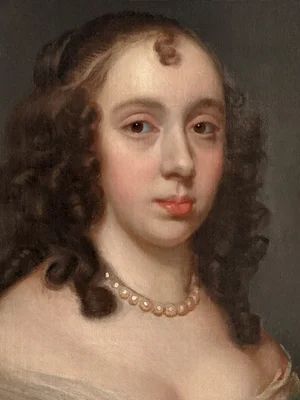
With her jewel studied dress and necklace, it his clear that this beauty had wealth in abundance.

John Hayls (1600-1679) John Hayls (pronounced Hales) ranks as one of the most talented portrait painters in mid-seventeenth century Britain. In spite of this fact, it is surprising perhaps that so few details of his life have survived. Most notably, his portrait of the diarist Samuel Pepys (now in the National Portrait Gallery) has remained the most enduring image of this infamous and iconic figure from the Restoration period.
Like so many during this period, Hayls’s portraits draw heavily on of the works of the prolific Sir Anthony Van Dyck, whose death in 1641 provided large shoes for a new generation of painters to step into. This portrait of an unknown lady is no exception to the rule. The dramatic pose, drapery and setting shows a great indebtedness to the tone set by Van Dyck around fourty years or so before this work was created.
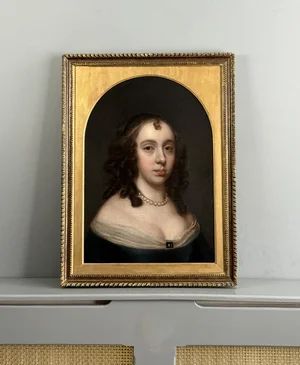
Although unsigned, the case for the attribution to Hayls is most evident in the painterly style executed onto the canvas. The combination of both thin and soft glazes, most evident in the face, contrasted with the bravura in the drapery, is typical of the artist’s work. So too is the landscape to the left of the sitter, which is highly reminiscent of other works by the painter.

Portraits such as these bring to mind the increasing competition between painters during the reign of Charles II. Artists such as the Dutch-born Sir Peter Lely, who also excelled whilst working in this three-quarter length format, presented a significant challenge to English painters like Hayls. It is recorded that the artist missed out on at least one important commission for the Justices of the Guildhall, an honour which was eventually awarded to fellow British artist John Michael Wright.

The painter’s untimely end came in 1679, where it was recorded that ‘comeing from the necessary house, he dropt down dead in the Garden. being drest in a velvet suit to go to a Ld Mayors feast.’

Higher resolution images on request.

Worldwide shipping available.

Framed: 25.5" x 19.25" / 66cm x 49cm.

Price: £6800

Physical Dimensions
Height
66cm (25.98")
Width
49cm (19.29")
Depth
2cm (0.79")
Declaration

Period Portraits has dated this 17th Century Oil Portrait to the 17th Century.

Reference Numbers
Sellingantiques Reference
SA1232877
Description
A fine and sensitively rendered 17th century oil on panel portrait of a beauty by John Hayls (1600-1679).
The as yet unknown noble sitter is depicted bust length dressed expensively dressed in the high status silk clothing of the period.
Period Portraits

Her costume has a low and wide neckline that reveals her décolletage., and it is held in place with a single gem set brooch at her bosom. Her luxuriant locks are pinned back, with a single curl at the centre of her forehead whilst others tumble across her shoulder. Her look is completed by a large single strand pearl necklace.

fig 1. A 17th-century oil portrait painting depicting a noblewoman with dark curled hair wearing a pearl necklace and a dark green gown.
fig 1. John Hayls - 17th Century Oil Portrait Painting of a Noblewoman C. 1655.

The clothing worn by the lady in this portrait is clearly derived from Van Dyck’s model of dressing his ladies in a manner described by William Sanderson as a ‘careless romance’. In other words, the plain satin fabric is clasped together in a manner unlike that worn in daily dress. This is ‘the norm’ for portraits from the 1640s onwards, as continued into the 1660s by Sir Peter Lely, to impart an air of timelessness and aristocratic ease.

fig 2. A 17th-century oil portrait painting depicting a noblewoman with dark curled hair wearing a pearl necklace and a dark green gown.
fig 2. John Hayls - 17th Century Oil Portrait Painting of a Noblewoman C. 1655.

Although this sitter shares the same relatively bold eyebrows, dark eyes, long nose, rouged cheek and full cupid-bow lips as the fashionable ideal. The depiction of her eyes is unlike Lely’s characteristic sleepy and seductive heavy-lidded almond shape. The rather rounded oval eyes, and very dark pupil are of course much more characteristic of Lely’s contemporary John Hayls.

fig 3. A 17th-century oil portrait painting depicting a noblewoman with dark curled hair wearing a pearl necklace and a dark green gown.
fig 3. John Hayls - 17th Century Oil Portrait Painting of a Noblewoman C. 1655.

With her jewel studied dress and necklace, it his clear that this beauty had wealth in abundance.

John Hayls (1600-1679) John Hayls (pronounced Hales) ranks as one of the most talented portrait painters in mid-seventeenth century Britain. In spite of this fact, it is surprising perhaps that so few details of his life have survived. Most notably, his portrait of the diarist Samuel Pepys (now in the National Portrait Gallery) has remained the most enduring image of this infamous and iconic figure from the Restoration period.

fig 4. A 17th-century oil portrait painting depicting a noblewoman with dark curled hair wearing a pearl necklace and a dark green gown.
fig 4. John Hayls - 17th Century Oil Portrait Painting of a Noblewoman C. 1655.

Like so many during this period, Hayls’s portraits draw heavily on of the works of the prolific Sir Anthony Van Dyck, whose death in 1641 provided large shoes for a new generation of painters to step into. This portrait of an unknown lady is no exception to the rule. The dramatic pose, drapery and setting shows a great indebtedness to the tone set by Van Dyck around fourty years or so before this work was created.

fig 5. A 17th-century oil portrait painting depicting a noblewoman with dark curled hair wearing a pearl necklace and a dark green gown.
fig 5. John Hayls - 17th Century Oil Portrait Painting of a Noblewoman C. 1655.

Although unsigned, the case for the attribution to Hayls is most evident in the painterly style executed onto the canvas. The combination of both thin and soft glazes, most evident in the face, contrasted with the bravura in the drapery, is typical of the artist’s work. So too is the landscape to the left of the sitter, which is highly reminiscent of other works by the painter.

Portraits such as these bring to mind the increasing competition between painters during the reign of Charles II. Artists such as the Dutch-born Sir Peter Lely, who also excelled whilst working in this three-quarter length format, presented a significant challenge to English painters like Hayls. It is recorded that the artist missed out on at least one important commission for the Justices of the Guildhall, an honour which was eventually awarded to fellow British artist John Michael Wright.

The painter’s untimely end came in 1679, where it was recorded that ‘comeing from the necessary house, he dropt down dead in the Garden. being drest in a velvet suit to go to a Ld Mayors feast.’

Higher resolution images on request.

Worldwide shipping available.

Framed: 25.5" x 19.25" / 66cm x 49cm.

Price: £6800

Height
66cm (25.98")
Width
49cm (19.29")
Depth
2cm (0.79")
Date of Manufacture

Period Portraits has dated this 17th Century Oil Portrait to the 17th Century.

Reference Numbers
Sellingantiques Ref
SA1232877
Period Portraits
Period Portraits
Sellingantiques verified Since Jan 2017

Specialist dealer in portraits from the 17th century to the 20th century. Our stock includes quality oil paintings, drawings, and mezzotints

Dealer Profile

You can view the stock and full dealer information on the Period Portraits Profile Page
PDF SHARE
SAVE
A 17th-century oil portrait painting depicting a noblewoman with dark curled hair wearing a pearl necklace and a dark green gown.
1 / 6
Archive I A 17th-century oil portrait painting depicting a noblewoman with dark curled hair wearing a pearl necklace and a dark green gown.

John Hayls - 17th Century Oil Portrait Painting of a Noblewoman C. 1655.
Archive II A 17th-century oil portrait painting depicting a noblewoman with dark curled hair wearing a pearl necklace and a dark green gown. View II
Archive III A 17th-century oil portrait painting depicting a noblewoman with dark curled hair wearing a pearl necklace and a dark green gown. View III
Archive IV A 17th-century oil portrait painting depicting a noblewoman with dark curled hair wearing a pearl necklace and a dark green gown. View IV
Archive V A 17th-century oil portrait painting depicting a noblewoman with dark curled hair wearing a pearl necklace and a dark green gown. View V
Archive VI A 17th-century oil portrait painting depicting a noblewoman with dark curled hair wearing a pearl necklace and a dark green gown. View VI
FURTHER BROWSING

Visitors also looked at these ⇣

Enlarged Archival View
Telephone 07889 859729
Location
North Yorkshire
United Kingdom
Verified Since Jan 2017
Items For Sale 47
Items Sold 61
Period Portraits
Period Portraits
Verified Since Jan 2017
View Dealer Info
Location: North Yorkshire, United Kingdom
Verified
Jan 2017
For Sale
47
Sold
61
A 17th-century oil portrait painting depicting a noblewoman with dark curled hair wearing a pearl necklace and a dark green gown.
JOHN HAYLS - 17TH CENTURY OIL PORTRAIT PAINTING OF A NOBLEWOMAN c. 1655.
Ref: SA1232877
A 17th-century oil portrait painting depicting a noblewoman with dark curled hair wearing a pearl necklace and a dark green gown.
Detail View 1
Detail View 2
Detail View 3
Detail View 4
Detail View 5
Archival Detail
Every single antique dealer on our platform is individually approved by our internal team. We verify their professional trade history, ethical standards, and photographic quality to ensure a secure, high-standard buying environment. Upon joining, every dealer agrees to a strict 9-point code of conduct. While issues can occasionally arise, our dealers typically resolve them swiftly and directly with the buyer. In fact, since our founding in 2002, Sellingantiques has only had to step in to help resolve an issue on roughly five occasions—a true testament to the quality of our dealers and their dedication to your happiness.
Our dealers are highly experienced in packing and shipping fragile, high-value antiques. Because you are in direct contact with the dealer, you will be able to easily go through all available shipping and insurance options together to ensure your item arrives safely.
Antiques are the ultimate green purchase. By choosing historical pieces over newly manufactured goods, you completely eliminate the carbon footprint of modern mass production while preserving exceptional, timeless craftsmanship.

During the 17th century, English portraiture was heavily influenced by continental painters, focusing on formality, social status, and precise depictions of costume, fabrics, and personal jewellery.

Artists primarily utilised hand-ground oil pigments applied to natural flax linen canvas or wooden panels, sealed with traditional tree resin varnishes.

Authenticity is identified through age-appropriate craquelure patterns, historic canvas weave or wood panel construction, and pigment analysis consistent with 17th-century artist materials.

A historic oil portrait functions as a focal point when positioned above a mantelpiece or sideboard, creating visual contrast alongside contemporary furnishings.

Preserve the painting by displaying it in a stable environment away from direct sunlight, fluctuating humidity, and direct heat sources, relying on professional conservators for cleaning.
items
Add keywords to the filter
Price
£100
£250000
Era
Movements
Material
Origin
Stock Location
Freshness
Online Payments
Categories