2,658  PAGES BROWSED TODAY PAGES TODAY 0 ANTIQUES UPLOADED TODAYNEW ARRIVALS
LATEST STOCK
Sort Order
Items Per Page
Browse Categories
Sort order
Relevant Links
Items per page
ID #SA1231836
FOR SALE
£9,000
Email Buy
Save
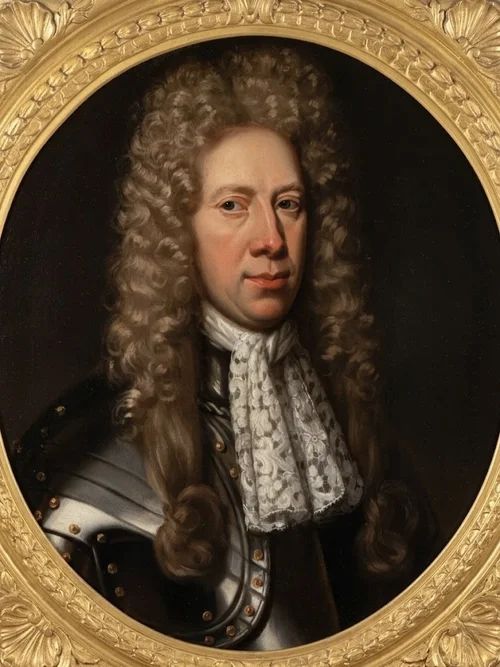
John Scougall (C.1645-1737) - Portrait of a Gentleman, Possibly Sir Patrick Maxwell of Springkell (1640-1723).
Period Portraits
for sale €10,530     $11,430
£9,000
Period Portraits

Period Portraits

Sellingantiques Verified Since Jan 2017
View Dealers Stock Page
  • About Us
    Specialist dealer in portraits from the 17th century to the 20th century. Our stock includes quality oil paintings, drawings, and mezzotints
Id #SA1231836
PDF SHARE
SAVE

John Scougall (C.1645-1737) - Portrait of a Gentleman, Possibly Sir Patrick Maxwell of Springkell (1640-1723).

17th century
For Sale by Period Portraits
Description

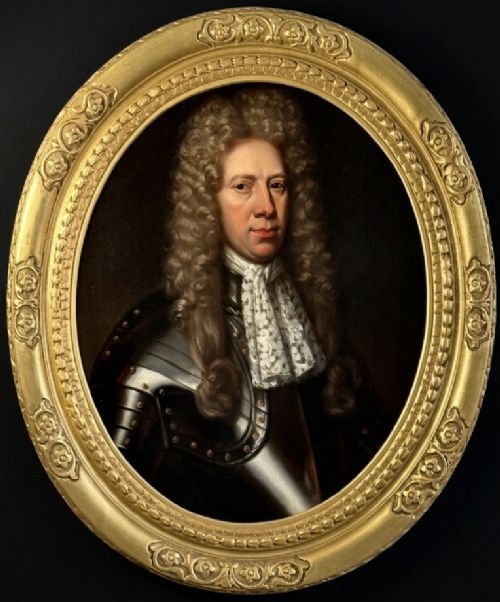
Fine 17th century portrait of a gentleman, painted in the oval by the celebrated Scottish portrait artist John Scougall (c. 1645-1723). The sitter, possibly Sir Patrick Maxwell of Springkell (1640-1723) is depicted half-length wearing plate armour, a finely worked lace jabot, and with his hair in an elaborate coiffure.

John Scougall (c.1645–1737)

John Scougall was a prolific Scottish portrait painter and limner based in Edinburgh. He was a central figure in Scottish art history, known for painting the Scottish nobility and royalty during the Restoration period.

The son of the prominent portrait painter David Scougall (c. 1630–1685) John Scougall operated within an extended family network of artists and notable figures, including his cousin Patrick Scougall, Bishop of Aberdeen.

He ran a highly successful portrait studio in Advocates' Close, Edinburgh, which also served as a picture gallery. His work was heavily influenced by fashionable London portrait painters like Sir Peter Lely and Sir Godfrey Kneller, but it retains a uniquely individualized and distinctly Scottish character.

Scougall was commissioned by the Glasgow Town Council to paint full-length portraits of William III, Queen Mary, and Queen Anne. He also painted a celebrated series of the Kings and Queens of Scotland for the University of Glasgow. His extensive list of subjects includes the 4th Earl of Panmure (Glamis Castle), Sir Archibald Primrose, and Sir Roger Hog, Lord Harcarse. Many of his works are housed in major UK cultural institutions, including: The National Galleries of Scotland.

Sir Patrick Maxwell of Springkell (c. 1640 – April 1723).

The sitter is possibly Sir Patrick Maxwell of Springkell who was the first holder of the Heron-Maxwell baronetcy having received the title in the Baronetage of Nova Scotia on 7 February 1683 as a mark of royal favour during the reign of Charles II.

A prominent landowner in Dumfriesshire, Maxwell played a political role by serving as a commissioner for the county in the Convention of Estates of 1689, which convened to address the Glorious Revolution and ultimately recognised William of Orange and Mary as joint sovereigns of Scotland.[

He married Mary Gordon, daughter of William Gordon, 6th Viscount Kenmure, and their union strengthened ties with other Border families.[9] Maxwell died in 1723 at Springkell, leaving the estate stable amid the political upheavals of the late 17th century, and was succeeded by his son without major contest.

Provenance: Lady Heron-Maxwell (according to label on verso) Anonymous sale, Christie's, London, 9 September 1999.

This fine work is in an excellent state of conservation and it is housed in a period oval ‘Lely ‘ style frame with floral cartouches, which has been sympathetically regilded, and is itself a work of art.

Higher resolution images on request.

Worldwide shipping available

Canvas: 26" x 23" / 66cm x 59cm.

Frame: 37" x 31" / 94cm x 79cm.

Price: £8950

Physical Dimensions
Height
94cm (37.01")
Width
79cm (31.10")
Depth
4cm (1.57")
Declaration

Period Portraits has dated this 17th Century Portrait Painting to the 17th Century.
Reference Numbers
Sellingantiques Reference
SA1231836
Description
Fine 17th century portrait of a gentleman, painted in the oval by the celebrated Scottish portrait artist John Scougall (c. 1645-1723).
The sitter, possibly Sir Patrick Maxwell of Springkell (1640-1723) is depicted half-length wearing plate armour, a finely worked lace jabot, and with his hair in an elaborate coiffure.
Period Portraits
fig 1. A late 17th-century oil painting depicting a gentleman wearing plate armour, a powdered wig, and a lace cravat, set within an oval carved gilded frame.
fig 1. John Scougall (C.1645-1737) - Portrait of a Gentleman, Possibly Sir Patrick Maxwell of Springkell (1640-1723).

John Scougall (c.1645–1737)

John Scougall was a prolific Scottish portrait painter and limner based in Edinburgh. He was a central figure in Scottish art history, known for painting the Scottish nobility and royalty during the Restoration period.
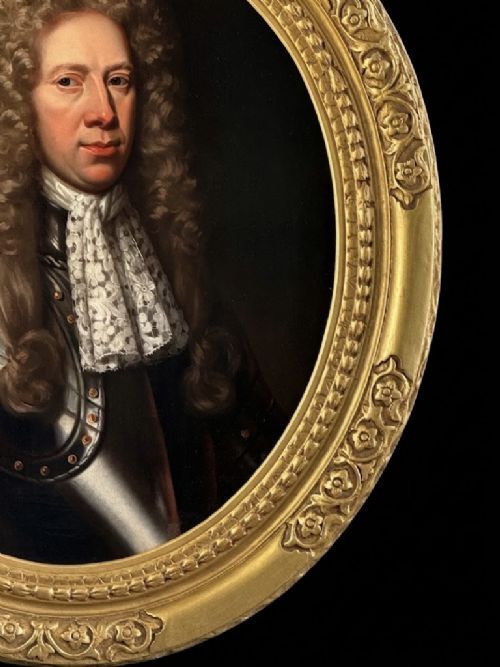
fig 2. A late 17th-century oil painting depicting a gentleman wearing plate armour, a powdered wig, and a lace cravat, set within an oval carved gilded frame.
fig 2. John Scougall (C.1645-1737) - Portrait of a Gentleman, Possibly Sir Patrick Maxwell of Springkell (1640-1723).

The son of the prominent portrait painter David Scougall (c. 1630–1685) John Scougall operated within an extended family network of artists and notable figures, including his cousin Patrick Scougall, Bishop of Aberdeen.
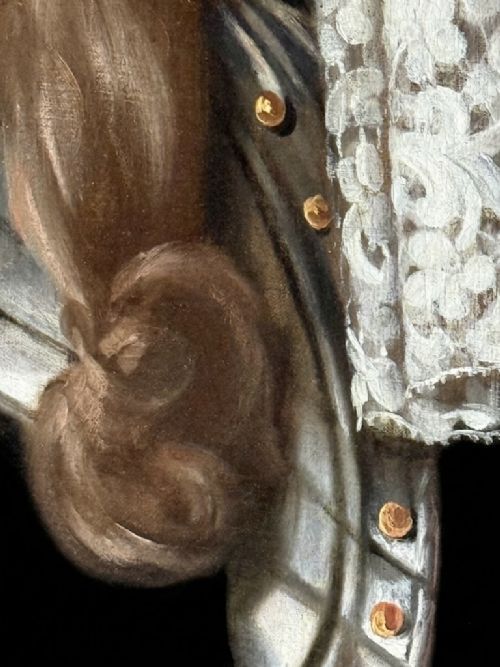
fig 3. A late 17th-century oil painting depicting a gentleman wearing plate armour, a powdered wig, and a lace cravat, set within an oval carved gilded frame.
fig 3. John Scougall (C.1645-1737) - Portrait of a Gentleman, Possibly Sir Patrick Maxwell of Springkell (1640-1723).

He ran a highly successful portrait studio in Advocates' Close, Edinburgh, which also served as a picture gallery. His work was heavily influenced by fashionable London portrait painters like Sir Peter Lely and Sir Godfrey Kneller, but it retains a uniquely individualized and distinctly Scottish character.
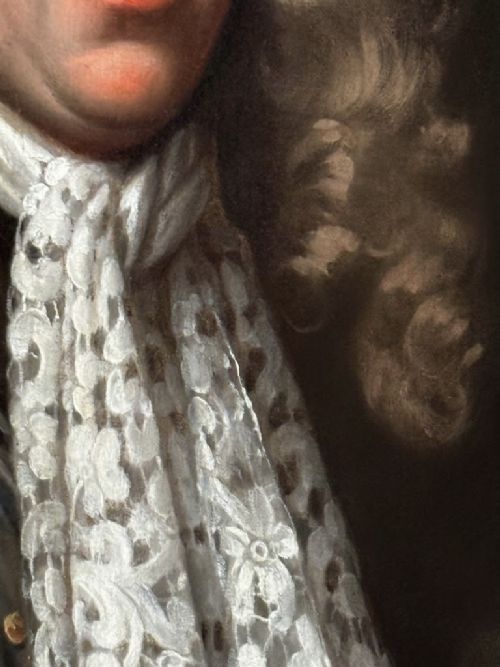
fig 4. A late 17th-century oil painting depicting a gentleman wearing plate armour, a powdered wig, and a lace cravat, set within an oval carved gilded frame.
fig 4. John Scougall (C.1645-1737) - Portrait of a Gentleman, Possibly Sir Patrick Maxwell of Springkell (1640-1723).

Scougall was commissioned by the Glasgow Town Council to paint full-length portraits of William III, Queen Mary, and Queen Anne. He also painted a celebrated series of the Kings and Queens of Scotland for the University of Glasgow. His extensive list of subjects includes the 4th Earl of Panmure (Glamis Castle), Sir Archibald Primrose, and Sir Roger Hog, Lord Harcarse. Many of his works are housed in major UK cultural institutions, including: The National Galleries of Scotland.
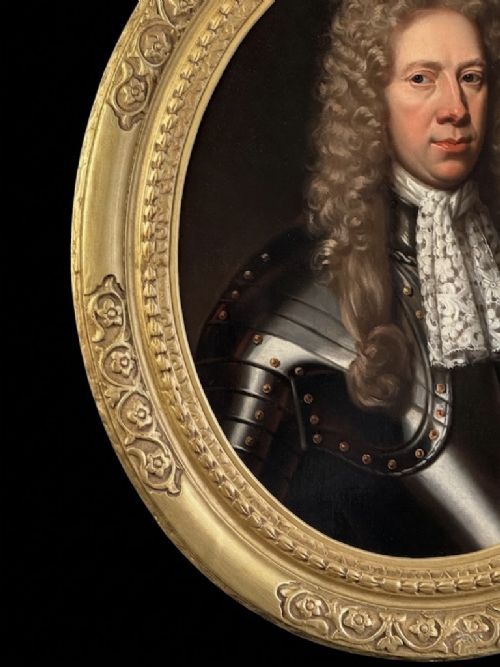
fig 5. A late 17th-century oil painting depicting a gentleman wearing plate armour, a powdered wig, and a lace cravat, set within an oval carved gilded frame.
fig 5. John Scougall (C.1645-1737) - Portrait of a Gentleman, Possibly Sir Patrick Maxwell of Springkell (1640-1723).

Sir Patrick Maxwell of Springkell (c. 1640 – April 1723).

The sitter is possibly Sir Patrick Maxwell of Springkell who was the first holder of the Heron-Maxwell baronetcy having received the title in the Baronetage of Nova Scotia on 7 February 1683 as a mark of royal favour during the reign of Charles II.
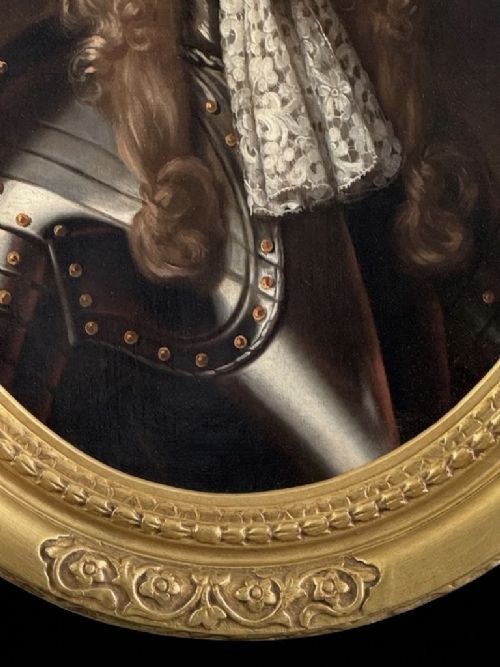
fig 6. A late 17th-century oil painting depicting a gentleman wearing plate armour, a powdered wig, and a lace cravat, set within an oval carved gilded frame.
fig 6. John Scougall (C.1645-1737) - Portrait of a Gentleman, Possibly Sir Patrick Maxwell of Springkell (1640-1723).

A prominent landowner in Dumfriesshire, Maxwell played a political role by serving as a commissioner for the county in the Convention of Estates of 1689, which convened to address the Glorious Revolution and ultimately recognised William of Orange and Mary as joint sovereigns of Scotland.[
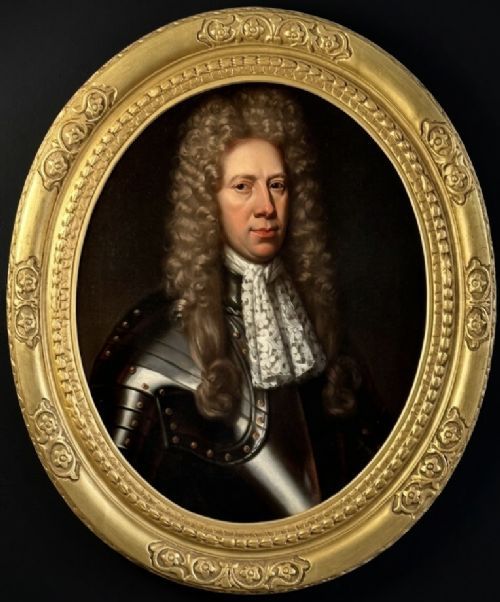
fig 7. A late 17th-century oil painting depicting a gentleman wearing plate armour, a powdered wig, and a lace cravat, set within an oval carved gilded frame.
fig 7. John Scougall (C.1645-1737) - Portrait of a Gentleman, Possibly Sir Patrick Maxwell of Springkell (1640-1723).

He married Mary Gordon, daughter of William Gordon, 6th Viscount Kenmure, and their union strengthened ties with other Border families.[9] Maxwell died in 1723 at Springkell, leaving the estate stable amid the political upheavals of the late 17th century, and was succeeded by his son without major contest.
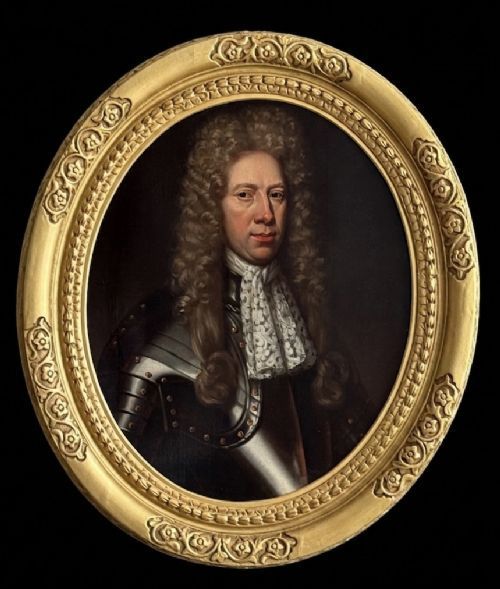
fig 8. A late 17th-century oil painting depicting a gentleman wearing plate armour, a powdered wig, and a lace cravat, set within an oval carved gilded frame.
fig 8. John Scougall (C.1645-1737) - Portrait of a Gentleman, Possibly Sir Patrick Maxwell of Springkell (1640-1723).

Provenance: Lady Heron-Maxwell (according to label on verso) Anonymous sale, Christie's, London, 9 September 1999.

This fine work is in an excellent state of conservation and it is housed in a period oval ‘Lely ‘ style frame with floral cartouches, which has been sympathetically regilded, and is itself a work of art.

Higher resolution images on request.

Worldwide shipping available

Canvas: 26" x 23" / 66cm x 59cm.

Frame: 37" x 31" / 94cm x 79cm.

Price: £8950

Height
94cm (37.01")
Width
79cm (31.10")
Depth
4cm (1.57")
Date of Manufacture

Period Portraits has dated this 17th Century Portrait Painting to the 17th Century.

Reference Numbers
Sellingantiques Ref
SA1231836
Period Portraits
Period Portraits
Sellingantiques verified Since Jan 2017

Specialist dealer in portraits from the 17th century to the 20th century. Our stock includes quality oil paintings, drawings, and mezzotints

Dealer Profile

You can view the stock and full dealer information on the Period Portraits Profile Page
PDF SHARE
SAVE
A late 17th-century oil painting depicting a gentleman wearing plate armour, a powdered wig, and a lace cravat, set within an oval carved gilded frame.
1 / 9
Archive I A late 17th-century oil painting depicting a gentleman wearing plate armour, a powdered wig, and a lace cravat, set within an oval carved gilded frame.

John Scougall (C.1645-1737) - Portrait of a Gentleman, Possibly Sir Patrick Maxwell of Springkell (1640-1723).

Archive II A late 17th-century oil painting depicting a gentleman wearing plate armour, a powdered wig, and a lace cravat, set within an oval carved gilded frame. View II
Archive III A late 17th-century oil painting depicting a gentleman wearing plate armour, a powdered wig, and a lace cravat, set within an oval carved gilded frame. View III
Archive IV A late 17th-century oil painting depicting a gentleman wearing plate armour, a powdered wig, and a lace cravat, set within an oval carved gilded frame. View IV
Archive V A late 17th-century oil painting depicting a gentleman wearing plate armour, a powdered wig, and a lace cravat, set within an oval carved gilded frame. View V
Archive VI A late 17th-century oil painting depicting a gentleman wearing plate armour, a powdered wig, and a lace cravat, set within an oval carved gilded frame. View VI
Archive VII A late 17th-century oil painting depicting a gentleman wearing plate armour, a powdered wig, and a lace cravat, set within an oval carved gilded frame. View VII
Archive VIII A late 17th-century oil painting depicting a gentleman wearing plate armour, a powdered wig, and a lace cravat, set within an oval carved gilded frame. View VIII
Archive IX A late 17th-century oil painting depicting a gentleman wearing plate armour, a powdered wig, and a lace cravat, set within an oval carved gilded frame. View IX
Enlarged Archival View
Telephone 07889 859729
Location
North Yorkshire
United Kingdom
Verified Since Jan 2017
Items For Sale 47
Items Sold 61
Period Portraits
Period Portraits
Verified Since Jan 2017
View Dealer Info
Location: North Yorkshire, United Kingdom
Verified
Jan 2017
For Sale
47
Sold
61
A late 17th-century oil painting depicting a gentleman wearing plate armour, a powdered wig, and a lace cravat, set within an oval carved gilded frame.
JOHN SCOUGALL (c.1645-1737) - PORTRAIT OF A GENTLEMAN, POSSIBLY SIR PATRICK MAXWELL OF SPRINGKELL (1640-1723).
Ref: SA1231836
A late 17th-century oil painting depicting a gentleman wearing plate armour, a powdered wig, and a lace cravat, set within an oval carved gilded frame.
Detail View 1
Detail View 2
Detail View 3
Detail View 4
Detail View 5
Detail View 6
Detail View 7
Detail View 8
Archival Detail
Every single antique dealer on our platform is individually approved by our internal team. We verify their professional trade history, ethical standards, and photographic quality to ensure a secure, high-standard buying environment. Upon joining, every dealer agrees to a strict 9-point code of conduct. While issues can occasionally arise, our dealers typically resolve them swiftly and directly with the buyer. In fact, since our founding in 2002, Sellingantiques has only had to step in to help resolve an issue on roughly five occasions—a true testament to the quality of our dealers and their dedication to your happiness.
Our dealers are highly experienced in packing and shipping fragile, high-value antiques. Because you are in direct contact with the dealer, you will be able to easily go through all available shipping and insurance options together to ensure your item arrives safely.
Antiques are the ultimate green purchase. By choosing historical pieces over newly manufactured goods, you completely eliminate the carbon footprint of modern mass production while preserving exceptional, timeless craftsmanship.

Late 17th-century portraiture often featured aristocratic subjects portrayed in formal attire, wigs, or ceremonial armour, rendered with dramatic chiaroscuro and rich colour palettes characteristic of the period.

Portraiture from this era typically utilized hand-mixed oil pigments applied to stretched linen canvas, set within carved and gilded wood frames.

Authentication relies on evaluating age-appropriate craquelure, period-correct canvas weave and stretcher construction, historical pigment composition, and artist-specific brushwork.

A carved gilt-framed portrait serves as a focal point when hung above a fireplace mantelpiece, positioned over a sideboard, or integrated into a gallery wall within classical or eclectic interiors.

Oil paintings require stable environmental humidity and temperature, placement away from direct sunlight and heat sources, and light dusting with a dry, soft brush rather than cleaning solutions.
items
Add keywords to the filter
Price
£100
£250000
Era
Movements
Material
Origin
Stock Location
Freshness
Online Payments
Categories