
Darnley Fine Art has dated this 19th Century Campfire Painting to the 19th Century.
Image size: 22 x 30 inches (56 x 76.25 cm)
Albert Bierstadt
At the age of two, his family emigrated to the United States, settling in New Bedford, Massachusetts. Nothing is known of his early art training; however, he could have been influenced by local landscape painters. By the time he was twenty, he was supporting himself by teaching “monochromatic” painting and his work was beginning to attract the attention of New Bedford collectors.
In 1853, Bierstadt travelled to Düsseldorf to broaden his art education. Here he associated with American artists like Worthington Whittredge and Carl Wimar, all of whom frequently gathered in the studio of the German-American history painter, Emanuel Leutze. During this period, he was introduced to the work of Carl Friedrich Lessing and Andreas Aachenbach, contemporary German painters widely admired for their heroic, highly finished landscape compositions. Bierstadt quickly absorbed these stylistic conventions, eventually becoming the leading American representative of the Düsseldorf style.
He returned to New Bedford in 1857. The following year, he made the first of his many contributions to the annual exhibitions of the National Academy of Design. In April of 1859, he joined the expedition along the Overland Trail, led by Colonel Frederick W. Lander, a trip that would soon give rise to the most productive and important phase of his career. Armed with sketches and stereographs, he returned to New York City in the autumn of 1859, establishing his studio in the Tenth Street Building. There he produced the first of the panoramic western landscapes that established his reputation on an international level and, during the mid-1860s, made him a rival of Frederick Church for the position of America’s pre-eminent painter.
As much of the continent remained unexplored at that time, Bierstadt’s monumental renderings of stately mountains and cascading waterfalls created romantic visions of wanderlust in the minds of Easterners. His first public exhibition of these works in 1860 was a resounding success. Many critics deemed viewing his depictions as an almost “religious” experience, associating his mountain spires with majestic cathedrals, his luminous skies with the awesome power of God.
Albert Bierstadt died in New York City in 1902. Although his reputation during the 1890s suffered slightly from the attraction for French art, his impact upon the American landscape tradition of the nineteenth century remains strong. His large-scale, panoramic landscapes, with their dramatic, almost sublime, light effects, coupled with the meticulous rendering of details, reflect the influences of both the contemporary landscape school of Düsseldorf as well as the native Hudson River School aesthetic. His works can be found in major public and private collections throughout North America and Europe, including the Metropolitan Museum of Art, the Wadsworth Atheneum, and the National Gallery of Canada.
Darnley Fine Art has dated this 19th Century Campfire Painting to the 19th Century.
You can view the stock and full dealer information on the Darnley Fine Art Profile Page
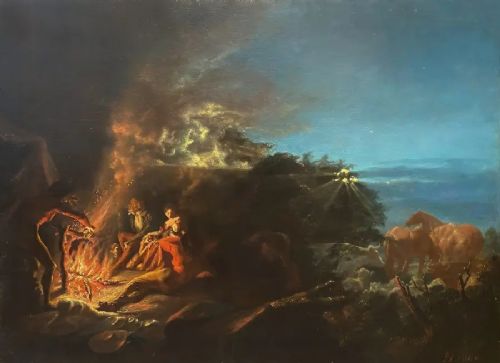
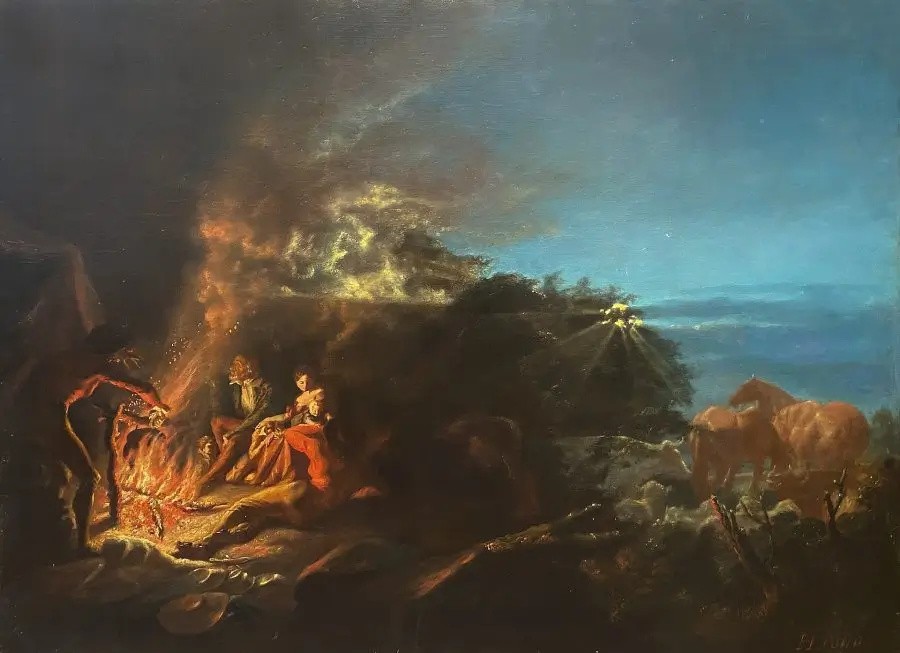
Circle of Albert Bierstadt Around the Camp Fire