It was listed by Titan Fine Art. Sold pieces stay on Sellingantiques as a record of what has passed through, and the next one is rarely far away.
Titan Fine Art has dated this Antique Oil Painting to the 18th Century.
The sitter conveys quiet authority and cultivated poise, placing the work among the more distinguished female portraits of the early Georgian period.

A contemporary inscription identifies the sitter as “Mary, Daughter of John Churchill Esq., wife of Joseph Damer Esq. Richardson Pinxt 1715.” Mary Churchill was the daughter of John Churchill of Henbury, Dorset, part of a landed gentry family connected to the wider Churchill milieu. While distinct from the ducal line of Marlborough, the name carried considerable social weight, and the family occupied a meaningful position within the provincial and political society of the late Stuart and early Hanoverian periods.

Her marriage to Joseph Damer (1676–1737), in December 1714, united this inherited status with a family rising rapidly through finance, landownership, and politics. Damer became a Member of Parliament and established significant estates in England and Ireland, particularly in Dorset and Tipperary. The portrait, dated 1715, was painted immediately following their marriage and can be understood as both a personal and strategic commission—asserting identity, legitimacy, and ambition at a pivotal moment. It was likely executed in London, where Richardson was at the height of his career and where the couple moved within influential political circles.

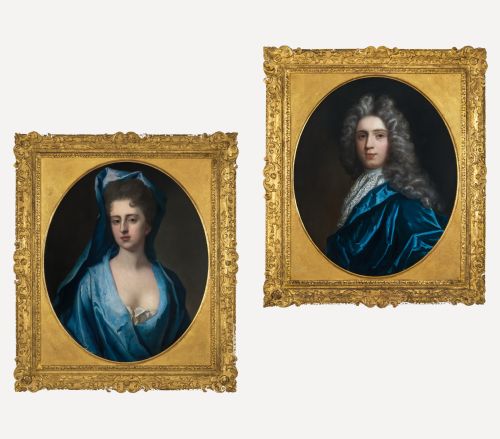
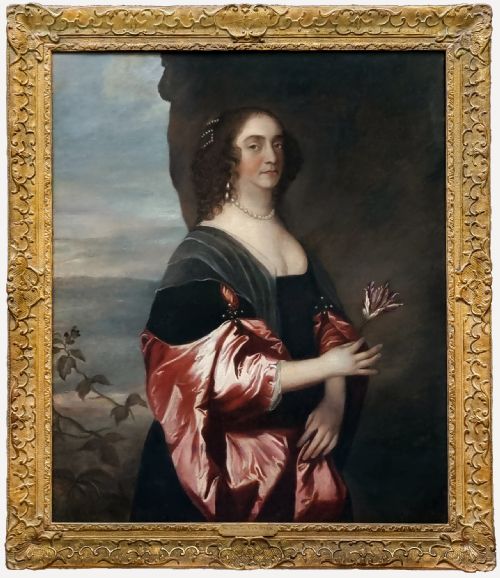
The sitter’s attire supports this dating. She wears a silk mantua typical of the 1710s, with a structured bodice over a white chemise and a low, broad neckline. The restrained presentation, with minimal jewellery, emphasises refinement over display. A rich blue mantle introduces chromatic depth and elevates the composition. This balance of elegance and restraint reflects a family in ascent rather than established aristocracy. Her softly arranged, naturalistic hair further confirms the date around 1715. The portrait is housed in a fine carved and gilded frame that complements the composition without distraction.

The painting’s later significance is underscored by a large-scale portrait of Mary Damer by Angelica Kauffman, recorded in the collection of the Earls of Portarlington and exhibited in London in 1981. That work is described as being after Richardson, indicating that the present portrait served as its prototype. This confirms that the likeness remained valued within the family and was reinterpreted in the later 18th century as their status rose into the aristocracy.

Jonathan Richardson the Elder (1667–1745) was one of the leading portraitists of early 18th-century England, known for his intellectual approach, psychological depth, and restrained compositions that moved away from late Baroque theatricality.

This portrait combines aesthetic quality, historical importance, and strong condition. It depicts a sitter of clear genealogical interest at a key moment of social ascent, likely served as the source for a later Kauffman portrait, and is executed by a major artist at the height of his career. Its inscribed identification and coherent historical context distinguish it within the market, while its composed and authoritative presence ensures enduring appeal.
Provenance:
Painted for Mary Churchill and Joseph Damer, c.1715;
by descent in the Damer family (Dorset and/or Ireland); within the Damer / Dawson-Damer (Portarlington) orbit into the 19th century;
probably UK sale, 23 January 1975 (verso: “Lot 77, 23-1-75”);
private collection, United States
Full description at: www.titanfineart.com
Titan Fine Art has dated this Antique Oil Painting to the 18th Century.
Specialist in 17th & 18thc portraits. Highly curated selection, museum-level research & pro conservation. Exceptional art, expertly vetted.
You can view the stock and full dealer information on the Titan Fine Art Profile Page
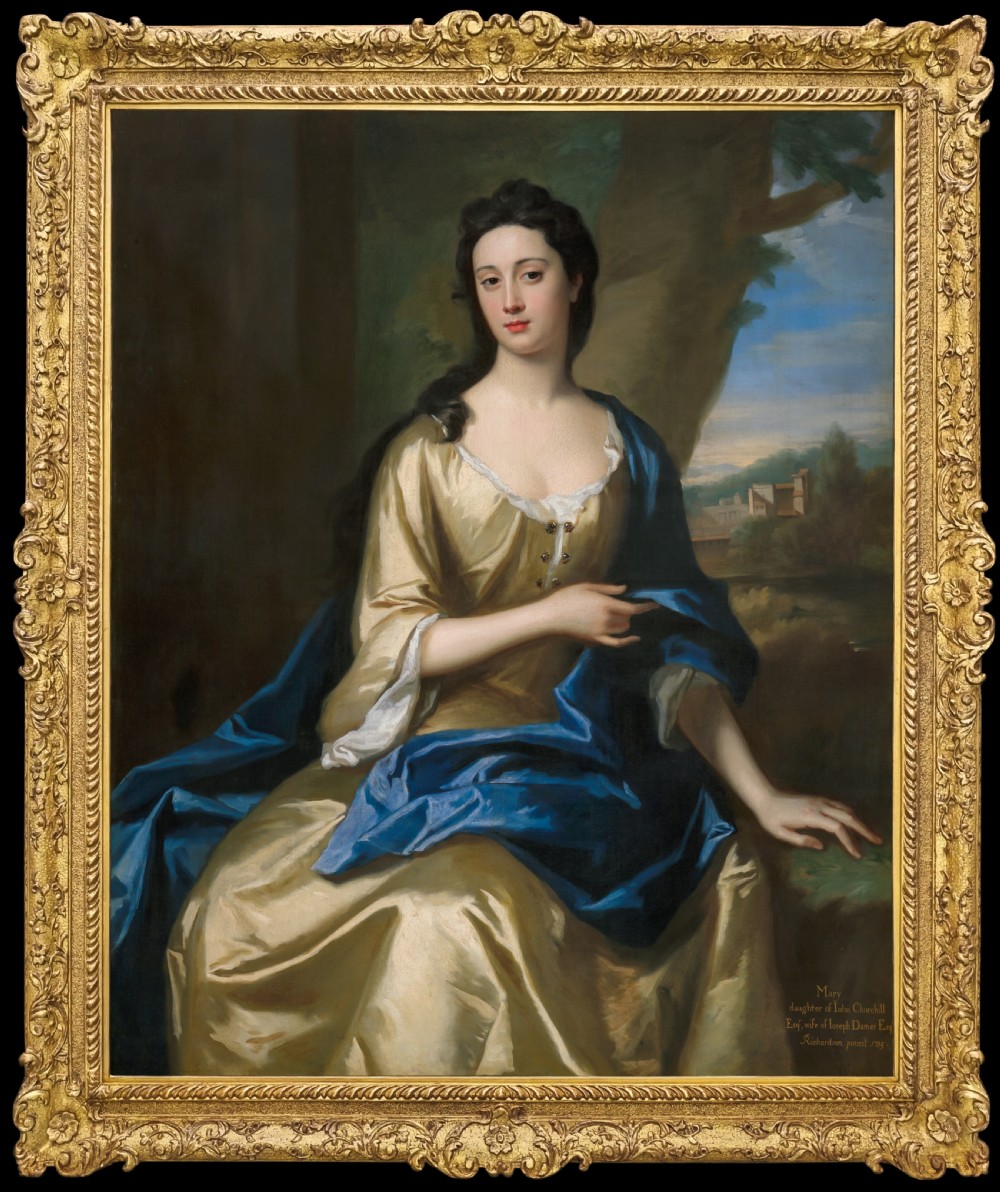

Portrait of Mary Churchill, Mrs Joseph Damer in a Yellow Dress and Blue Mantle, 1715; Jonathan Richardson the Elder (1667–1745), Oil on Canvas Painting