It was listed by Titan Fine Art. Sold pieces stay on Sellingantiques as a record of what has passed through, and the next one is rarely far away.
Titan Fine Art has dated this piece to the 17th Century.
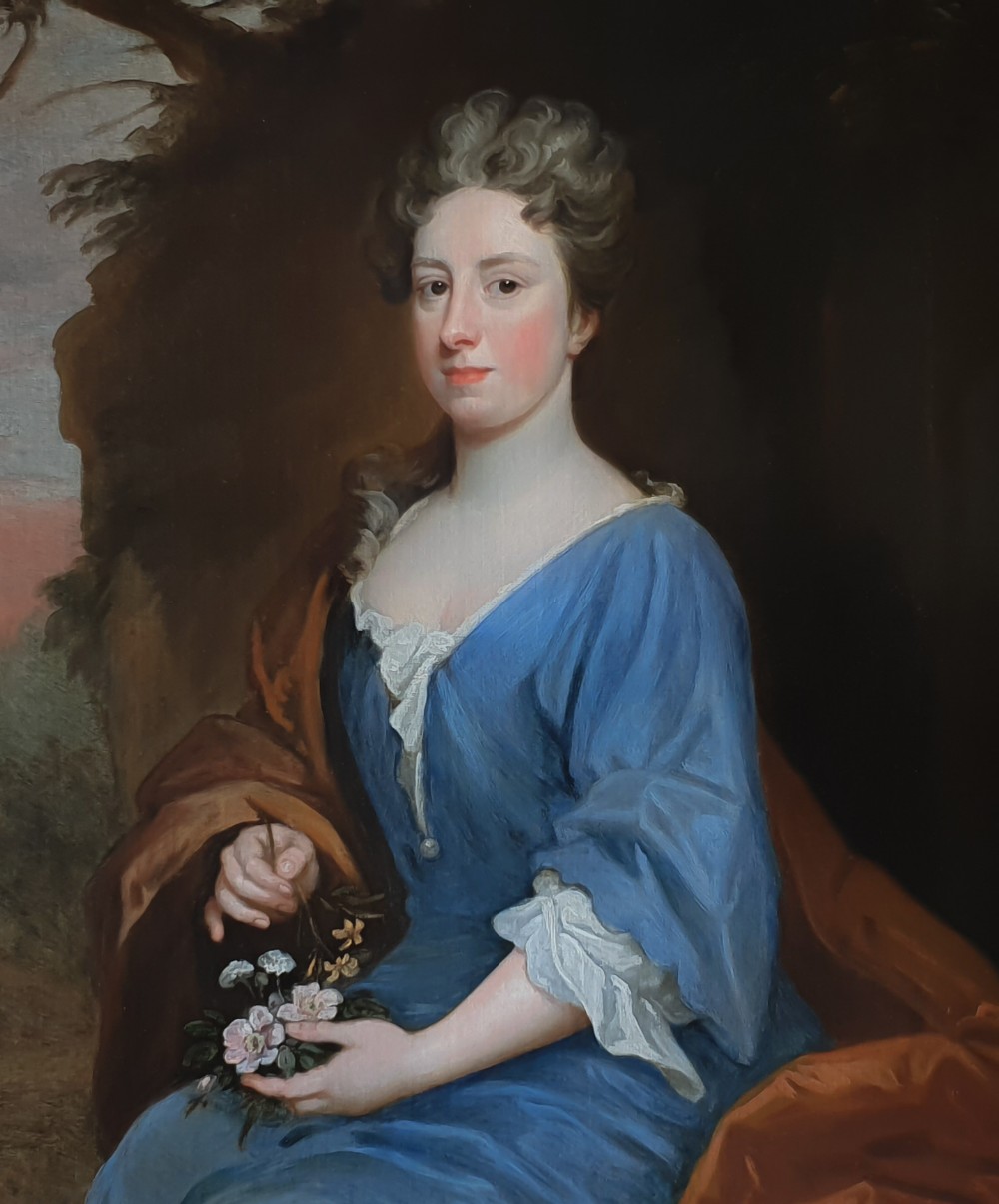
Beautifully composed, the sitter is three quarter length and seated within a wooded landscape. Pastoral backgrounds imply a virtuous character of unpretentious sincerity undefiled by the possession of great wealth and estates. In this picture, we can see Kneller’s technique at its best, the excellent drawing of the face. It is painted with a delicacy that contrasts with Kneller’s more usual bold manner. The sitter is also unencumbered by high fashion or a background of stately topography. The emphasis is instead placed directly on the alluring femininity, and enhanced by the loose drapery and falling hair around her shoulder. We can see how Kneller often allowed the bluer ground layer to show through when suggesting the darker flesh tones.

In accordance with the sitter's age and the style of clothing and hair this portrait can be dated to the 1690s. Traditionally this portrait is thought to represent Susannah Papillon (nee Gregory) who was born on 13th Feb 1699 and married John Gregory Esq - however the portrait was painted before her birth. The sitter is almost definitely her mother, Susannah Henshaw Papillon (1661-1707) and indeed, a portrait of “Susannah Henshaw, 2nd Wife of Philipp Papillon” (oil on canvas, 49.6 in. x 40.2 inches), sold at Dorotheum on October 4, 2000 [Lot 389] and bears a striking resemblance to our sitter.

Susannah Henshaw was a daughter of George Henshaw, a merchant and diplomat who served as British Consul in Genoa (d.1724). In 1695 she married Philip Papillon MP (1660-1736). The Papillon’s were a line of politicians and land-owning gentry whose family home was Papillon Hall and Acrise Place, in Kent. The couple had two sons and three daughters. As the portrait was painted in the 1690s, and with the inclusion of the sweetbriar roses in her hand, a representation of love, this portrait was almost certainly painted to celebrate the occasion of her marriage in 1695.

The Papillons were Huguenots that came to England from Frame in 1588 to avoid persecution as Protestants. They built Papillon Hall in Lubenham (Leicestershire) in about 1620. The family purchased Acrise Place, Kent in 1664 and sold it in 1850 (but repurchased by Mr. A.H. Papillon around 1946).

Although history records what became of the sitter’s husband (and his heir) it is not known which branch of the family held this portrait in the eighteenth and nineteenth centuries. It is possible that a collection of art and furniture, which may have included this picture, was reassembled at the time of Acrise Place's re-acquisition around 1946.

The painting was recently located at Dewlish House, near Dewlish - one of Dorset’s most beautiful country houses built in the Queen Anne/Georgian style in 1702 on the site of a large Roman villa.
This exquisite painting is held in its outstanding original hand carved and gilded frame.

Sir Godfrey Kneller (1646-1723) dominates our understanding of British portraiture at the turn of the seventeenth century. With Van Dyck, Lely and Reynolds, his name has become synonymous with the visual interpretation of British history – not least because he painted almost every person of prominence in forty years of British public life. This reputation was well-deserved, and although Kneller's age embraced many accomplished painters none came close to Kneller in immediate fame, or in such instant association in the popular mind with the exercise of portraiture. Kneller is remembered for having painted ten ruling sovereigns, including every reigning British monarch from King Charles II to King George I.
See full description at: www.titanfineart.com
Titan Fine Art has dated this piece to the 17th Century.
Specialist in 17th & 18thc portraits. Highly curated selection, museum-level research & pro conservation. Exceptional art, expertly vetted.
You can view the stock and full dealer information on the Titan Fine Art Profile Page

Portrait of a Lady Susannah Papillon C.1695; Sir Godfrey Kneller (1646-1723), Antique Oil on Canvas Painting