


Yorkshire Coastal Landscape
Yorkshire coastal landscape watercolours and oil paintings capture the rugged harbours, fishing villages and cliffs of the North Sea coast through Victorian and mid-century eyes.
Yorkshire Coastal Landscape
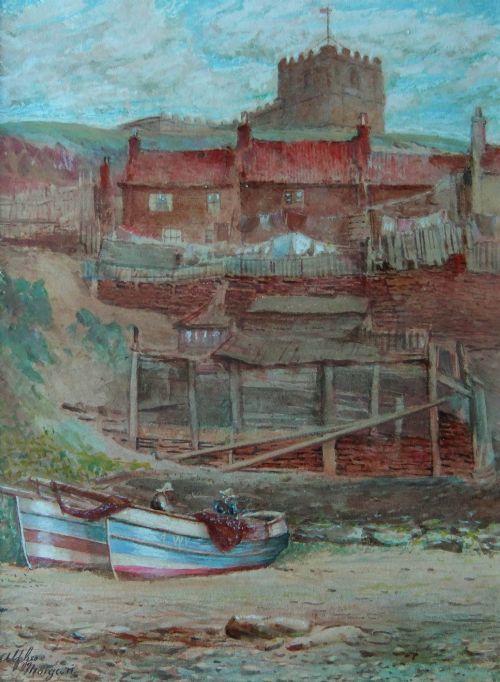
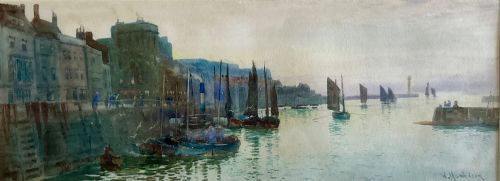
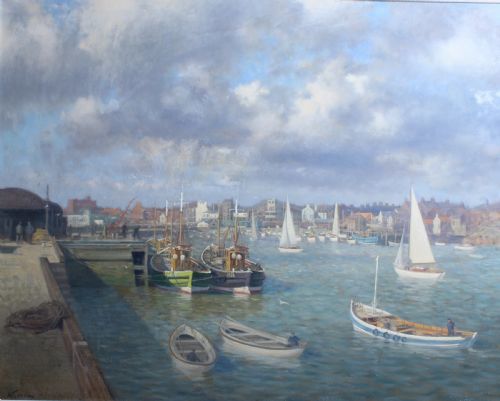
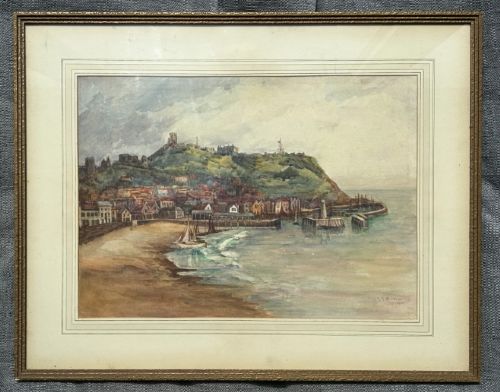
A yorkshire coastal landscape on this page typically takes the form of a framed painting depicting maritime scenes, harbour views or cliff tops around locations such as Whitby, Staithes and Scarborough. The works span from the nineteenth century through the Victorian period and into the mid-twentieth century, recording local landmarks like Whitby Abbey and bustling fishing docks.
Most examples found here are works on paper executed in watercolour pigment, though oil paintings on canvas, board and panel also appear. Painters of these scenes focused heavily on the changing light of the North Yorkshire coast, capturing local vessels, cobles and village life in styles ranging from early academic realism to British Impressionism and Modern British approaches.
How They Were Made
Artists working on these coastal scenes utilised traditional watercolours on paper or oil paint applied to canvas, board and wood panels. Watercolour pigment was layered to capture transparent atmospheric effects over the North Sea, while oil paint allowed for richer, heavier application on canvas or panel to render the textures of cliffs and sea spray.
Support materials varied according to the medium, with heavy paper utilised for watercolours and stretched canvas or wooden panels selected for oil paintings. Many works were signed by the artist directly on the surface and housed in period frames suited to late-nineteenth and early-twentieth-century tastes.
The selection spans several movements including British Impressionism, Victorian Realism and Modern British fine art.
What Varies in Quality
The strength of a yorkshire coastal landscape lies in the artist's handling of atmospheric light and topographical accuracy rather than mere scale. Stronger examples demonstrate confident brushwork that conveys the movement of water and weather, whereas lesser pieces can rely on stiff, formulaic renditions of familiar harbour views.
Compositional balance and the vitality of the figures at work - such as flither pickers or fishermen - separate standard topographical records from more accomplished artistic interpretations of the coastline.
Alfred G. Morgan·William Matthison·Walter Goodin·Arthur Tucker·Robert Leslie Howey·Tom Clough·James Watson·Florence Hess·George Hamilton Constantine·Frederick William Booty·Kate E Booth·Frederick Williamson·Alfred Robert Quinton·William Kay Blacklock·Rowland Henry Hill·Harry Wanless·Frank Rousse·Fred Lawson
The Yorkshire Coastal Landscape Glossary
- Coble
- A traditional type of open fishing boat with a high bow and flat bottom, frequently seen in paintings of Yorkshire coastal villages such as Runswick Bay.
- Flither pickers
- Local gatherers of limpets used for bait, often depicted along the shoreline in nineteenth-century Yorkshire art.
- Watercolour pigment
- A colour medium ground with a water-soluble binder, applied in translucent washes onto paper.
- British Impressionism
- An artistic movement focusing on light, everyday subjects and loose brushwork, adopted by various painters working along the British coast.
- Panel
- A flat piece of wood used as a rigid support for oil painting instead of stretched canvas.
Yorkshire Coastal Landscape: Frequently Asked Questions
Where were these coastal scenes painted?
These paintings focus on specific locations along the North Yorkshire coast, most notably the harbours, piers and abbey ruins of Whitby, Staithes, Scarborough and Runswick Bay.
Artists frequently set up their easels directly within these fishing communities to record daily maritime life and local architecture.
How do I date a watercolour?
Dating relies on stylistic clues, artist signatures and period framing, alongside explicit dates occasionally added by the hand of the painter.
Victorian works tend towards tighter detail and academic realism, while pieces from the early twentieth century often show the looser brushwork of British Impressionism.
What is the difference between oil and watercolour?
Watercolour paintings utilise water-soluble pigment applied to paper to achieve translucent effects of light and sky, requiring protective glass when framed.
Oil paintings use suspended pigment in a drying oil on canvas or panel, offering heavier texture and depth without the need for glass.
How should I display these paintings?
Works on paper require conservation mounting under glass away from direct sunlight to prevent fading of the watercolour pigments over time.
Oil paintings on canvas or panel benefit from stable indoor humidity and gentle ambient lighting that respects their historic framing.