

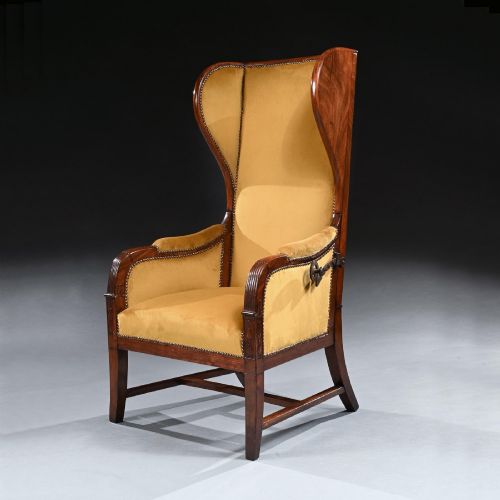
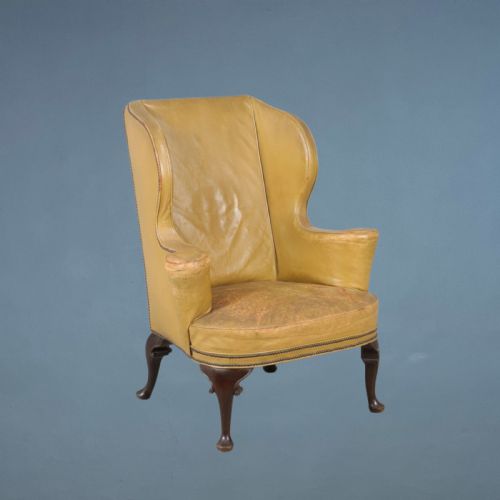
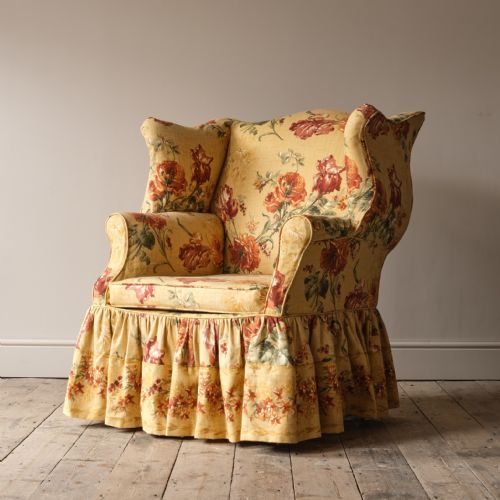
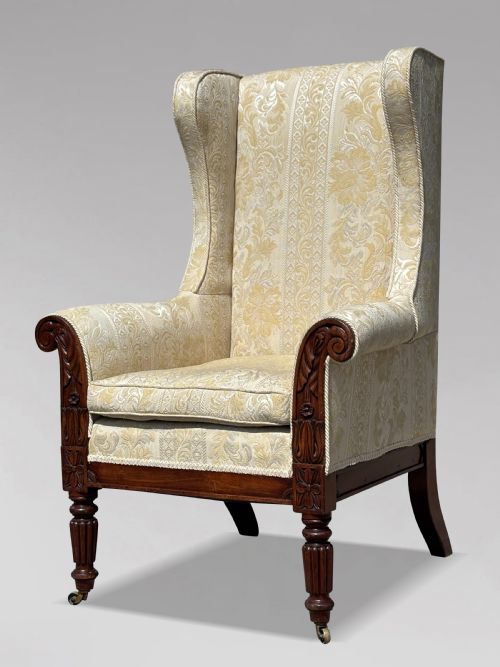


Yellow Wingback Armchair
A yellow wingback armchair brings colour and deep-set comfort to a room, offering the high-sided draught protection designed for centuries ago.
Yellow Wingback Armchair
A yellow wingback armchair is a high-backed seat designed with protective side panels, known as wings, to shield the sitter from draughts and retain fireplace heat. The selection spans the eighteenth century through the Edwardian period and into the early twentieth century, taking in George III, Victorian, Edwardian, and Queen Anne Revival styles.
Most examples found here date from the nineteenth and early twentieth centuries, constructed in forms such as the barrel back, the reclining wing back, and the library chair. The timber frames reflect enduring periods including Georgian, William IV, and French Empire designs.
Makers utilised traditional silhouettes, pairing deep upholstery with substantial wooden legs, often carved in the Irish manner or shaped in plain mahogany and walnut. These chairs serve equally as reading seats in a study or statement pieces in a drawing room.
How they were made
The structural framework relies on dense hardwoods, principally mahogany, walnut, and general timber, providing a rigid skeleton designed to endure heavy daily use. Joinery is traditional, anchored by internal corner blocks and sturdy rails that support the generous proportions of the seat.
Upholstery techniques involve durable textiles such as leather, velvet, damask fabric, and standard fabric stretched over deep padding. Brass detailing often appears through decorative studs or castors, securing the edges of the heavy coverings to the wooden frame.
Yellow Wingback Armchair Retail Price Guide 2026
Typical asking prices for yellow wingback armchair among the pieces listed under this phrase on Sellingantiques today, from the lower quarter to the upper quarter. They describe what is for sale here now, not the wider market.
Some chairs feature wings designed so deep they practically whispered secrets to the sitter.
What varies in quality
Quality rests significantly in the integrity of the timber frame and the sophistication of the woodwork, from plain structural rails to finely carved mahogany legs in the Irish manner. The proportion of the wings and the sweep of the arms dictate the visual balance of the silhouette.
The choice and execution of the covering material mark another tier of distinction, moving from standard utility fabrics to rich damask, velvet, or deep-buttoned leather. Original brass castors and untouched period surfaces further elevate an example above standard workshop production.
The Yellow Wingback Armchair Glossary
- Wingback
- An armchair featuring high side panels attached to the arms, originally conceived to shield the face and torso from cold draughts. This form evolved across the Georgian and Victorian eras.
- Mahogany
- A durable, reddish-brown tropical hardwood favoured by cabinetmakers throughout the eighteenth and nineteenth centuries for its strength and fine grain. It takes a high polish and supports intricate carving.
- Damask fabric
- A reversible, figured textile woven on a jacquard loom, frequently utilised for upholstery to introduce subtle patterned texture. It provides a formal appearance suitable for period seating.
- Barrel back
- A seating form where the upholstered back curves continuously into the arms in a circular enclosure. This style offers a particularly enclosed and supportive seat.
- French Empire
- A neoclassical design style spanning the late eighteenth and early nineteenth centuries, characterised by monumental forms and classical motifs. Pieces from this aesthetic display heavier proportions and rich wood grains.
Yellow Wingback Armchair: Frequently Asked Questions
What is a wingback armchair used for?
These chairs were historically positioned near fireplaces to trap heat within the seating area and protect the occupant from cold draughts. Today, they function as reading chairs or living room statement seating.
The high back and enclosed sides offer a private, quiet space while adding period character to domestic interiors.
Are these chairs comfortable for daily use?
Most examples provide deep seating and firm support thanks to traditional stuffing and sturdy wooden frames. The high back supports the head and shoulders during extended periods of sitting.
Comfort levels vary depending on the restoration history of the internal webbing and padding beneath the leather or fabric.
What materials are used in these frames?
The structural frames are built from hardwoods such as mahogany, walnut, and general timber. Brass details often appear as decorative nailheads or functional castors on the feet.
Coverings range from smooth leather to tactile velvet and patterned damask fabric, depending on the specific period and style.