



Yellow Gold Turquoise Pendant
These yellow gold turquoise pendant examples bring bright blue stones and warm metal together in Victorian and Edwardian designs.
Yellow Gold Turquoise Pendant
When you search for a yellow gold turquoise pendant, you are looking at nineteenth and early twentieth-century jewellery that pairs vibrant turquoise stones with rich gold settings. These pieces range from simple drops to complex lockets and multi-stone necklaces.
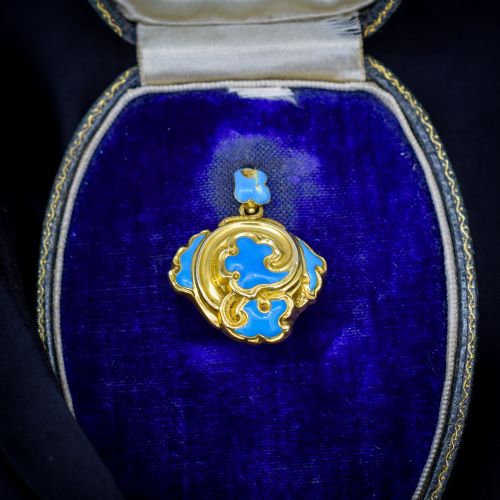
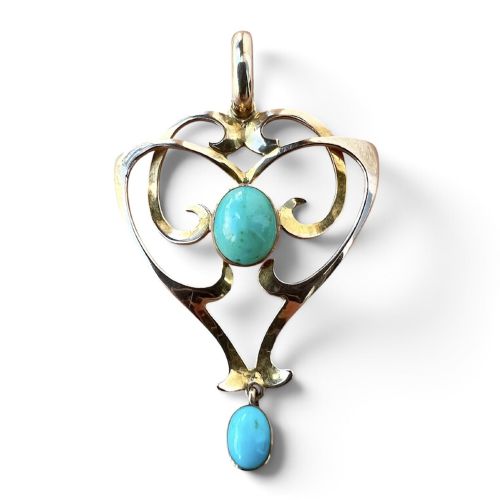
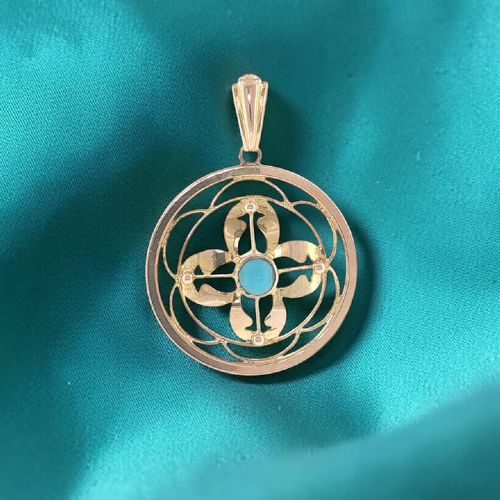
You are most likely to meet Victorian and Edwardian examples on this page, often incorporating pearls, diamonds, or blue enamel alongside the central turquoise. The forms vary from bows and hearts to star motifs and French Napoleon III double photo lockets.
Many of these items double as brooches, featuring integrated pins that allowed the Victorians to wear them on a lapel as well as suspended from a chain. The gold carat weight shifts across the selection, moving between nine carat, fifteen carat, and eighteen carat standards.
Materials and construction
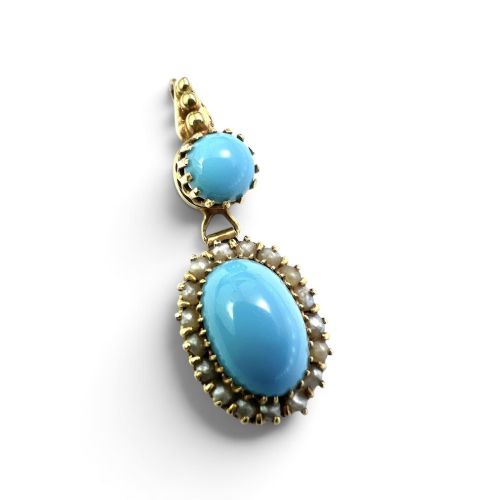
Jewellers built these pendants using yellow gold in various purities, alongside natural turquoise stones and occasionally seed pearls or small diamonds. Enamel work also appears in specific pieces to add contrasting blue tones beside the gems.
The construction relies on traditional goldsmithing techniques of the period, including hollow stampings for puffed hearts and secure bezel or collet settings for the turquoise stones. Makers combined these methods with fine wirework and granulation, particularly in revival styles.
Yellow Gold Turquoise Pendant Retail Price Guide 2026
Typical asking prices for yellow gold turquoise pendant among the pieces listed under this phrase on Sellingantiques today, from the lower quarter to the upper quarter. They describe what is for sale here now, not the wider market.
The listings on this page include both nine carat and high carat fifteen and eighteen carat yellow gold pieces, alongside mixed gemstone arrangements featuring diamonds and pearls.
What sets individual pieces apart
The grade of the gold and the presence of maker attribution create a distinct division in these pieces, alongside the weight and colour uniformity of the turquoise stones. Items bearing documented maker marks command particular attention from collectors.
The complexity of the design and the integration of secondary gems like diamonds or split pearls elevate certain pendants above standard production. Survival of original enamel and crisp detail in embossed motifs further distinguish the finer examples.
Deakin & Francis·Murrle Bennett & Co
The Yellow Gold Turquoise Pendant Glossary
- Turquoise
- An opaque, blue-to-green mineral used extensively in nineteenth-century jewellery for its striking colour. It appears frequently in circular cabochons and heart shapes.
- Locket
- A hinged jewellery case designed to hold a small portrait or lock of hair. Many examples in this selection open to reveal glazed photo compartments.
- Seed pearl
- A very small, natural or saltwater pearl often used in tight clusters or borders around larger gems. They accent the turquoise in numerous Victorian and Edwardian pieces.
- Collet setting
- A metal collar that wraps around the edge of a gemstone to hold it securely in place. This technique is typical for bezel-set stones in period jewellery.
- Cabochon
- A gemstone shaped and polished with a smooth, rounded surface rather than faceted. This cut displays the natural colour and matrix of turquoise.
Yellow Gold Turquoise Pendant: Frequently Asked Questions
How do I wear a convertible pendant brooch?
Many period pieces feature a hidden or hinged pin alongside a small loop for a chain, allowing you to switch between wearing the item on your lapel or around your neck.
Ensure the pin catch fastens securely if you wear it as a brooch, or remove any threaded chain carefully to avoid straining the suspension loop.
What periods do these pendants come from?
The listings span the Victorian and Edwardian eras, encompassing late nineteenth-century revival styles as well as early twentieth-century work up to about nineteen ten.
Stylistic cues such as sinuous lines or strict geometric halos help place each piece within its specific decade.
What does high carat gold mean here?
High carat refers to gold alloys with a higher proportion of pure gold, specifically fifteen carat and eighteen carat standards found commonly in nineteenth-century British jewellery.
These higher purities offer a richer, warmer yellow hue compared to standard modern nine carat alloys.