

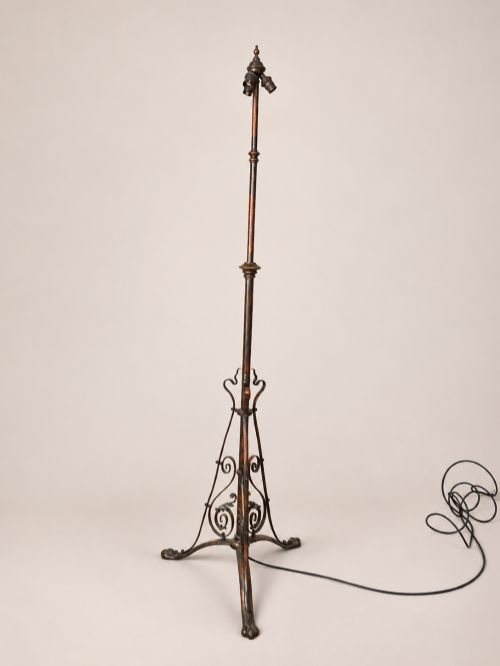
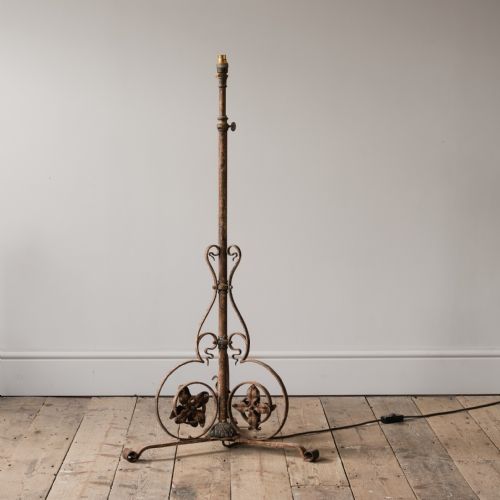


Wrought Metal Standard Lamp
These wrought metal standard lamps bring honest craftsmanship and sturdy vertical presence to a room, offering adjustable arms and period character.
Wrought Metal Standard Lamp
A wrought metal standard lamp stands tall to cast ambient or task light across a room, serving as a functional focal point. These tall floor-standing fixtures appear in various historic guises, from simple nineteenth-century iron designs to decorative Edwardian examples.
The selections on this page span several distinct periods including Victorian, Edwardian, and the nineteen-thirties, alongside specific aesthetic movements like Arts and Crafts, Art Nouveau, and Gothic Revival. Floor lamps and standard lamps dominate the offerings, often featuring adjustable arms or telescopic shafts designed for practical utility.
Makers utilised iron, brass, copper, and cast iron to build these durable vertical lights, sometimes pairing them with fabric shades or converting earlier oil and gas fittings for electricity. Pieces range from blacksmith-made adjustable floor lamps to French metal standard lamps and pairs of art deco torcheres.
How they were made
Blacksmiths and metalworkers shaped wrought iron and cast iron by hand, forging structural stems and decorative scrollwork that provided both weight and stability. Brass and copper components added contrasting warmth, often shaped through spinning or panel-beating techniques.
Makers incorporated mechanical ingenuity into many standard lamps, utilising telescopic shafts and adjustable arms for height and angle control. Early examples adapted for oil or gas lighting mechanisms were subsequently electrified, retaining their original metal collars and burners.
Wrought Metal Standard Lamp Retail Price Guide 2026
Typical asking prices for wrought metal standard lamp among the pieces listed under this phrase on Sellingantiques today, from the lower quarter to the upper quarter. They describe what is for sale here now, not the wider market.
Some nineteenth-century models started life burning oil before welcoming the twentieth century's electric current.
What varies in quality
The distinction between standard examples and finer pieces lies in the articulation of the metalwork and the integrity of the mechanical adjustments. Hand-forged blacksmith-made standards display deliberate hammer marks and balanced proportions, whereas mass-produced alternatives lack this individual sculptural depth.
Material combination and finish condition also dictate the hierarchy, with patinated copper, brass, and wrought iron retaining richer surface character than painted or plated substitutes. Original mechanisms for telescopic height adjustment operate smoothly on superior items, reflecting precision in historical manufacturing.
W A S Benson
The Wrought Metal Standard Lamp Glossary
- Standard lamp
- A tall floor lamp designed to stand independently and illuminate a room from an elevated light source. These fixtures often feature heavy bases to support long vertical shafts.
- Telescopic
- A shaft construction that allows the upper section of the lamp to slide upward and downward to alter the overall height. This mechanism uses a thumbscrew or collar to lock the shaft into position.
- Arts and Crafts
- A design movement valuing hand craftsmanship, visible construction methods, and simple utility over mass-produced ornamentation. Objects from this tradition emphasise the natural qualities of wrought iron, copper, and brass.
- Art Nouveau
- A style characterised by flowing, organic lines inspired by natural forms such as plant stems and flowers. Metalwork in this manner often displays sinuous curves and whipped-line motifs.
Wrought Metal Standard Lamp: Frequently Asked Questions
What is a standard lamp?
A standard lamp is a tall, freestanding floor lamp designed to provide ambient illumination in a room. These pieces utilise heavy metal bases to support elevated light fittings.
Historically, these fixtures stood beside reading chairs or in corners to project light downward from a higher vantage point than table lamps.
How do I date a metal floor lamp?
Dating relies on examining the construction methods, materials, and stylistic motifs present in the metalwork. Victorian and Edwardian examples often display specific Gothic Revival, Arts and Crafts, or Art Nouveau detailing.
Mechanisms such as telescopic adjustment collars and original oil or gas fittings also provide clues to the manufacturing era of the piece.
Were these lamps originally electrified?
Many older standard lamps were originally built for oil or gas illumination before being converted to electricity later in their lifespan. Items described as standard lamps or electrified oil lamps often retain their original burners, reservoirs, or gas keys alongside modern wiring.
This adaptation preserves the antique metal body while allowing safe everyday use in contemporary interiors.
How do I style a wrought metal lamp?
Wrought iron and patinated metal lamps suit both traditional period interiors and modern rustic spaces by introducing industrial texture and vertical height. Pairing them with appropriate fabric shades helps balance the heavy metal base and diffuses the light softly.
Their adjustable arms and telescopic stems make them practical additions beside armchairs, desks, or seating groups.