
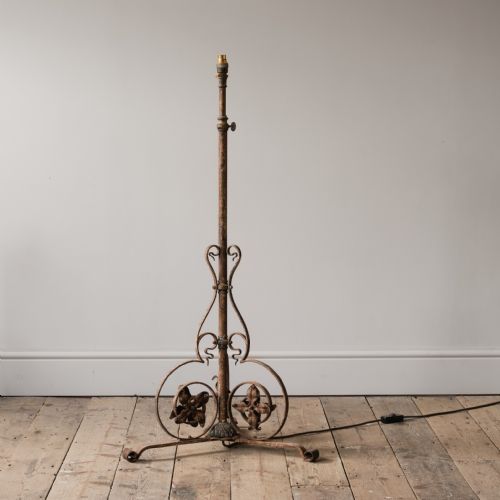


Wrought Iron Floor Standing Lamp
These wrought iron floor standing lamp examples range from adjustable 19th-century standards to Gothic revival lantern stands, built to provide height and sturdy illumination.
Wrought Iron Floor Standing Lamp
A wrought iron floor standing lamp serves as a robust vertical light source, frequently appearing in forms such as standard lamps, telescopic designs, and lantern stands. The selection spans Victorian, 19th-century, and 18th-century origins, often incorporating adjustable arms for directed lighting.
Buyers encounter diverse stylistic expressions including Gothic Revival, Arts and Crafts, Art Deco, and Art Nouveau. These pieces combine utilitarian metalwork with brass, paint, fabric shades, and cast iron components to create functional floor-standing illumination.
Origins include domestic and tavern contexts, with examples ranging from blacksmith-made adjustable reading lights to French metal standard lamps and floor candle holders adapted for electricity.
Construction and Materials
Blacksmiths shaped wrought iron by hand, utilising hammering and joining techniques to create durable shafts and scrolling bases. Telescopic mechanisms and adjustable arms allowed height and angle modifications for reading or general illumination.
Makers integrated brass fittings and cast iron elements to add structural support and decorative contrast to the dark metal framework. Painted finishes and fabric elements complete the construction of standard lamps and electrified oil lamps.
Some heavy iron stands spent centuries in noisy taverns before settling down next to a quiet armchair.
Distinctions in Execution
Quality rests in the finesse of the blacksmith's forge work and the integrity of the adjustable mechanisms. Hand-hammered detail and fluid scrollwork distinguish superior examples from simpler production.
The Wrought Iron Floor Standing Lamp Glossary
- Wrought iron
- Iron that has been heated and shaped with tools by a blacksmith, yielding a fibrous texture and durable structure. It forms the primary material for these floor standing lamps.
- Telescopic
- A design featuring nested sliding tubes that permit height adjustment of the lamp standard. This mechanical feature appears frequently in 19th-century examples.
- Torchere
- A tall decorative floor stand originally designed to carry a torch or candle, later adapted for gas or electricity. Pairs of these architectural lights appear in Art Deco styles.
- Standard lamp
- A traditional British term for a floor lamp, supporting a shade and bulb at eye level. These pieces utilise heavy metal bases to ensure stability.
- Lantern stand
- A specialised vertical support designed to display a hanging lantern at height. These tall wrought iron pieces served tavern and domestic interiors alike.
Wrought Iron Floor Standing Lamp: Frequently Asked Questions
What is a telescopic floor lamp?
A telescopic floor lamp utilises an adjustable sliding mechanism within the vertical shaft to raise or lower the light source.
This engineering allowed users to tailor the height of the lamp for reading or ambient room illumination.
How do I date a wrought iron lamp?
Dating relies on observing construction marks, such as blacksmith hammer signatures, and stylistic indicators like Gothic Revival or Art Nouveau motifs.
Earlier pieces often display hand-forged wrought iron joints, while later 19th-century and 1930s examples introduce different mechanical adjustments.
Were these lamps originally electrified?
Many older floor standing lamps began as candle holders, oil lamps, or gas lights before undergoing later conversion to electricity.
Original variants include electrified oil lamps and reading lights adapted to modern domestic wiring.
Where were lantern stands used?
Lantern stands provided sturdy, elevated lighting in domestic rooms, hallways, and taverns where stable floor illumination was essential.
Their heavy wrought iron or cast iron construction kept the tall stands secure in busy spaces.