


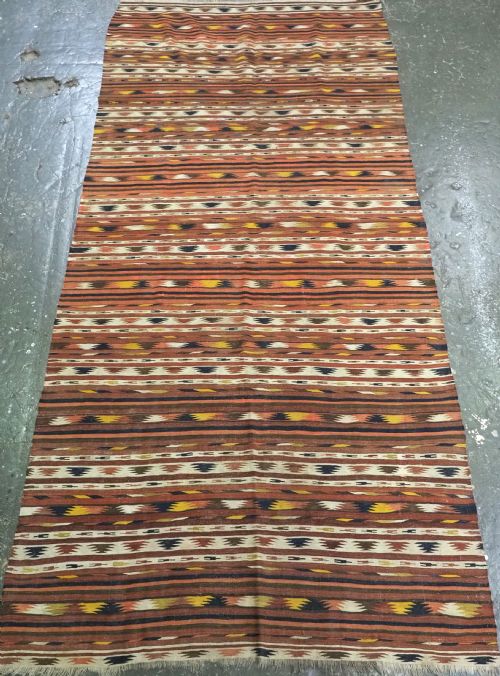

Woven Floor Textile
A woven floor textile brings character and warmth to a room through traditional patterns and enduring craftsmanship.
Woven Floor Textile
A woven floor textile encompasses a diverse range of flat weave rugs, runners, and kilims produced by tribal and regional makers across Persia, Central Asia, and Scandinavia. When browsing for a woven floor textile, buyers encounter items from the late nineteenth century through to the early decades of the twentieth century, reflecting distinct regional aesthetics and domestic uses.
The objects take several structural forms, from long runner rugs and symmetrical carpets to repurposed bag faces and flat weave spreads. Many pieces originate from nomadic or village traditions, utilising traditional motifs that denote specific tribal identities and weaving practices.
Scandinavian country runners and Persian tribal rugs dominate the visual landscape of this category, offering varied scales and palettes suited to different interior spaces. Each woven floor textile serves as a practical ground covering while carrying historical patterns handed down through generations of makers.
Materials and construction
The construction of a woven floor textile relies primarily on natural fibres such as wool, cotton, and linen, often spun by hand before dyeing. Artisans select these materials for their resilience and ability to hold rich colour values over decades of domestic use.
Weaving techniques vary between pile knots and flat weave structures, including kilim and jajim constructions that produce a smooth, durable surface. Supplementary materials such as wicker, willow, cane, and rope appear in utilitarian basketry forms associated with the broader category.
Woven Floor Textile Retail Price Guide 2026
Typical asking prices for woven floor textile among the pieces listed under this phrase on Sellingantiques today, from the lower quarter to the upper quarter. They describe what is for sale here now, not the wider market.
Object types documented in the inventory include runner rugs, saddlebags, cushion covers, flat weave wall hangings, and storage baskets.
Assessing quality in the weave
Quality in a woven floor textile rests upon the tightness of the weave and the precision of the geometric or floral layout. Finer knots and denser flat weave structures result in greater durability and clarity of design across the surface.
The integrity of the natural dyes and the consistency of the hand-spun fibres further distinguish superior examples from standard utility pieces. Preservation of original selvedges and ends indicates careful historical handling and contributes to the structural longevity of the textile.
The Woven Floor Textile Glossary
- Kilim
- A flat weave textile produced without a pile, traditionally used as a floor covering, wall hanging, or storage container.
- Jajim
- A heavy flat weave textile constructed from narrow strips joined together, often utilised as a floor spread or blanket.
- Saddlebag
- A utilitarian container woven in pairs for transport on animals, frequently separated into individual bag faces for decorative use.
- Runner
- A long, narrow carpet format designed for hallways, corridors, or alongside beds.
Woven Floor Textile: Frequently Asked Questions
How do I clean an antique woven floor textile?
Gentle surface cleaning and regular cautious vacuuming without a beater bar help maintain the fibres of a woven floor textile. Professional specialist washing is recommended for deeper maintenance to protect natural dyes.
Avoid exposing these textiles to excessive moisture or direct sunlight for prolonged periods to prevent fading and fibre degradation. Proper padding underneath helps reduce friction against hard floors during daily use.
Where were these tribal rugs made?
These textiles originate from various regions including Persia, Central Asia, and Scandinavia, produced by nomadic and village communities. Tribal groups such as the Yomut, Bakhtiari, and Baluch developed distinct weaving styles.
Each region utilised local materials and traditional dyeing methods, resulting in recognizable patterns and colour palettes. Geographic attribution relies on these structural and stylistic characteristics.
Can I use a flat weave rug in high traffic areas?
Many flat weave rugs possess a durable structure that withstands moderate foot traffic when paired with a suitable underlay. Placing a quality rug pad underneath prevents slipping and cushions the weave against hard impact.
Delicate or older examples benefit from placement in lower traffic zones to preserve the historical fibres. Regular rotation ensures even wear across the surface of the textile.
What is the difference between a kilim and a pile rug?
A kilim is constructed using a flat weave technique without any raised pile, resulting in a smooth, lighter textile. Pile rugs feature knotted vertical yarns that create a plush, textured surface.
Both forms served practical insulating and decorative purposes in traditional domestic interiors. The choice between them depends on desired texture and functional placement within a room.