


Wool Floor Covering
These Persian and tribal wool floor covering pieces bring traditional patterns and durable textiles into your home.

Wool Floor Covering
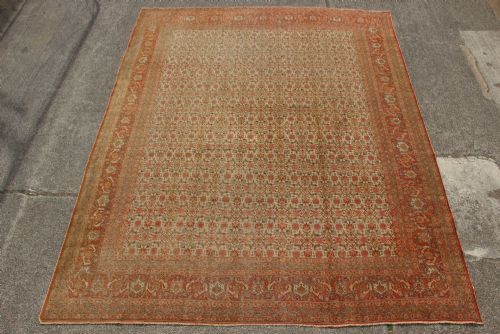
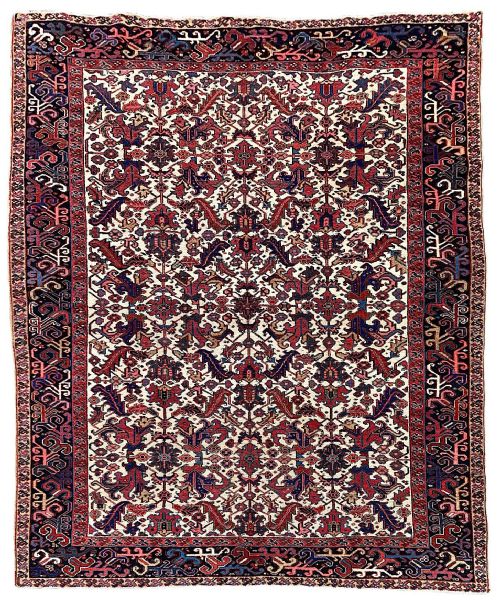
A wool floor covering serves as a durable textile foundation for a room, ranging from large carpets to smaller area rugs and utilitarian items such as saddlebags. When searching for a wool floor covering, you encounter numerous Persian examples alongside Turkish Oushak pieces and Caucasian designs. These items span the nineteenth and early twentieth centuries, including room-size carpets, palace-size floor coverings, and smaller tribal bag faces.
The selection on this page relies heavily on Persian styles, including Heriz, Tabriz, Isfahan, Kashan, and Ushak traditions. Regional workshops and nomadic tribes produced these floor coverings using distinct local motifs, palette choices, and weaving structures. Buyers find both grand city carpets designed for formal spaces and smaller tribal rugs carrying geometric or village patterns.
How they were made
These floor coverings are primarily hand-knotted using wool, hand-spun wool, and cotton foundations. Weavers worked on vertical looms, knotting pile yarn onto warp and weft threads to build dense, durable textiles that withstand generations of foot traffic.
Makers utilised natural materials, dyeing wool yarns with substances derived from plants and minerals to achieve deep, lasting tones. Cotton frequently appears in the foundation structures of city carpets to provide stability, whilst tribal pieces often employ all-wool construction.
The listings span periods from eighteen-fifty to nineteen-thirty, covering nineteenth-century tribal weavings and early twentieth-century city workshop production.
What varies in quality
The quality of a wool floor covering depends on knot density, the precision of the weave, and the fineness of the spun wool. Higher-tier city carpets from workshops in Isfahan, Tabriz, or Kashan display intricate detail and tight foundations, reflecting expert labour.
Material selection and dye consistency also dictate distinction within the range. Pieces utilising superior hand-spun wool and well-preserved natural dyes hold greater visual depth and structural integrity compared to examples with coarse yarns or uneven wear.
Benlian·Mokhtashem
The Wool Floor Covering Glossary
- Wool
- A natural textile fibre obtained from sheep fleece, used to form the pile of traditional carpets and rugs. It provides natural resilience and elasticity to the floor covering.
- Hand-Spun Wool
- Yarn twisted manually rather than by machine, creating subtle variations in thickness and texture that absorb dye unevenly in a desirable way.
- Cotton
- A plant-based fibre utilised for the warp and weft threads in many city-woven carpets, offering high tensile strength and dimensional stability to the foundation.
- Saddlebag
- A utilitarian bag woven by nomadic or village weavers for transport on animals, often surviving today as a smaller decorative rug or cushion face.
- Caucasian
- A geographical descriptor for rugs and carpets woven in the Caucasus region, known for bold geometric patterns and striking primary colours.
Wool Floor Covering: Frequently Asked Questions
How do I identify a Heriz carpet?
Heriz carpets typically feature bold, geometric medallion designs anchored in the centre with substantial corner spandrels. They are known for robust construction and heavier wool yarns.
These carpets originate from the Heris region in north-west Persia and often incorporate a distinctive rusty red or deep navy ground colour.
Where were Oushak carpets made?
Oushak carpets were woven in the town of Ushak in western Anatolia, Turkey. They are historically recognised for larger-scale floral motifs and a softer, muted palette.
These Turkish floor coverings frequently display warm terracotta, golden yellow, or scarce pink grounds that distinguish them from Persian production.
What is a tribal bag face?
A tribal bag face is the decorative front panel salvaged from a larger utilitarian storage bag made by nomadic groups. These pieces were originally used for household storage or transport during migrations.
Purchased examples now serve as small wall hangings, table mats, or cushion covers, showcasing concentrated tribal iconography in a compact format.
How do I care for a antique wool rug?
Protect your antique wool floor covering by using a breathable underlay to prevent sliding and reduce friction against hard floors. Vacuum gently with a suction-only attachment, avoiding rotating brush bars that can pull the pile.
Rotate the rug periodically to ensure even wear from foot traffic and sunlight exposure, and consult a specialist textile conservator for professional washing.