
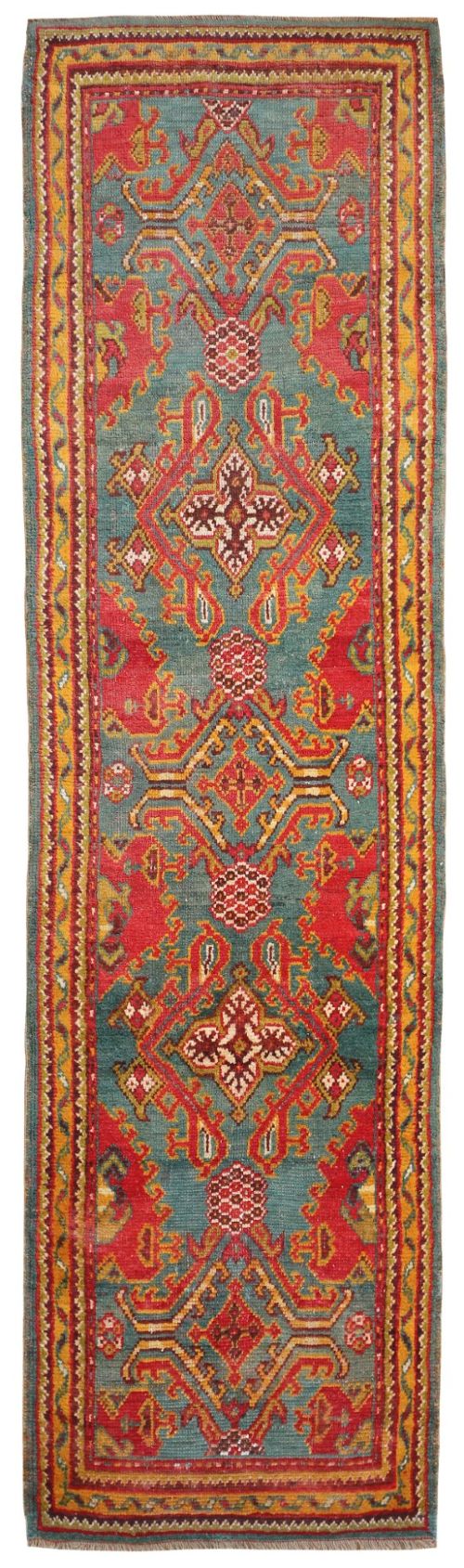



Blue Oushak Rug
A blue oushak rug brings grand Anatolian design and softened wool texture into a room.

Blue Oushak Rug
A blue oushak rug is a woven floor covering originating from western Anatolia, encompassing regional formats from runner rugs to oversized carpets. These pieces emerge from periods spanning the late Victorian era through the early twentieth century.
The selections available here include standard area rugs alongside long runners and large scale carpets. Makers from these historical Turkish weaving traditions employed distinctive medallion and star motifs within softer colour palettes.
How they were made
Weavers constructed these carpets using wool and cotton foundations, occasionally incorporating angora wool for added softness. Natural dyeing methods produced the characteristic pale blue, ivory, and muted ground colours seen across the pieces.
The production involved hand knotting wool onto cotton warps and wefts to create durable pile textiles. Larger formats required considerable time and labour from workshops across the Anatolian region.
The listings span several decades, featuring pieces dated across the Victorian era, the 1880s, 1890s, 1900s, 1910s, and 1920s.
What varies in quality
The distinction between tiers rests upon the fineness of the knotting and the depth of the wool pile. Superior examples display greater clarity in the medallion layouts and more balanced proportions across large dimensions.
Material selection also influences the overall handle, with angora wool variants offering a distinct texture. Preservation of the original pile depth and edge bindings distinguishes better preserved specimens from heavily worn items.
Maples Ushak
The Blue Oushak Rug Glossary
- Oushak
- A traditional style of rug originating from the town of Ushak in western Turkey. These pieces are known for large scale floral designs and muted colour schemes.
- Angora wool
- A soft fibre derived from angora goats or rabbits, sometimes utilised in these carpets for a luxurious pile. It contributes a distinctive sheen to the surface.
- Medallion
- A central decorative motif placed in the field of the rug. It forms the focal point of the traditional Anatolian design.
- Runner
- A long, narrow carpet format designed for hallways or corridors. Several pairs of these specific dimensions appear in the listings.
- Warp
- The vertical threads stretched on the loom that form the structural foundation of the textile. Weft threads are then interlaced across them.
Blue Oushak Rug: Frequently Asked Questions
Where were these rugs made?
These textiles originate from the town of Ushak and the surrounding Anatolian region in Turkey. Weavers produced them across various workshops during the late nineteenth and early twentieth centuries.
Traditional methods and regional designs were passed down through generations of makers in these areas. The output includes both standard area rugs and very large carpets.
How do I choose the right size?
Measure your floor space carefully to determine whether an area rug, a runner, or an oversize carpet suits the room. Runners work well in narrow hallways, while large carpets anchor major living spaces.
Consider the dimensions given in the listings, noting that formats range from compact area sizes up to expansive room dimensions.
What materials are used?
The pieces consist primarily of wool pile woven onto cotton foundations. Certain examples incorporate angora wool to modify the texture and appearance of the surface.
Natural fibres were utilised throughout the construction of these historical floor coverings. This combination of materials provided both structural durability and a soft underfoot feel.
How do I date an old rug?
Dating relies on stylistic markers, structural analysis, and historical records associated with specific production eras. The pieces listed span from the Victorian period through the early twentieth century.
Examining the weave density and colour palettes helps contextualize when a particular carpet was made. Expert attribution links specific aesthetic traits to decades such as the 1880s, 1900s, or 1920s.
How do I care for an antique rug?
Vacuum gently without using a rotating brush roll to protect the vintage wool pile. Professional cleaning suited to antique textiles helps preserve the natural fibres over time.
Positioning the rug out of harsh direct sunlight prevents fading of the blue and ivory dyes. Using a suitable underlay prevents unnecessary sliding and friction against the floor.