




Wooden Wall Weather Station
These wooden wall weather station pieces combine timekeeping, temperature, and atmospheric pressure in carved timber frames designed for hanging.
Wooden Wall Weather Station
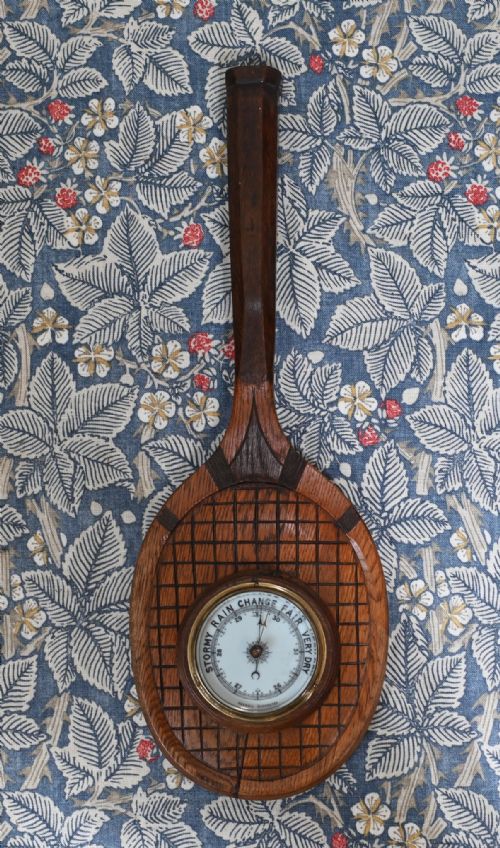
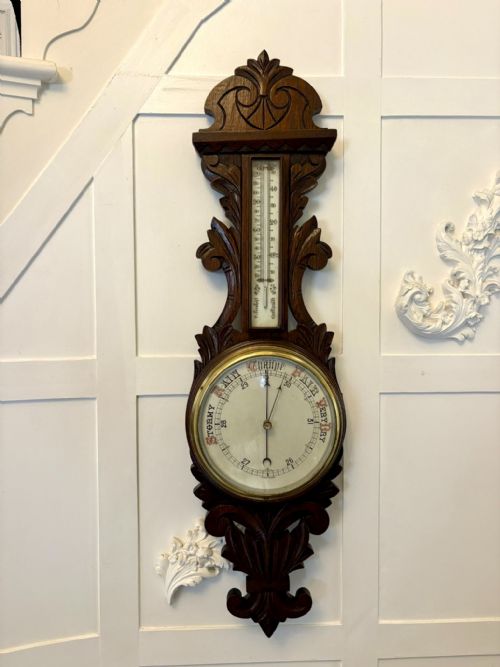
A wooden wall weather station provides practical meteorological data while serving as decorative wall furniture for domestic interiors. When searching for a wooden wall weather station, buyers encounter instruments housed in timber wall panels, banjo frames, and combined clock units.
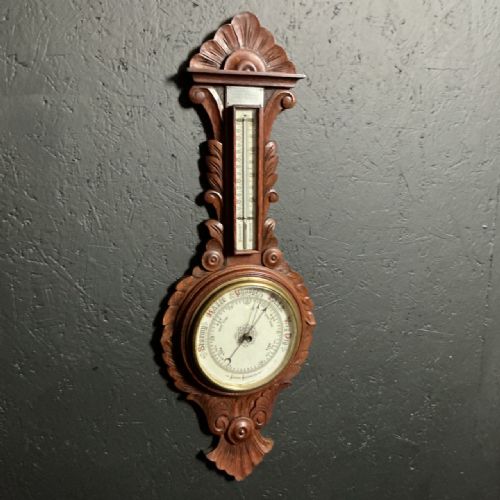
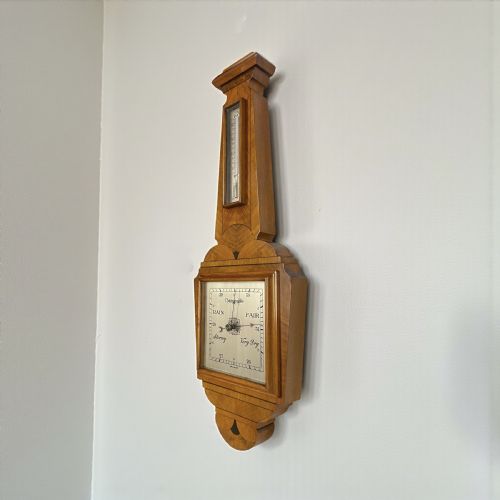
The selections span the Victorian, Edwardian, and Art Deco periods, stretching from the mid nineteenth century into the twentieth century. Common formats include aneroid barometers paired with thermometers, mercury stick barometers, and multi-functional wall panels featuring maritime clocks.
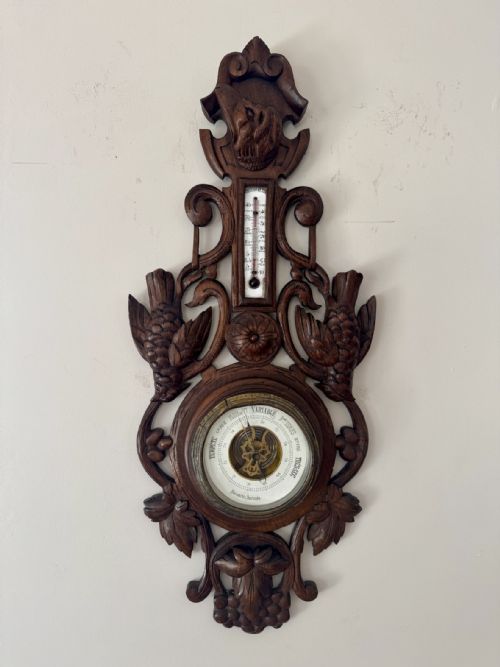
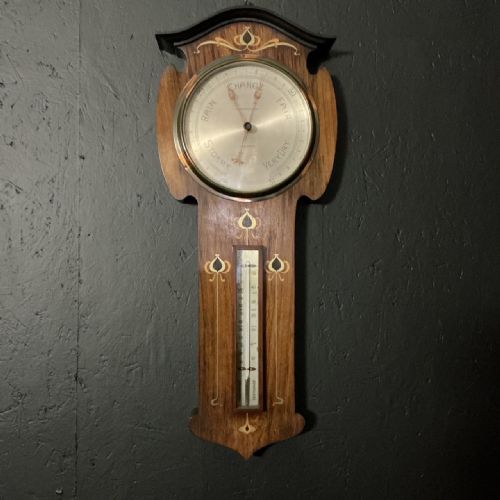
Origin variations include British domestic workshops, German Black Forest carving centres, and American timber cabinets. Buyers frequently meet oak, walnut, and mahogany housings adorned with carved foliage, geometric wood inlay, or classical neo-classical marquetry.
How they were made
Cabinet makers utilised dense domestic and imported hardwoods, selecting oak, walnut, mahogany, beechwood, and carved wood for structural durability and decorative potential. Timbers were shaped through sawing, turning, and joinery before receiving hand-carved ornamentation or smooth polished finishes.
Intricate examples display deep relief carving, particularly within the Black Forest tradition where foliage and natural motifs wrap around the instrument dials. Wood inlay and marquetry techniques introduced contrasting veneers to create geometric or pictorial patterns on flat wall panels.
Internal instrumentation relied on brass bezels, glass dials, and delicate metal linkages to house mercury tubes or aneroid vacuum chambers. Instrument makers fitted these brass and glass components securely into the timber surrounds alongside porcelain thermometer scales.
Listings feature timber housings in oak, walnut, mahogany, beechwood, and carved wood alongside brass and glass instruments.
What varies in quality
The depth and execution of the timber carving separate standard utility instruments from top-tier decorative works. Hand-carved Black Forest items with crisp, undercut foliage and balanced proportions demonstrate superior craftsmanship compared to simpler moulded or machine-finished casings.
The complexity of the combination instruments dictates the grade of the piece, with single-dial barometers sitting below integrated units housing clocks, thermometers, and hydrometers together. Signed maker dials and higher-grade brass fittings elevate the standing of an individual piece within its period.
W Watson & Sons·Jenkins Of Old Swindon·Negretti & Zambra·James Pitkin London·Vecchio & Co of Shaftsbury
The Wooden Wall Weather Station Glossary
- Aneroid barometer
- An instrument measuring atmospheric pressure through the expansion and contraction of a sealed metal box, operating without liquid mercury. These mechanisms allow wall mountings in various orientations.
- Banjo barometer
- A wall-hanging barometer shaped like a banjo, featuring a narrow stem above a bulbous lower section containing the main dial. This form dominated nineteenth-century domestic interiors.
- Marquetry
- The art of applying pieces of veneer to a structural panel to form decorative patterns and pictures. Craftsmen utilised contrasting wood tones to achieve pictorial depth.
- Bulkhead clock
- A rugged timepiece originally designed for marine use, featuring a secure brass housing suitable for wall mounting. These frequently accompany barometers in pairs.
- Mercury barometer
- A traditional instrument using a column of liquid mercury in a glass tube to indicate atmospheric pressure changes. Stick barometers represent the primary iteration of this type.
Wooden Wall Weather Station: Frequently Asked Questions
How do I hang a heavy wooden barometer?
Heavy carved oak and walnut barometers require secure wall fixings attached directly to structural studs or masonry plugs rather than simple plaster hooks.
Ensure the hanging ring or bracket on the back of the timber frame supports the full weight before releasing the instrument.
Can antique barometers still measure the weather accurately?
Many aneroid and mercury instruments retain functional internal mechanics capable of tracking local atmospheric shifts.
Calibration screws located at the rear allow adjustment against known local barometric pressures for reliable readings.
What is the difference between a stick barometer and a banjo barometer?
Stick barometers are tall, narrow instruments displaying an exposed mercury tube alongside a vernier scale.
Banjo barometers incorporate a circular dial at the base with internal mechanical linkages connected to an aneroid capsule.
How should I clean carved wooden weather stations?
Dust intricate carved wooden frames gently with a soft, dry brush to prevent dirt accumulation within deep recesses.
Avoid liquid polishes or moisture near exposed brass bezels, glass faces, and paper or porcelain thermometer scales.