
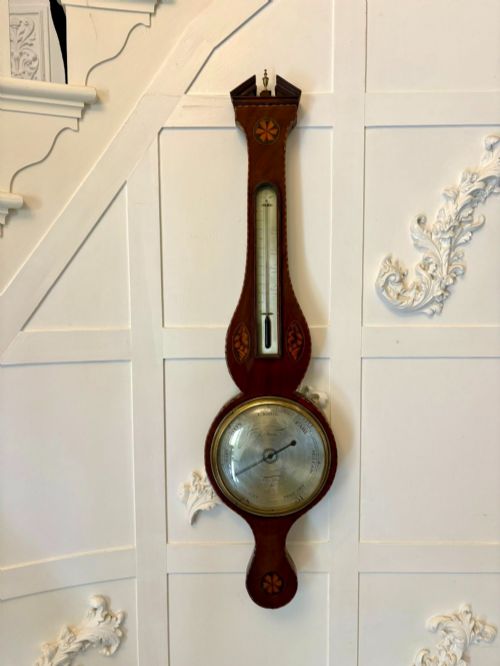


Georgian Style Banjo Barometer
A georgian style banjo barometer brings classic wall instrumentation into a room, offering both practical weather tracking and rich timber character.
Georgian Style Banjo Barometer
When you search for a georgian style banjo barometer, you are looking for wall-hung instruments shaped like the stringed musical instrument, featuring an elongated trunk and a circular dial base. These pieces combine functional weather prediction with decorative woodwork that suits both traditional and period interiors.
You will most commonly meet mahogany examples on this page, often enriched with boxwood and marquetry inlay. The selection spans genuine Georgian origins through to later 19th-century interpretations and 20th-century revivals.
The layout typically incorporates a thermometer set into the upper stem alongside a hygrometer or spirit level at the base, creating a balanced vertical composition. Makers from various regional hubs contributed to this tradition, ensuring distinct touches in dial engraving and cabinetwork.
Materials and construction
Cabinetmakers constructed the distinctive bodies using dense hardwoods like mahogany and rosewood, selected for stability and rich grain patterns. Finer editions incorporate delicate boxwood stringing and marquetry inlay around the perimeters and central stem.
Functional instrumentation relied on mercury columns housed behind protective glass faces, paired with brass bezels and indicators. Regional makers engraved dials with precise scales to measure atmospheric pressure changes alongside temperature readings.
Listings span multiple decades from the Georgian era through to the 1930s, featuring mahogany, rosewood, and satinwood.
What separates the best examples
Quality rests heavily on the crispness of the cabinetwork and the subtlety of the marquetry inlay. Superior instruments display clean brass fittings, undamaged glass, and well-preserved mercury tubes that reflect careful historical maintenance.
The distinction between standard workshop output and top-tier maker pieces lies in the precision of the dial engraving and the depth of the timber finishing. Better proportioned stems and harmonious stringing elevate the visual impact on the wall.
Prada of High Wycombe·Giana Shrewsbury·Jenkins Of Old Swindon·L Casatelli of Liverpool·J Groce York
The Georgian Style Banjo Barometer Glossary
- Banjo barometer
- A wall barometer featuring a rounded lower dial and an extended vertical trunk resembling the shape of a banjo. This form became popular during the late 18th century and continued through later revivals.
- Marquetry inlay
- Decorative patterns formed by fitting contrasting pieces of wood veneer into a prepared surface. This technique creates detailed floral or geometric motifs along the instrument trunk.
- Mercury barometer
- An instrument that measures atmospheric pressure by balancing the weight of a mercury column against the outside air pressure. These traditional tubes require careful handling during transport.
- Boxwood stringing
- Thin lines of pale boxwood inlaid into darker surrounding timber to create contrasting geometric borders. It acts as a hallmark of refined cabinetwork on period wall instruments.
- Thermometer
- A secondary gauge mounted on the upper stem to measure ambient room temperature alongside atmospheric pressure. Many period banjo barometers include this as an integrated feature.
Georgian Style Banjo Barometer: Frequently Asked Questions
How do banjo barometers work?
These instruments utilise a sealed glass tube containing mercury that rises and falls in response to changing atmospheric pressure. A internal mechanism connects the fluid level to the visible hand on the dial.
Changes in the weather alter the pressure, pushing the mercury column up or down to indicate shifting conditions such as rain or fair weather.
Where should I hang my barometer?
Select an interior wall that avoids direct sunlight, intense heat sources, and heavy vibrations from slamming doors. Stable indoor temperatures help keep the mechanical and wooden components in sound condition.
Ensure the wall fixings can securely support the weight of the hardwood case and glass dial assembly.
How do I read the dial?
The main circular face displays descriptive weather terms alongside numerical pressure readings measured in inches or millibars. Turning the brass indicator knob aligns the reference hand with the current reading to track daily movement.
By observing whether the hand moves clockwise towards fair or anti-clockwise towards rain, you can anticipate local weather shifts.
How can I tell the age?
Examine the timber species, the style of the marquetry inlay, and the construction methods used inside the trunk. Earlier pieces often display hand-beveled glass and distinct regional dial signatures.
Revival pieces from later centuries frequently adopt cleaner mechanical fastenings and standardised lettering on the engraved scales.