
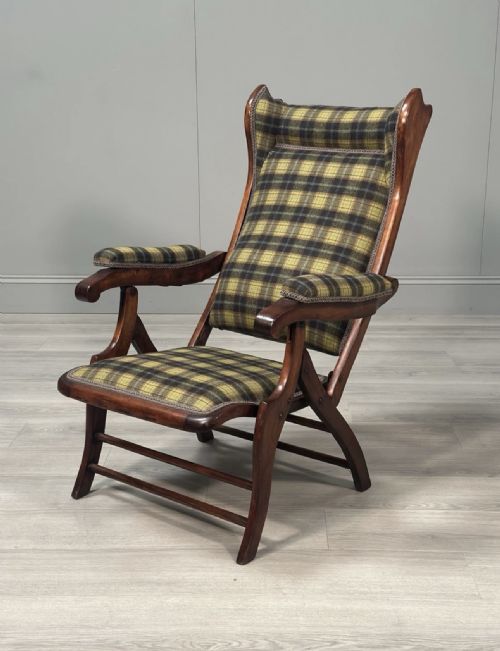


Wooden Reclining Armchair
A wooden reclining armchair offers a clever mix of solid construction and deep rest, drawing buyers who appreciate adjustable comfort.
Wooden Reclining Armchair
A wooden reclining armchair is a functional seat designed for relaxation, appearing across periods from the Georgian era through to the 1920s. These chairs take various forms, including campaign chairs, steamer deck chairs, planters chairs, and adjustable wing armchairs.
The assortment includes specialised forms like ladderbacks on castors and Chinese day beds or stargazers chairs. Each version provides a mechanism or posture designed for resting, whether through folding frames or adjustable backs.
Materials and construction
Construction relies heavily on durable timbers such as mahogany, oak, walnut, teak, and rosewood, chosen for both structural strength and appearance. Brass fittings frequently appear on adjustable mechanisms and castors, supporting the moving parts.
Upholstery incorporates materials like fabric and wool, whilst cane provides flexible seating surfaces in specific regional designs. Folding frames and ladderback adjustments demonstrate practical carpentry tailored for portability and ease of movement.
Judging quality in a wooden reclining armchair
Quality rests upon the refinement of the timber selection and the ingenuity of the adjustable mechanism. Pieces utilising dense hardwoods like Bombay rosewood or finely grained mahogany display greater sculptural ambition than simpler utilitarian forms.
The integration of brass hardware and the precision of folding joints separate standard campaign chairs from more distinguished Arts and Crafts or Georgian commissions. Upholstery finishing and the preservation of original cane or woodwork further define the tier of a piece.
The Wooden Reclining Armchair Glossary
- Campaign chair
- A portable folding chair designed for travel and military use. These pieces often feature clever hinges and brass mounts for easy dismantling.
- Planters chair
- A large armchair featuring extended armrests designed for resting legs. Originating in colonial contexts, these chairs utilise timbers like rosewood and teak.
- Steamer deck chair
- A reclining chair equipped with folding slats and adjustable footrests. They are typically associated with travel and outdoor leisure on ships.
- Ladderback
- A chair back constructed with horizontal wooden slats resembling a ladder. This traditional form often incorporates adjustable reclining angles.
Wooden Reclining Armchair: Frequently Asked Questions
What periods do these armchairs come from?
The selection spans from the Georgian period through the 19th century and into Edwardian times, with specific examples dated around 1910 and 1920.
Craftsmanship evolves across these eras, moving from 18th-century oak and elm designs to early 20th-century folding teak and walnut steamer chairs.
How do the reclining mechanisms work?
Mechanisms vary by style, utilising folding frames, adjustable ladderback notches, or pivoting elements to alter the angle of the backrest.
Pieces like campaign chairs and steamer deck chairs use collapsible wooden framing supported by brass hinges and fittings to achieve different positions.
What woods were used for these chairs?
Carpenters utilised a variety of sturdy timbers including oak, mahogany, walnut, teak, and rosewood depending on the origin and period.
Regional variations also introduce materials like elm and cane, matching the structural demands of folding or resting furniture.
Were these chairs used indoors or outdoors?
Many designs served dual purposes, functioning as indoor library or wing armchairs as well as portable deck and campaign seating.
Steamer chairs and folding models were built for travel and leisure, while wing armchairs and day beds suited domestic sitting rooms.