


Winding Carriage Clock
A winding carriage clock offers portable mechanical precision, combining bevelled glass panels and substantial metal cases for travel and domestic use.

Winding Carriage Clock
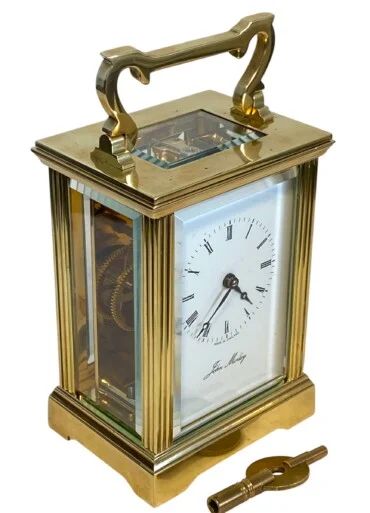
A winding carriage clock is a portable timepiece designed originally for travel, enclosed within a metal frame fitted with glass panels to display the movement. The selection on this page spans periods from the nineteenth century through the mid-twentieth century, showing Victorian, Edwardian, and French nineteenth-century stylistic influences.
Makers produced these clocks in various formats, including miniature examples, standard carriage forms, and larger pieces featuring moon phases, alarms, or repeating mechanisms. Most originate from French workshops or English makers, reflecting traditional manufacturing centres of the period.
Buyers encounter forms housed in traditional gorge cases, brass frames, and gilt bronze housings, often retaining white enamel dials with Roman numerals. These clocks range from simple timepieces to complex mechanisms with striking trains and repeater functions.
What varies in quality
Quality in a winding carriage clock rests upon the complexity and execution of the internal movement, distinguishing simple timepieces from examples with five-minute repeaters, grande-sonnerie striking, or alarm complications. The thickness of the brass casting and the weight of the overall case also indicate the standard of production.
Finishing details such as the crispness of the gilding, the flatness of the bevelled glass panes, and the legibility of the enamel dial separate standard workshop output from exceptional pieces by known makers.
Listings feature pieces spanning the nineteenth century, Edwardian era, and mid-twentieth century, utilising brass, gilt bronze, and bevelled glass.
John Morley·L Epee·Mappin and Webb·Bourdin Paris·Lamy and Lacroix·Joseph Soldano·Penlington and Batty
The Winding Carriage Clock Glossary
- Gorge case
- A distinct rectangular brass carriage clock case style featuring stepped mouldings at the top and bottom. This form is frequently encountered on French-made pieces.
- Repeater
- A mechanism that chimes the hours and quarters on demand when a button or lever is pressed. This complication allowed time-checking in the dark.
- Grande-sonnerie
- A striking train that sounds the hours and the passing quarters automatically on bells or gongs. It represents a high level of horological complexity.
- Escapement
- The internal mechanism that controls the release of power from the mainspring to the gear train. Carriage clocks often utilise platform escapements visible through the top glass.
- Enamel dial
- A metal dial face coated in fused glass powder and fired to create a smooth white surface. Numerals are painted onto this durable ground.
Winding Carriage Clock: Frequently Asked Questions
How do I wind a carriage clock?
Most pieces require a specific winding key inserted into the arbours located on the base or the backplate behind the rear door. Turn the key gently until resistance indicates the mainspring is fully tensioned.
Avoid overwinding the mechanism, as this places excessive strain on the internal springs and can prevent proper operation.
Why does my clock have a platform escapement?
The platform escapement mounts the balance wheel and hairspring on a small removable brass carriage at the top of the movement. This innovation allowed portable clocks to keep accurate time regardless of their orientation.
It replaced pendulum systems which required a stationary environment to function correctly.
What maintenance do these clocks need?
A mechanical carriage clock benefits from professional cleaning and lubrication every few years to prevent old oils from gumming up the gear trains. Keep the exterior brass and glass clean using soft, dry cloths without abrasive polishes.
Stable household environments away from dampness and direct sunlight help preserve both metalwork and enamel dials.