

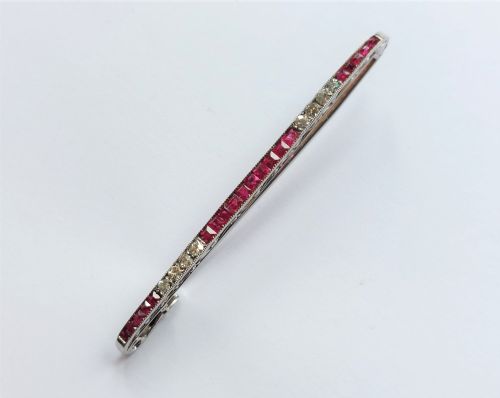


White Gold Diamond Brooch
A white gold diamond brooch brings together crisp precious metal and brilliant stones, offering a versatile piece of wearable history that spans the Victorian era to the mid-twentieth century.
White Gold Diamond Brooch
A white gold diamond brooch spans several distinct periods, with Edwardian, Art Deco, and mid-century modern pieces forming the core of what you will encounter. These ornaments take various shapes, from geometric bar pins and floral sprays to convertible pendant brooches and whimsical animal subjects.
The materials recorded in the evidence range from early yellow and white gold alloys through to platinum combinations, frequently augmented by rubies, sapphires, emeralds, opals, and natural pearls. Art Deco geometric designs and Edwardian filigree work dominate the selection, alongside robust mid-century floral clusters.
You meet pieces that function as simple lapel pins, double clip brooches, and hair ornaments. The survival of these varied forms demonstrates the enduring popularity of mounting diamonds in pale precious metals.
Materials and Construction Techniques
The construction relies on white gold variants, including 9ct, 14ct, 18ct, and platinum pairings, which provide a neutral backdrop designed to enhance the brilliance of old cut, single cut, and brilliant cut diamonds. Master jewellers utilised millgraining, pierced openwork, and delicate filigree to achieve the light, airy aesthetic seen in Edwardian and Art Deco examples.
Coloured gemstones such as rubies, sapphires, emeralds, and fire opals appear alongside rock crystal quartz, black onyx, and natural pearls to create contrast within the metallic framework. Secure pin stems, c-clasps, and locking trombone catches are integrated into the reverse of the pieces to ensure wearable stability.
White Gold Diamond Brooch Retail Price Guide 2026
Typical asking prices for white gold diamond brooch among the pieces listed under this phrase on Sellingantiques today, from the lower quarter to the upper quarter. They describe what is for sale here now, not the wider market.
Among the creatures pinned to these historic metals, a sharp-eyed terrier holds its ground alongside the usual floral sprays and geometric bursts.
Distinguishing Quality in the Range
Quality rests upon the precision of the metalwork, the integration of supplementary gemstones, and the calibre of the diamond cutting. Pieces that display intricate pierce-work, crisp millegrain edges, and well-matched stone groupings occupy the upper tier of the market.
The presence of certified stones, substantial total diamond weight, and unusual subject matter such as carved cameos or figural animal motifs elevates an item. Simpler bar brooches rely on the symmetry of their design and the cleanliness of the gold alloy.
The White Gold Diamond Brooch Glossary
- Millegraining
- A technique involving a row of tiny raised metal beads along the edges of a setting. This decorative border softens the transition between the metal and the stones.
- Old Cut Diamond
- A general term for diamond cuts preceding modern brilliant standards, often characterised by high crowns and small tables. These stones exhibit a distinctive chunky pattern of light return under candlelight.
- Pendant Brooch
- A dual-purpose piece equipped with a concealed loop or bail. This allows the ornament to function interchangeably as a brooch pinned to clothing or suspended from a chain.
- Filigree
- Openwork metal formed by twisting and soldering fine threads of gold or platinum into delicate lace-like patterns. It is frequently seen in Edwardian and Art Deco mountings.
White Gold Diamond Brooch: Frequently Asked Questions
How do I wear a white gold diamond brooch?
These pieces pin securely to coat lapels, heavy knitwear, scarves, and evening wear using traditional pin stems and safety catches. Many examples featuring hidden bails transform into pendants for necklace chains.
Heavier floral spray or double clip designs require sturdy fabrics to support their weight without sagging. Lighter bar pins suit delicate silks and lapels alike.
What periods do these brooches come from?
The inventory spans from the late Victorian era through the Edwardian period, the Art Deco 1920s and 1930s, and into mid-century modern design. Each era brings distinct motifs, from floral sprays and crescent shapes to stark geometric lines.
Victorian and Edwardian pieces lean towards organic shapes and delicate filigree, while Art Deco items favour symmetry and contrasting dark onyx or bright coloured gems.
Are these brooches made of solid white gold?
The listings show metal purities ranging from 9ct and 14ct to 18ct white gold, alongside platinum and mixed metal settings. Earlier pieces often combine 18ct white gold with platinum tops to showcase the stones securely.
Maker practices varied by decade, with platinum and white gold alloys becoming the standard choices for achieving a bright, silvery finish that does not distract from the diamonds.
Can I convert a brooch into a necklace?
Pendant brooches possess integrated loops that accommodate chains directly, allowing instant conversion from a pinned ornament to a neckpiece. Items without dedicated loops sometimes utilise specialised safe converters provided by jewellers.
Solid bar brooches and delicate filigree pins lack this feature and remain strictly suited for pinning to garments.