



White French Bedside Tables
White French bedside tables bring Continental elegance to a bedroom, combining practical bedside storage with classic carved details and painted finishes.
White French Bedside Tables
White French bedside tables encompass a range of Continental sleeping chamber furniture designed to sit beside the bed, frequently taking the form of enclosed bedside cabinets or small side tables. When seeking white French bedside tables, buyers encounter pieces spanning the nineteenth century through the early twentieth century, drawing on design idioms such as Louis XVI style, French Provincial, and French Chateau.
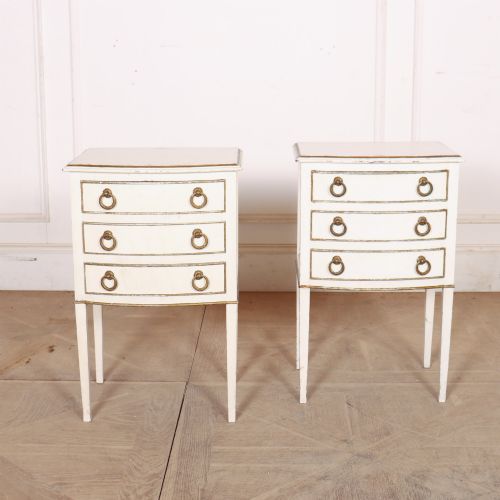
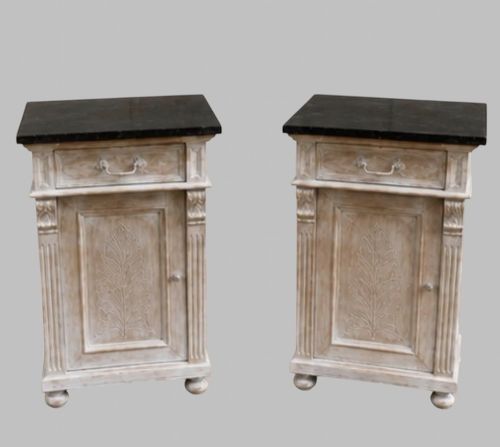
The inventory demonstrates that these items often appear in matched pairs, offering symmetry for the bedroom. Alongside traditional bedside cabinets with single doors or drawers, the selection incorporates painted night tables and demi lune console tables adapted for bedside use.
Origins stretch across various periods including the eighteen-eighties, nineteen-hundreds, and nineteen-twenties. While some items display natural wood beneath paint, the overarching aesthetic relies on painted wood surfaces that complement classic French interior schemes.
How they were made
Maker workshops constructed these cabinets and tables using traditional timber framing, frequently employing oak, walnut, mahogany, fruitwood, or satinwood as a carcase. Surface decoration relied heavily on applied paint finishes, often layered over plaster mouldings or carved wood details to achieve the characteristic aged white appearance.
Many examples incorporate inset marble tops in white or grey tones, providing a durable and cool surface for bedside items. Metal components such as brass, bronze, and ormolu mounts, handles, and trim were cast and fixed to enhance the neoclassical or provincial ornamentation.
Listings feature painted wood, marble, and bronze, spanning periods from the nineteenth century to nineteen-thirty.
What varies in quality
Quality reveals itself in the crispness of the wood carving and the stability of the timber joinery, where superior pieces retain tight joints and smooth drawer operation. The application of the painted finish dictates visual depth, distinguishing finely layered historic paint from flat modern coatings.
The inclusion of heavy, well-veined marble tops and finely cast bronze or brass mounts elevates a piece significantly. Furthermore, the presence of matching pairs rather than single items alters the desirability and architectural balance within a bedroom setting.
Gien·Melissa White
The White French Bedside Tables Glossary
- Demi lune
- A half-moon shape used for console tables and bedside chests that sit flat against the wall with a curved front. This profile saves floor space while offering surface utility.
- Louis XVI Style
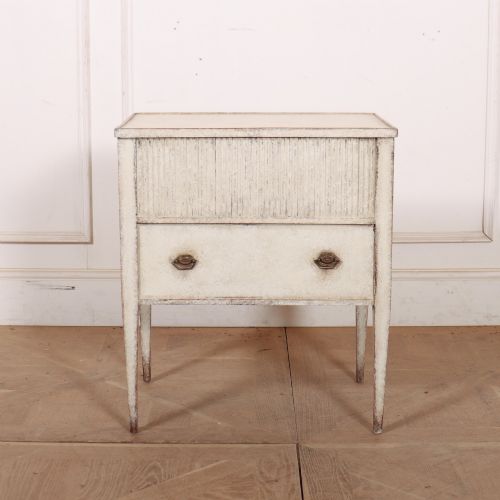
- A neoclassical design movement characterised by straight tapered legs, geometric symmetry, and restrained classical ornamentation. It reflects eighteenth-century French royal aesthetics revived in later periods.
- Ormolu
- Gilt bronze ornamentation applied to furniture and lighting. The technique involves treating bronze with a finely ground gold-mercury amalgam.
- Marble top
- A polished stone slab fitted to the upper surface of a cabinet or table. It provides a heat-resistant and easily cleaned finish ideal for daily bedside use.
White French Bedside Tables: Frequently Asked Questions
What periods do these bedside tables come from?
The pieces span the nineteenth century through the early twentieth century, including examples from the eighteen-eighties, eighteen-nineties, and the nineteen-twenties.
Craftsmen during these eras produced both formal neoclassical designs and rustic provincial variants.
Are these tables usually found in pairs?
Many listings present matching pairs of bedside cabinets and lamp tables, which suits the symmetrical arrangement of a traditional master bedroom.
Single cabinets also appear, often originating as individual night tables or boudoir pieces.
What materials are used on the tops?
Many bedside tables feature fitted marble tops in white or grey stone, offering a durable surface alongside wooden and painted variants.
Timber carcases beneath the paint typically consist of oak, walnut, mahogany, or fruitwood.
How do I identify Louis XVI style features?
Louis XVI pieces are marked by straight, tapered legs, often fluted, and a strict adherence to classical geometric symmetry.
Ornaments on these tables draw from ancient Greek and Roman motifs rather than the curved asymmetry of earlier rococo designs.