
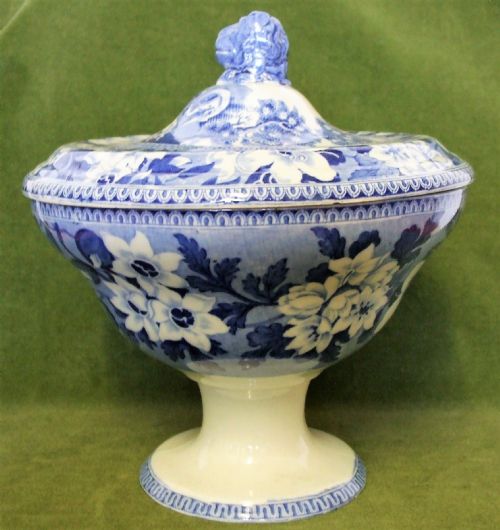
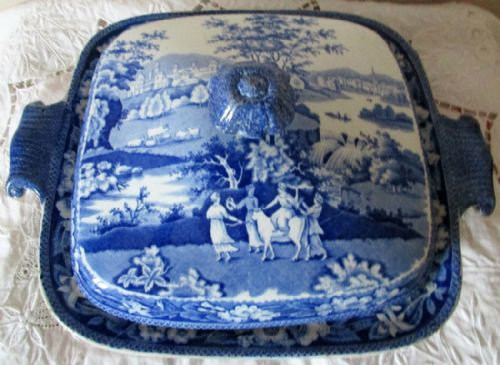


White Earthenware Tureen
A white earthenware tureen brings the crisp transfer-printed landscapes and robust forms of the nineteenth century directly to the table.
White Earthenware Tureen
A white earthenware tureen serves as the centrepiece of a nineteenth-century dining arrangement, designed to hold soup, vegetables or sauce with practical elegance. These pieces emerge in Georgian, Regency, Victorian and Edwardian periods, often forming part of larger dinner services or child's sets.
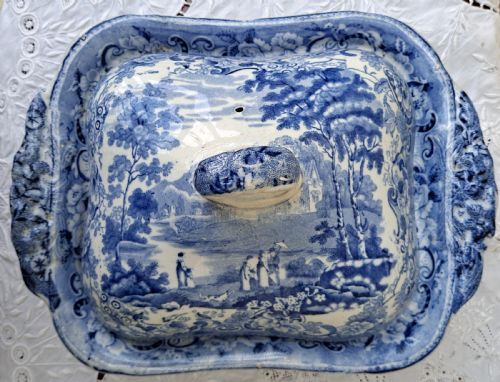
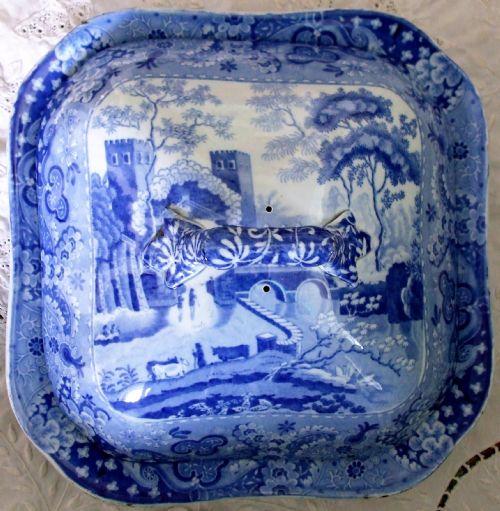
The most common examples on this page are blue and white transfer-printed vessels bearing romantic ruins, pastoral scenes or classical subjects. Collectors encounter vegetable tureens complete with covers, smaller sauce tureens with matching stands, and occasional footed bowls.
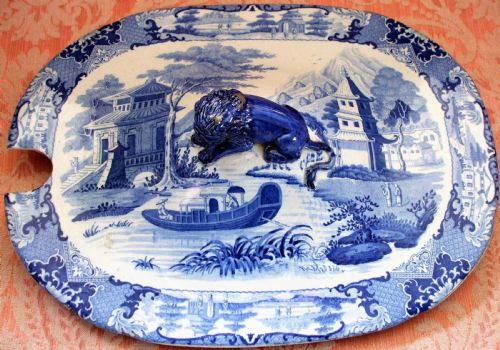
Makers shaped these utilitarian objects with considerable artistry, applying detailed patterns such as Canton River Scene, Elephant and Castle across earthenware, pearlware and glazed ceramic bodies.
Materials and methods of production
Potters utilised refined earthenware and pearlware bodies, coating the finished forms in lead glazes and enamel to achieve a smooth, glossy surface. These materials provided an ideal, bright white ground for intricate blue and white transfer printing.
Transfer printing allowed workshops to apply complex pictorial designs like floral sheet patterns and rural scenery onto curved ceramic surfaces with remarkable consistency. Artisans then fired the pieces at high temperatures to fuse the glaze and secure the deep blue pigment.
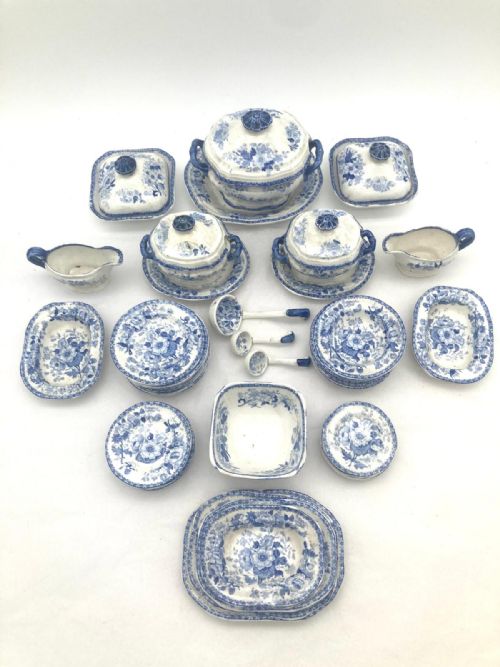
Some miniature child's services allowed Victorian children to practice formal dining etiquette using perfectly scaled transfer-printed tureens.
Judging quality and execution
Quality rests upon the crispness of the transfer print and the clarity of the glaze across the tureen and its cover. Superior examples display sharp details in complex motifs like architectural ruins or animal designs without blurring or smudging.
The sophistication of the potting and the completeness of matching sets also dictate standard. Surviving covers, stands, ladles and matching bases elevate a piece significantly above a solitary vessel.
Robert Hamilton·James Wallace and Co·J and R Clews·John Rogers and Son·John and Richard Riley·Booths·Ridgway·Doulton Burslem·Wedgwood·Spode·Copeland and Garrett
The White Earthenware Tureen Glossary
- Earthenware
- A porous pottery body fired at lower temperatures, requiring a vitreous glaze to hold liquids. It forms the structural base for the vast majority of nineteenth-century tureens.
- Pearlware
- A refined earthenware developed with a bluish-white glaze that pooled in recesses, creating a subtle contrast. It bridges the transition from creamware to brilliant white ceramics.
- Transfer printing
- A decoration technique using an engraved copper plate to transfer inked designs onto tissue paper, which is then pressed onto the ceramic body. This method revolutionised pottery decoration.
- Flow blue
- A Staffordshire style where cobalt blue pigment deliberately blurred or bled into the white glaze during firing. This created a rich, hazy, atmospheric depth on the finished surface.
White Earthenware Tureen: Frequently Asked Questions
How were antique tureens used?
These vessels held hot soups, stews or vegetables at the dining table, keeping contents warm beneath fitted ceramic covers.
Servants brought them to the table as part of large service sets, often accompanied by matching ladles and decorative stands.
Can I use my tureen daily?
Modern use is generally discouraged due to the age and porous nature of nineteenth-century earthenware bodies.
Gentle hand washing preserves the fragile lead glazes and delicate transfer-printed decoration from thermal shock and abrasive detergents.
How do I date a white earthenware tureen?
Dating relies on maker marks, ceramic body composition, and stylistic clues within the transfer print.
Pearlware glazes and specific pictorial themes usually point toward the Georgian era, while later Victorian pieces show different registry marks and denser pastes.
What is a vegetable tureen?
A vegetable tureen is a medium-sized covered vessel specifically designed for serving side dishes at formal meals.
They are frequently found paired with matching covers and distinct platter bases to protect dining tables from heat.