


White Dial Carriage Clock
A white dial carriage clock brings portable precision into a room, combining brass and glass with mechanical complexity.
White Dial Carriage Clock
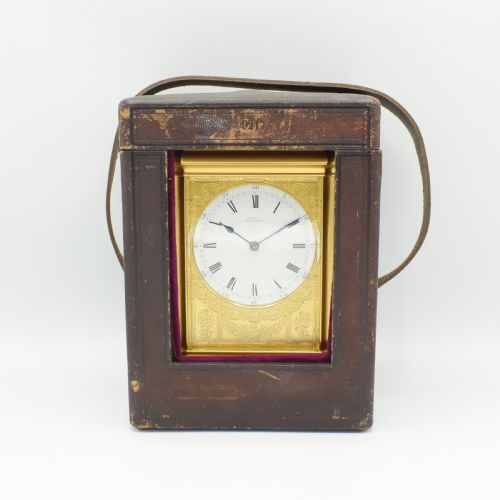
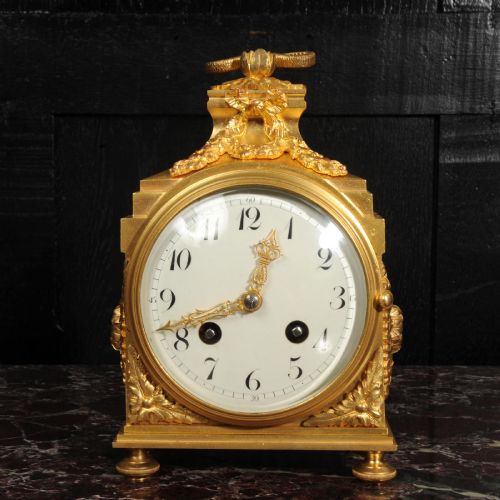
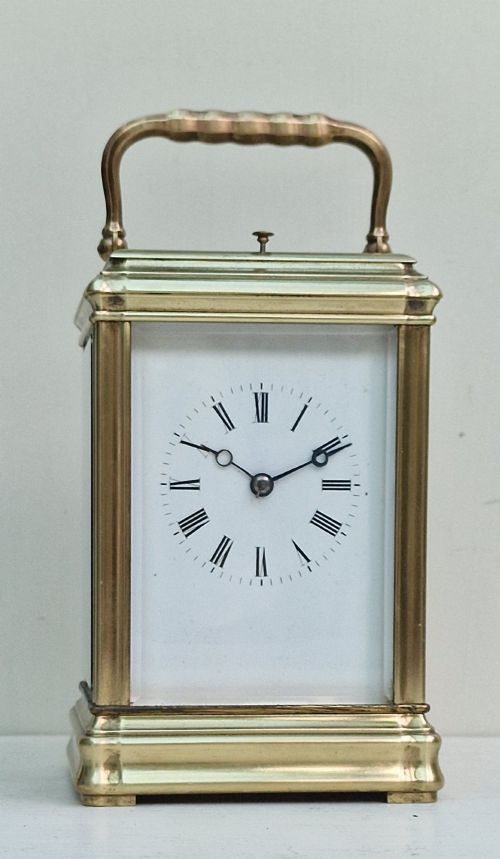
A white dial carriage clock is a portable timepiece housed in a brass or gilt frame with glass panels, designed for travel and domestic use during the nineteenth and early twentieth centuries. The selections found here span periods from the Victorian era through the Edwardian period, capturing both French workshops and English makers.
Most examples rely on enamel faces for legibility, often paired with striking or repeating mechanisms. Miniature formats, giant sizes, and ornate cases like the gorge or doucine styles appear regularly among the available pieces.
Materials and construction
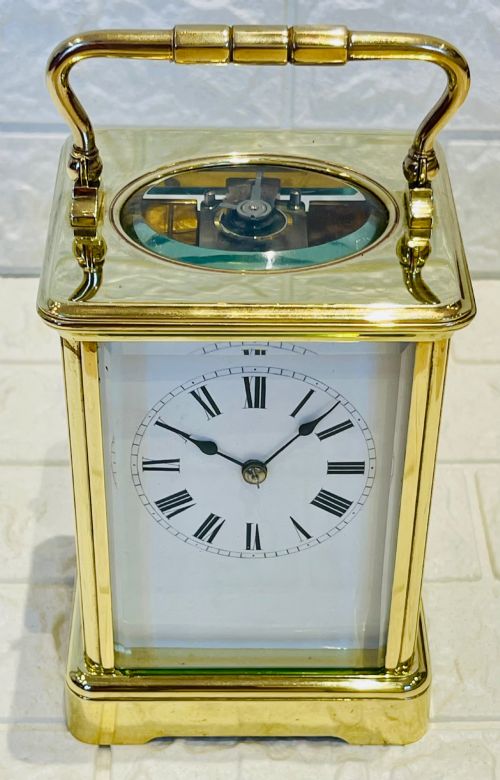
Brass, gilt brass, and gilt bronze form the structural housing for these movements, complemented by silver and leather for specific cased or miniature variants. Enamel provides the crisp white surface for the dial, while glass panels on all sides allow visibility of the gear trains and escapements.
Makers utilised precision casting, engine turning, and hand engraving to finish the metalwork. Complex movements incorporate platforms for the escapement, striking hammers for bells or gongs, and repeat functions operated by buttons on the case.
White Dial Carriage Clock Retail Price Guide 2026
Typical asking prices for white dial carriage clock among the pieces listed under this phrase on Sellingantiques today, from the lower quarter to the upper quarter. They describe what is for sale here now, not the wider market.
The listings span the Victorian and Edwardian eras, featuring brass, silver, and gilt bronze cases housing white enamel dials.
Distinctions in quality
Quality rests in the execution of the movement and the crispness of the case work. Examples by notable makers demonstrate superior finishing on the platform escapement and more complex striking or alarm mechanisms.
The weight of the cast brass, the depth of the hand engraving on the mask or case, and the retention of original gilding separate standard production pieces from exceptional works of horology.
Pickford of London·Delépine-Barrois·Gontard & Bolviller Paris·Paul Garnier·Charles Frodsham & Holingue Frères·Leroy Paris·Henry Matthews·Henry Jacot
The White Dial Carriage Clock Glossary
- Carriage clock
- A portable spring-driven timepiece originally designed for travellers in the nineteenth century. These clocks typically feature a rectangular brass case with glass windows.
- Platform escapement
- The assembly carrying the balance wheel and hairspring, mounted visibly on top of the movement. This innovation allowed carriage clocks to keep accurate time while moving.
- Repeating mechanism
- A complication that chimes the hours and quarters upon pressing a button on the case. This allowed the owner to check the time audibly in total darkness.
- Gorge case
- A distinct rectangular brass case style with stepped mouldings at the top and bottom and a curved handle. It is characteristic of better quality French carriage clocks.
- Enamel dial
- A fused glass-on-metal face providing a smooth white background for painted numerals. They require careful firing to avoid cracks around the winding squares.
- Petit sonnerie
- A striking train that sounds the hours and the current quarter-hour automatically as the quarters pass. It represents a higher tier of horological complexity.
White Dial Carriage Clock: Frequently Asked Questions
How do I wind a carriage clock?
Use the matching key on the winding squares located through the back door of the movement. Turn carefully until resistance indicates the mainspring is fully tensioned.
Take care not to overwind the springs, as this can cause breakage in older metal components.
What is a repeating carriage clock?
A repeating carriage clock includes an extra mechanism that sounds the last hour and quarters when a plunger on top is depressed. This function was designed for checking the time at night without lighting a candle.
Originating in French workshops, the repeating function adds notable complexity and weight to the movement.
How do I date a carriage clock?
Examine the style of the brass case, the shape of the handle, and any maker signatures or serial numbers stamped on the backplate. Victorian and Edwardian pieces often show distinct progression in case architecture and escapement design.
Earlier nineteenth-century examples tend toward heavier fire gilding and simpler white enamel dials without extensive decoration.
Where should I place a carriage clock?
Position the clock on a stable, level surface away from direct sunlight, drafts, and heavy vibrations. A mantelpiece or a secure desk allows the escapement to beat evenly.
Keep the glass panels clear of walls so the inner movement remains visible from multiple angles.