
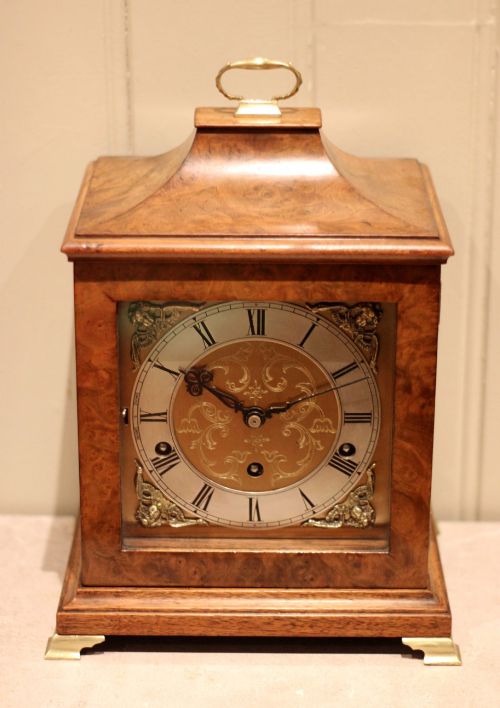


Westminster Chime Bracket Clock
A westminster chime bracket clock brings deep quarter-hour melodies and substantial wood cases directly into the room.
Westminster Chime Bracket Clock
A westminster chime bracket clock sits securely upon tables, mantelpieces and dedicated pedestals rather than hanging from walls. These pieces operate as both precise timekeepers and musical instruments, sounding the familiar four-note quarter-hour melody derived from the Cambridge quarters.
The format encompasses several variations, with mahogany, oak and burr walnut providing the predominant case structures. Mantel clocks and table clocks appear frequently alongside traditional bracket clock forms across the selection.
Victorian and Edwardian pieces dominate the records, supplemented by Edwardian boardroom examples and items from the early decades of the twentieth century. Makers such as Winterhalder and Hofmeier, Gustav Becker and Elliott of London shape the heritage of these mechanisms.
Judging quality and execution
The refinement of the wooden case separates standard production from exceptional examples, particularly where burr walnut veneer, flame mahogany or ormolu mounts are handled with precision. Cabinetry finish and the crispness of carved details indicate the maker's original investment of skill.
Internal movement complexity dictates execution standards, distinguishing simpler spring-driven mechanisms from intricate triple fusee systems with multiple bells and gongs. The clarity and resonance of the chime sequence reflect the original tuning and mechanical calibration.
Listings feature woods including mahogany, oak and burr walnut veneer alongside brass, glass and ormolu mounts.
Mappin and Webb·Winterhalder and Hofmeier·Gustav Becker·Elliott of London·Thwaites and Reed
The Westminster Chime Bracket Clock Glossary
- Bracket clock
- A portable timekeeper originally designed to sit on a wall bracket to aid resonance. These pieces evolved into substantial table and mantel clocks.
- Fusee
- A conical pulley connected to the mainspring by a chain or cord. This device maintains even power delivery to the movement as the spring unwinds.
- Triple fusee
- A movement configuration utilising three separate fusee chains. One drives the timekeeping, while the others power the chime and the striking trains.
- Ormolu
- Gilt bronze ornamentation applied to furniture and clock cases. The technique involves creating a finely chased bronze base finished with gold amalgam.
- Spandrel
- The triangular ornamental corner space on a clock dial surrounding the circular chapter ring. These elements often feature cast brass scrollwork or floral motifs.
Westminster Chime Bracket Clock: Frequently Asked Questions
Where should I place a bracket clock?
These clocks require a stable, level surface such as a sideboard, mantelpiece or dedicated wooden pedestal. Placing the piece away from direct heat sources and damp walls protects the wood veneer and internal metal components.
Ensuring the surface does not vibrate allows the pendulum to swing evenly and lets the chime hammers strike clearly against the gongs or bells.
How do I wind the movement safely?
Use the correct winding key for each specific arbour on the dial face, turning it gently until resistance meets you. Avoid over-winding, which can damage the mainsprings or the fusee chain mechanism.
Keep track of the winding schedule so the clock maintains steady tension and accurate timekeeping throughout its operational cycle.
How can I tell a Victorian piece from an Edwardian one?
Victorian examples often display heavier ornamentation, darker ebonised finishes, or elaborate architectural carvings influenced by revival styles. Their proportions tend to be robust and monumental.
Edwardian pieces frequently adopt lighter mahogany tones or cleaner geometric lines, reflecting changing interior tastes towards simpler forms while retaining complex chiming functions.
Why does the clock play different melodies?
Many movements include selector levers that allow the owner to switch between the Westminster chime sequence and alternative tunes such as Whittington. These options demonstrate the versatility built into multi-train bracket clocks.
Selecting silent mode stops the music during the night while allowing the timekeeping train to continue running uninterrupted.