


Welsh Valley Landscape Art
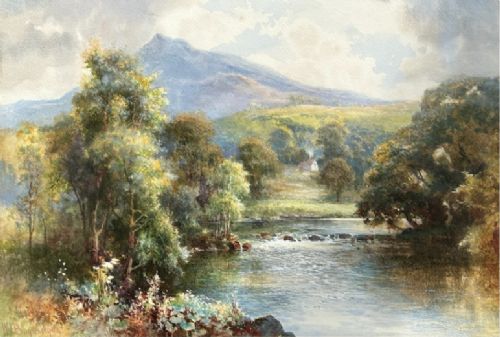
Welsh valley landscape art brings the rugged topography of rivers, glens and mountains directly to the wall through watercolour and oil.
Welsh Valley Landscape Art
Welsh valley landscape art captures the distinct scenery of locations such as the Ogwen Valley, Wye Valley and North Wales across the nineteenth and twentieth centuries. These works record mountainous horizons, winding rivers and wooded glens through the lens of Victorian and Modern British aesthetics.
The pieces appearing on this page take the form of original watercolours on paper and oil paintings on canvas or wood panels. Buyers encounter signed works by established British painters alongside evocative nineteenth-century watercolours depicting Snowdonia and surrounding valleys.
Victorian Pastoral and Victorian Naturalism styles frequently define the earlier examples, while twentieth-century pieces introduce a shift towards Modern British sensibilities. Each painting offers a window into the topography and light of Welsh topography as interpreted by period artists.
Materials and methods
Artists rendering these scenes relied primarily on watercolour on paper or oil paint applied to canvas and wood panels. Watercolours achieved translucent effects for skies and rivers, while oils provided deep texture for wooded glens and rugged mountain terrain.
Many works retain their period framing, utilising gilt wood and decorative wooden mouldings that complement the painting style. The application of pigment ranges from delicate washes in nineteenth-century watercolours to robust brushwork on early twentieth-century wood panels.
Listings feature works spanning from the mid-nineteenth century to the 1940s, executed in watercolour, oil on canvas and oil on wood panel.
Differentiating quality
Quality in these landscapes rests upon the artist's ability to capture atmospheric light and topographical accuracy within the specific valley setting. Finer examples demonstrate confident brushwork, controlled washes and a sophisticated handling of depth in mountainous terrain.
The material support and framing also influence the overall character of the piece, with original gilt wood frames and stable wood panels preserving the integrity of the artwork. Signed works with documented provenance by known painters distinguish the upper tier of available selections.
William Joseph Boyes·Hubert Wellington·Clarence Henry Roe·William Mellor·J Barclay·John Syer·Harold Lawes·Cornelius Pearson·John J. Hamer
The Welsh Valley Landscape Art Glossary
- Watercolour painting
- A work created using water-soluble pigments on paper supports, valued for luminosity and delicate tonal gradations. This medium dominates nineteenth-century depictions of Welsh rivers and valleys.
- Oil on canvas
- A technique involving pigment suspended in drying oil applied to stretched canvas, allowing for rich texture and deep colour saturation. Painters utilised this method for robust depictions of wooded glens and mountain ranges.
- Wood panel
- A rigid wooden support used by artists for oil paintings, offering a smooth and stable surface. Early twentieth-century works frequently employed this material.
- Gilt wood
- Wood carved and coated with gold leaf or metallic paint to form decorative picture frames. These frames frequently accompany period paintings from the nineteenth and twentieth centuries.
Welsh Valley Landscape Art: Frequently Asked Questions
How do I identify a nineteenth-century Welsh watercolour?
Nineteenth-century watercolours typically employ paper supports with muted, stable pigments depicting specific locations like the Ogwen Valley or Snowdonia. Signatures, period framing and stylistic traits such as Victorian Naturalism assist in establishing the era.
Examination of the paper backing and signature style further clarifies the period context of these topographical works.
What is the difference between oil and watercolour landscapes?
Oil paintings utilise thick pigments on canvas or wood panels, resulting in textured surfaces and rich colour depth suitable for dramatic mountain scenes. Watercolours on paper offer lighter, transparent qualities ideal for capturing atmospheric river views.
Both mediums were widely used by British artists recording Welsh scenery during the Victorian and Edwardian periods.
Where were these Welsh valley scenes typically painted?
Artists focused their efforts on renowned locations throughout Wales, including the Conwy Valley, Wye Valley, Cardiganshire and the rivers of North Wales. These sites provided varied topography ranging from gentle pastoral riverbanks to rugged mountainous glens.
Inscribed titles on the reverse or front of the works frequently identify the exact valley or river depicted.
How should I care for antique paper watercolours?
Antique watercolours on paper require protection from direct sunlight to prevent fading of the delicate pigments. Displaying them in rooms with stable humidity levels helps preserve the paper support and prevents foxing.
Professional framing with acid-free mounts ensures the long-term preservation of nineteenth-century works.