
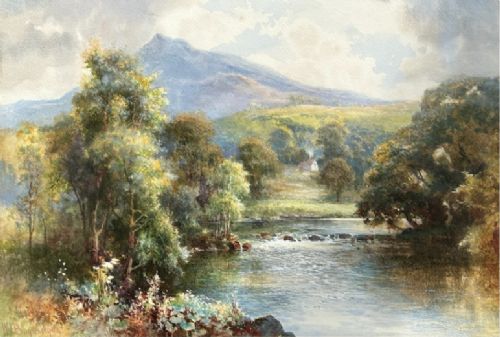


Welsh Valley Artwork
These pieces of welsh valley artwork capture the rugged terrain and quiet rivers of Wales through nineteenth and twentieth century watercolours and oil paintings.
Welsh Valley Artwork
When you search for welsh valley artwork, you find a collection of landscape paintings capturing locations such as the River Llugwy, North Wales, and Cardiganshire. These works depict valleys, rivers, and wooded glens through the lens of nineteenth and twentieth century artists.
The pieces appearing on this page most frequently take the form of watercolours on paper and oil paintings on canvas or wood panels. Examples range from Victorian naturalism and pastoral scenes to early twentieth century British works.
Subjects concentrate heavily on specific Welsh topography, including Bethesda, Conwy, the Wye Valley, and Deganny. Artists record these rural vistas with varying palettes, spanning bright summer tones to moody, atmospheric riverbanks.
Materials and methods
The physical works rely primarily on paper for watercolours and canvas or wood panel for oils. Pigments are applied with varying brushwork to build up textures of foliage, water, and mountainous backdrops.
Many of these historical pieces retain their original framing, often constructed from gilt wood that complements the traditional painted compositions.
Materials documented across the listings include paper, canvas, wood, watercolour, oil paint, and gilt wood.
Judging quality
Quality in these landscape paintings rests upon the artist's ability to capture light and spatial depth within the valley setting. Stronger examples demonstrate confident brush handling in the rendering of water reflections and distant hills.
Condition of the medium also separates pieces, with watercolours maintaining vibrancy on clean paper and oil paintings showing stable pigment adhesion across canvas and wood panels.
William Joseph Boyes·Hubert Wellington·Clarence Henry Roe·William Mellor·J Barclay·Harold Lawes·Cornelius Pearson·John J. Hamer
The Welsh Valley Artwork Glossary
- Watercolour
- A painting method where fine pigments are suspended in a water-based solution on paper. This medium allows for translucent washes and delicate atmospheric effects.
- Oil on Canvas
- Pigments mixed with drying oils applied to a stretched canvas support. This technique provides rich colour saturation and textured impasto surfaces.
- Wood Panel
- A rigid wooden support used as a base for oil paintings. Artists frequently utilised these panels for smaller landscape studies.
- Gilt Wood
- Timber framing finished with a thin layer of gold leaf or metallic gilt paint. It provides a traditional decorative border for historical paintings.
- Victorian Pastoral
- An artistic style celebrating rural life and peaceful countryside scenery. These works romanticise agricultural and natural landscapes.
Welsh Valley Artwork: Frequently Asked Questions
What periods do these paintings cover?
The works span from the nineteenth century through to the mid twentieth century. They reflect shifting stylistic approaches from Victorian naturalism to early twentieth century British art.
Dates on individual pieces range from the eighteen seventies up to nineteen forty, documenting changing artistic interpretations of Welsh scenery over several decades.
Which mediums are most common?
Listings feature a split between watercolour paintings on paper and oil paintings executed on canvas or wood panels. Watercolours often present lighter, transparent views of rivers.
Oil paintings tend to offer heavier textures and deeper tones, particularly when depicting wooded glens and mountainous valley backdrops.
Where are the locations depicted?
The geographical focus centres firmly on Welsh topography, including specific sites like the River Llugwy, Bethesda, and Cardiganshire. Other identified views cover the Wye Valley, Conwy, and Deganny.
Artists travelled directly to these rural regions to record local topography, riverbanks, and pastoral terrain.
How should I frame and display them?
Many pieces come preserved in period gilt wood frames that match the age of the artwork. When displaying watercolours, keep them away from direct sunlight to prevent fading of the paper and pigments.
Oil paintings on canvas or panel require stable indoor humidity to protect the wooden supports and traditional painted surfaces.