

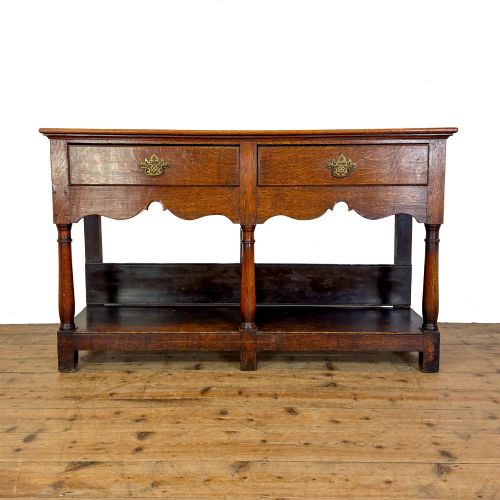


Welsh Oak Hall Table
These welsh oak hall table examples bring honest country craftsmanship and rich timber grain to an entrance.
Welsh Oak Hall Table
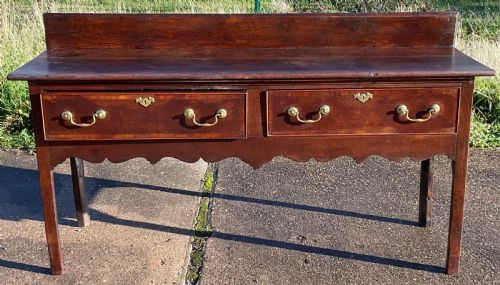
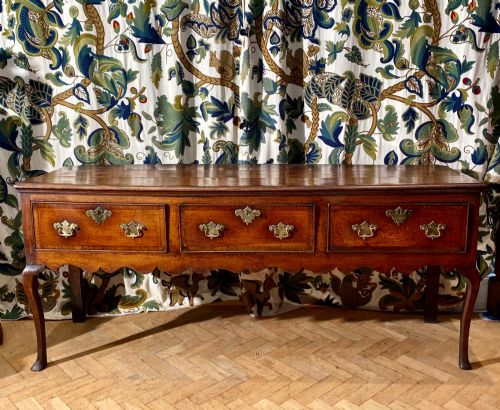
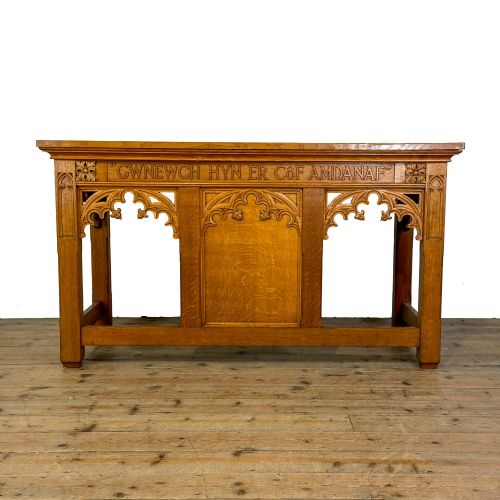
A welsh oak hall table usually takes the form of a side table, lowboy, or dresser base intended for utility and display in a country interior. You will encounter side tables and dresser bases dating from the seventeenth, eighteenth, and nineteenth centuries, often showing regional vernacular traits.
The proportions are generally shallow enough for narrow hallways or reception spaces, relying on sturdy timber construction rather than delicate ornamentation. Pieces span George II, Georgian Country, and Welsh Vernacular styles, reflecting the practical needs of rural households.
How they were made
Local craftsmen relied on solid oak for the primary structure, sometimes supplementing secondary parts with pine. Surfaces display the natural figure of the timber, worked with hand tools and pegged joinery.
Where brass hardware appears, it serves drawer pulls and handles, while occasional timber inlay adds modest decoration to the plain oak surfaces.
Welsh Oak Hall Table Retail Price Guide 2026
Typical asking prices for welsh oak hall table among the pieces listed under this phrase on Sellingantiques today, from the lower quarter to the upper quarter. They describe what is for sale here now, not the wider market.
What varies in quality
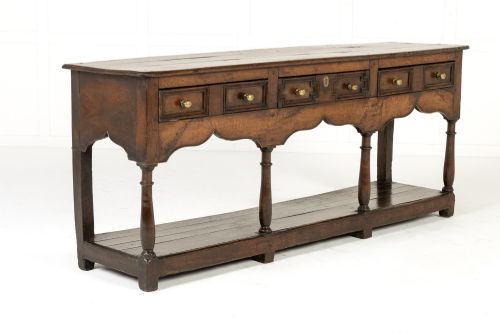
The integrity of the original timber and the retention of honest surface patination set superior examples apart from heavily restored or stripped items. Subtle details such as fretted aprons, turned legs, or open potboards indicate the care taken in the workshop.
Proportion and regional character dictate desirability, with early pieces demonstrating simpler, more robust construction methods than later Victorian interpretations.
The Welsh Oak Hall Table Glossary
- Lowboy
- A small side table or dressing table featuring one or more rows of drawers beneath the work surface. These compact forms suit hallway placement.
- Dresser base
- The lower section of a kitchen or dining dresser, functioning as a sideboard with cupboards and drawers. They provide substantial surface area and storage.
- Potboard
- An open lower shelf fitted between the legs of a dresser base or table, originally designed for storing pots and pans. It adds structural rigidity to the base.
- Vernacular
- Regional style and construction methods dictated by local traditions and available materials rather than metropolitan fashion. This approach defines much country furniture.
- Fretted apron
- A decorative wooden board beneath the table top, pierced or cut into geometric patterns. It softens the junction between the legs and the frame.
Welsh Oak Hall Table: Frequently Asked Questions
Where should I put a welsh oak hall table?
These tables fit naturally in entrance halls, corridors, or living spaces where a shallow profile is required. Their rustic character complements stone floors and neutral lime-washed walls.
Keep them away from direct heat sources and strong sunlight to protect the aged timber surface from drying out or splitting.
How do I care for antique oak furniture?
Maintain the surface with occasional applications of natural beeswax, buffing gently with a soft cloth to preserve the sheen. Avoid modern silicone polishes that build up and attract dust.
Control the room humidity to prevent the timber from expanding or contracting too severely across the seasonal changes.
What is the difference between a lowboy and a side table?
A lowboy specifically incorporates drawers beneath the top surface, functioning as a small desk or dressing piece. A side table may simply consist of a top supported by legs and aprons without drawers.
Both forms share similar shallow proportions that suit narrow circulation spaces in period properties.
How can I tell an eighteenth-century table from a later copy?
Examine the drawer construction for hand-cut dovetails and timber shrinkage that matches the age of the piece. Tool marks and peg construction reveal the manual methods of earlier country makers.
Later Victorian and revival interpretations often display different internal secondary woods and uniform machine finishing.