


Welsh Mountain Landscape Artwork
Welsh mountain landscape artwork captures rugged peaks and winding rivers of the region through nineteenth-century oils and watercolours, bringing historic British topography directly into your home.
Welsh Mountain Landscape Artwork
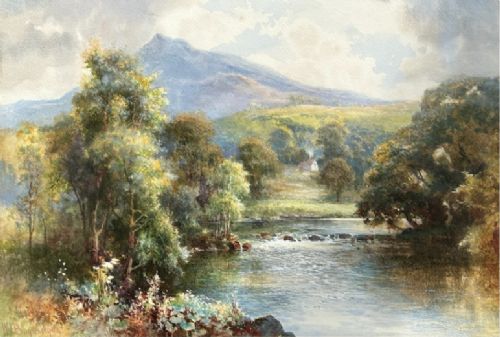
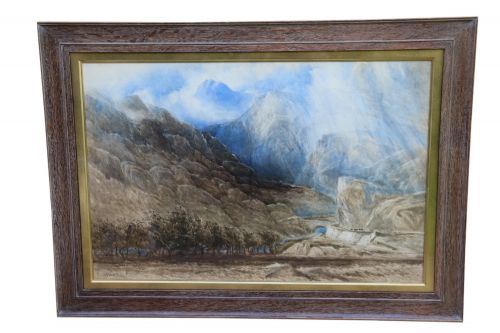
When you search for welsh mountain landscape artwork, you encounter nineteenth-century and early twentieth-century paintings depicting iconic locations such as Snowdon, the Conwy valley, and Betws-y-coed. These pieces primarily record the dramatic topography and pastoral scenes of North Wales during the Victorian and Edwardian periods.
The works available on this page span several decades from the 1870s to the 1920s, showing how artists captured changing light across rocky terrain and river valleys. You will find both watercolours on paper and substantial oil paintings on canvas, often housed in original giltwood or gesso frames.
Most compositions focus on recognisable Welsh landmarks like Moel Siabod, the Pass of Llanberis, and Dolgellau. These paintings offer a direct window into the traditional British landscape traditions favoured by Victorian realists and romantic painters.
Materials and execution
Artists working on welsh mountain landscape artwork relied principally on oil on canvas or watercolour applied to paper. Oil paintings allowed for rich textures and deep tonal ranges, particularly when depicting heavy skies and dark mountainous backdrops, while watercolours achieved a lighter, more translucent atmospheric effect.
Frames play an integral role in the presentation of these pieces, frequently constructed from oak or shaped wood finished with gesso and gilt. These ornate or simple wooden surrounds protect the paintings and reflect the framing conventions typical of the Victorian and Edwardian eras.
Common motifs across the inventory include river scenes, mountain passes, and farm workers in Welsh landscapes.
Distinctions in quality
The strength of a welsh mountain landscape artwork rests upon the artist's ability to render light and atmospheric depth across difficult terrain. Finer pieces demonstrate confident brushwork and precise topographical detail that immediately ground the viewer in specific Welsh locations like the Conwy river or Snowdonia.
Another measure of quality lies in the preservation of the medium and the retention of the original giltwood or gesso frame. Works that maintain vibrant pigments without excessive fading or restoration stand apart from more compromised examples.
William Joseph Boyes·Henry Martin Pope·Sidney Richard Percy·Thomas Spinks·Walter J Watson·J Barclay·William Henry Mander·Cornelius Pearson·Samuel Towers·Benjamin Williams Leader·Alfred de Breanski·James Poole·Henry Bright
The Welsh Mountain Landscape Artwork Glossary
- Giltwood
- Wood carved and coated with gold leaf or a gold-coloured finish. This material is standard for framing many nineteenth-century oil paintings.
- Gesso
- A plaster-like mixture applied to wood frames before gilding. It provides a smooth surface for intricate mouldings and decorative details.
- Watercolour
- A paint consisting of pigment suspended in a water-based solution, typically applied to paper. It was widely used by Victorian artists to capture rapid landscape sketches.
- Oil on Canvas
- Pigment mixed with drying oil applied to stretched fabric. This medium dominated nineteenth-century gallery painting for its durability and rich colour depth.
Welsh Mountain Landscape Artwork: Frequently Asked Questions
What periods do these paintings date from?
The pieces span the nineteenth and early twentieth centuries, with a strong concentration of Victorian and Edwardian works. Artists worked actively in these Welsh regions from the 1870s through the 1920s.
This era produced distinct landscape styles ranging from Victorian realism to romantic pastoral scenes.
Are the frames original to the artwork?
Many pieces retain their period frames constructed from giltwood, gesso, or oak. These surrounds reflect the framing styles popular during the Victorian and Edwardian periods.
Original frames enhance the historic character of the painting.
How should I care for a nineteenth-century watercolour?
Watercolours on paper require protection from direct sunlight to prevent fading of the delicate pigments. Displaying them away from moisture and extreme temperature fluctuations ensures longevity.
UV-filtering glass provides an extra layer of conservation security.