


Welsh Landscape Picture
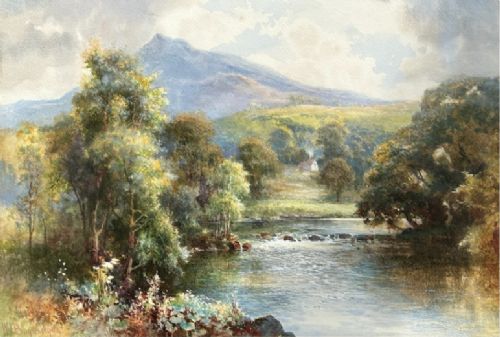
A welsh landscape picture captures the rugged mountains, rivers, and coastal valleys of Wales through nineteenth and twentieth-century painting.
Welsh Landscape Picture
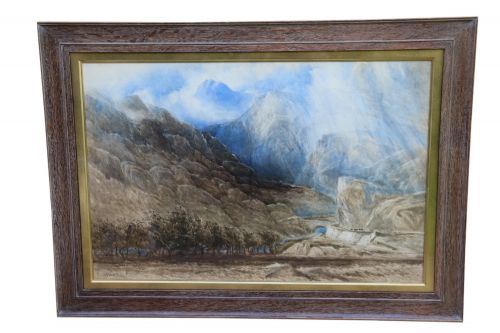
A welsh landscape picture typically portrays recognizable locations such as the River Llugwy, the pass of Llanberis, or Cardigan Bay, recorded by artists working across the nineteenth and twentieth centuries. These works range from modest waterpaintings on paper to larger oil paintings on canvas and wood panel.
The pieces appearing most frequently on this page combine Victorian pastoral traditions with topographical views, showing rural farmsteads, river valleys, and mountainous terrain. Painters of the period often inscribed specific Welsh place names directly onto the mount, canvas, or reverse of the work.
Examples span from mid-Victorian watercolours to mid-century British school oils, demonstrating how artistic interpretations of Welsh scenery evolved from precise topographical records into impressionistic treatments of light and weather.
Materials and execution
Artists employed watercolour on paper for portable field studies and finished compositions, frequently protecting them beneath glass within giltwood and gesso frames. These waterpaintings rely on the white of the paper to provide luminosity behind washes of pigment.
Oil paintings were executed primarily on stretched canvas or wood panels, allowing for heavier impasto and richer layering of colour to capture the damp atmosphere and heavy skies of North and South Wales.
At least one Victorian watercolour on this page records a pack of hounds at work, proving that Welsh sheepdogs were not the only animals earning their keep in the hills.
Evaluating the work
Quality in these paintings rests upon the artist's ability to render atmosphere and light accurately rather than on mere topographical detail. Stronger works command attention through confident brushwork and balanced composition, particularly in the handling of water, mountain mists, and changing skies.
The integration of original framing, often elaborate moulded gesso and giltwood, adds significantly to the character of a piece and indicates how the work was valued by its contemporary owners.
William Joseph Boyes·Henry Martin Pope·Hubert Wellington·Cornelius Pearson·Arthur Wardle·Walter J Watson·Harold Lawes·William Langley·Herbert Royle·John Cuthbert Salmon·William Henry Mander·Samuel Towers·Benjamin Williams Leader·Clarence Woodburn·David Bates·Carleton Grant·George Parson-Norman·Thomas Henry Thomas·Thomas Walmsley
The Welsh Landscape Picture Glossary
- Watercolour
- A painting method where fine pigment is suspended in a water-soluble binder, traditionally applied to paper sheets.
- Giltwood
- Timber carved and coated with a thin layer of gold leaf, commonly used for nineteenth-century picture frames.
- Gesso
- A plaster-like mixture applied to wooden frame mouldings as a smooth base before gilding.
- Impasto
- Paint applied thickly to a canvas or panel, leaving visible brush or palette knife marks that stand proud of the surface.
- Topographical
- Representing specific, identifiable physical locations accurately rather than composing an imaginary scene.
Welsh Landscape Picture: Frequently Asked Questions
How do I identify a Welsh location?
Many paintings include handwritten or printed inscriptions on the original mount, the reverse of the canvas, or within the composition itself naming rivers, passes, and bays.
Familiarity with prominent landmarks such as Snowdonia peaks, Conwy, or the Wye Valley often helps confirm the depicted region.
Are these paintings original works?
The selections shown here consist entirely of original hand-painted watercolours and oil paintings created by individual artists.
They are distinct from mass-produced prints or mechanical reproductions, carrying the unique brushwork and signature of the creator.
How should I frame and display them?
Watercolour paintings require protection behind glass and conservation-grade mounting to prevent fading from direct sunlight and moisture damage.
Oil paintings on canvas or wood panel are more resilient but benefit from stable indoor humidity away from direct heat sources.
What periods do these paintings cover?
The inventory spans the nineteenth and twentieth centuries, encompassing Victorian pastoral scenes, Edwardian views, and mid-century British school interpretations.
Dates are established through artist biographies, stylistic markers, and occasionally direct inscriptions left by the painter.