

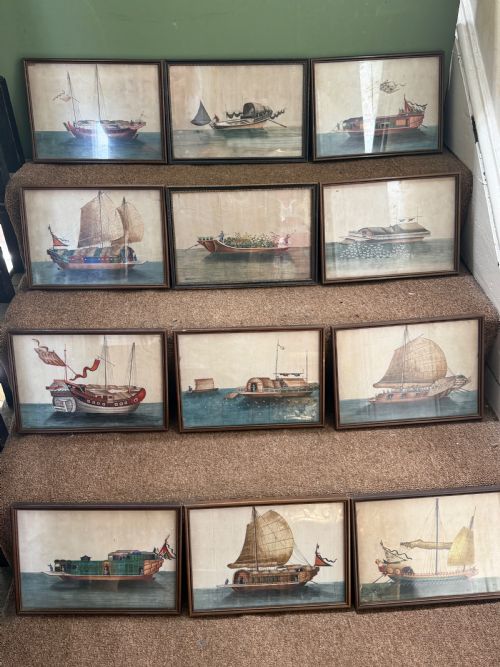
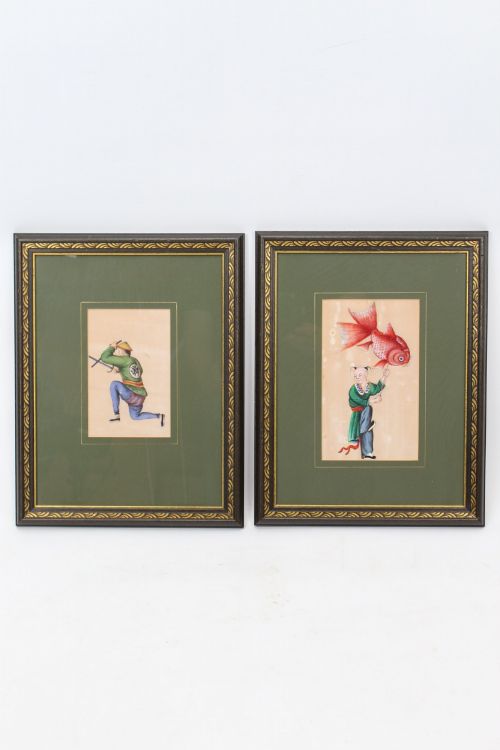


Watercolour on Pith
Watercolour on pith brings delicate botanical and figural studies straight from nineteenth-century export workshops into your home.
Watercolour on Pith
Watercolour on pith comprises traditional Chinese export paintings created across the eighteenth and nineteenth centuries, including the Regency and Edwardian eras. These delicate works frequently arrive framed behind glass in wood settings, preserving their fragile surfaces.
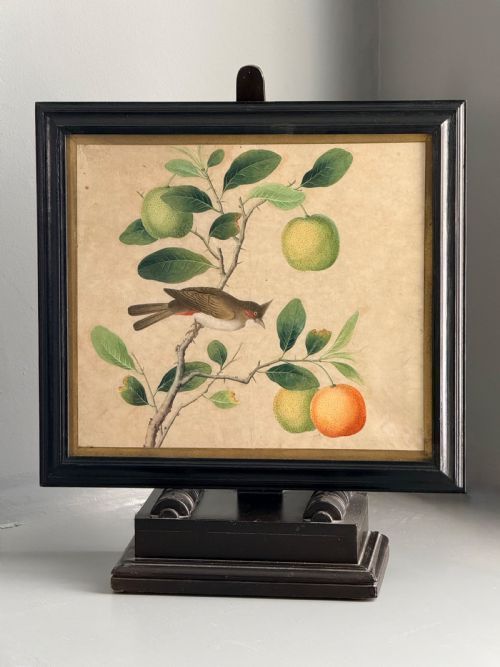
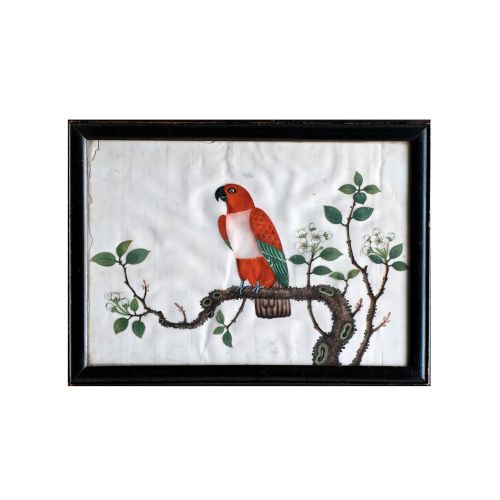
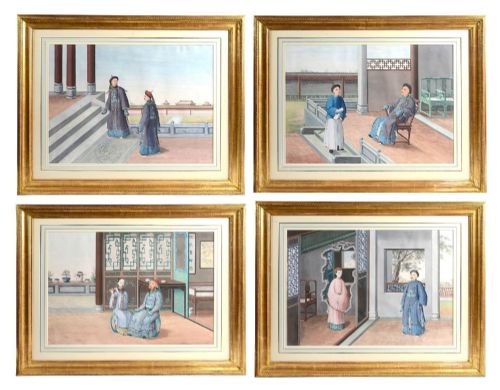
Subjects range widely across the listings, showing colourful parrots, butterflies, insects, and maritime junks. Buyers commonly encounter sets of multiple paintings, such as groups of twelve or twenty-one figural scenes.
Originating largely from Qing Dynasty export art and Chinese Canton studios, these pieces capture historic trades and native fauna with vivid pigments. The distinct material gives each framed artwork a luminous, velvety depth unlike standard paper.
Making watercolours on pith
Artists painted directly onto pith paper, often erroneously called rice paper, using gouache and watercolour pigments alongside ink. This spongy plant material absorbs water-based paints deeply, creating intense colour saturation without heavy brush textures.
Makers framed these delicate sheets using wood and glass to protect the fragile organic surface from moisture and physical damage. The resulting wall art combines traditional Chinese export painting techniques with period framing styles.
Watercolour on Pith Retail Price Guide 2026
Typical asking prices for watercolour on pith among the pieces listed under this phrase on Sellingantiques today, from the lower quarter to the upper quarter. They describe what is for sale here now, not the wider market.
Victorian buyers collected these delicate botanical scenes in albums, treating exotic insects and colourful parrots as portable windows to distant shores.
Quality differences in pith paintings
Superior examples display exceptional crispness in botanical and avian details, maintaining vibrant gouache pigments without flaking. Lesser pieces suffer from surface abrasion or faded inks that obscure the original hand-painted lines.
Completeness defines the appeal of sets, with matched groupings of twelve or twenty-one holding greater visual weight than isolated sheets. The precision of the brushwork distinguishes standard export souvenirs from finer workshop commissions.
The Watercolour on Pith Glossary
- Pith paper
- A delicate spongy material sliced from the pith of the Tetrapanax papyrifer plant, commonly used for Chinese export watercolours. It has a velvet-like texture that absorbs bright gouache pigments uniquely.
- Gouache
- An opaque water-based paint composed of pigment, water, and a binding agent such as gum arabic. It provides the dense, matte colour saturation seen across nineteenth-century export paintings.
- Chinese Export
- Artworks created in China specifically for Western markets during the Qing Dynasty and related historical periods. These pieces blend traditional Eastern techniques with subjects appealing to European buyers.
- Qing Dynasty
- The final imperial dynasty of China, spanning from the seventeenth to the early twentieth century. Many export paintings originate from the late stages of this era.
Watercolour on Pith: Frequently Asked Questions
What is pith paper?
Pith paper is a delicate, fibrous material harvested from the pith of a specific plant native to southern China. It possesses a spongy, absorbent texture that holds water-based pigments with remarkable velvet depth.
Historically misnamed as rice paper by Western traders, it requires careful framing behind glass to prevent physical degradation over time.
How should I display them?
These works demand placement away from direct sunlight to protect the fugitive gouache and watercolour pigments from fading. Keeping them behind glass in stable indoor humidity preserves the fragile pith support.
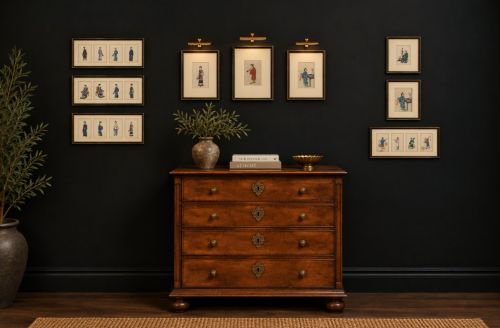
Group matched sets together on a wall to replicate the historical scale and visual impact of nineteenth-century export art displays.
Are these works Chinese export art?
Yes, these paintings formed a major part of the trade between China and the West during the eighteenth and nineteenth centuries. Canton workshops produced vast quantities of botanical, avian, and figural studies specifically for foreign merchants.
They offer a direct window into the cross-cultural exchange of the Qing Dynasty era.
Why do sets vary in size?
Export painters commonly produced works in structured series for bound albums or individual framing. Surviving sets often retain twelve or more related subjects, such as butterflies, ships, or figures.
Individual sheets appear on the market when original albums were dismantled by collectors or dealers over the decades.