


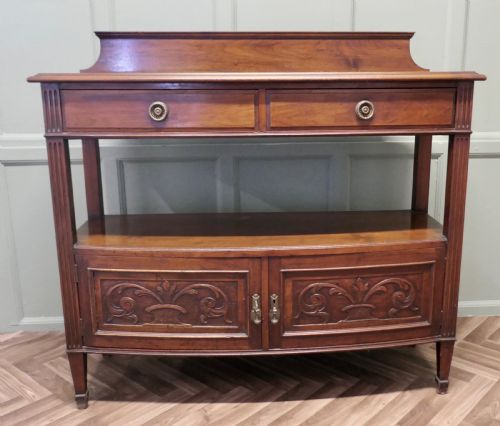
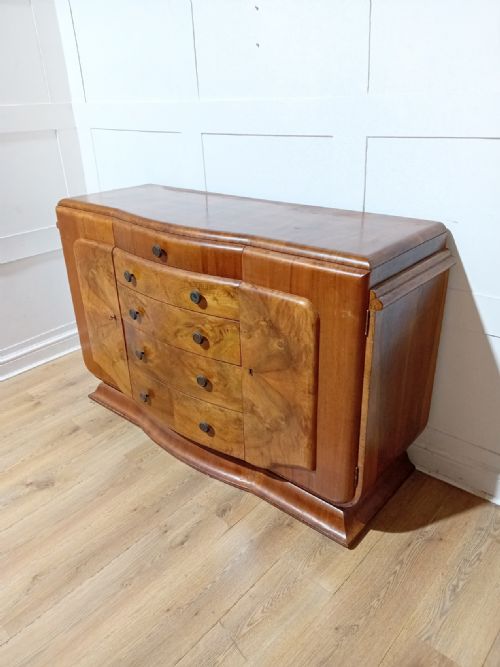

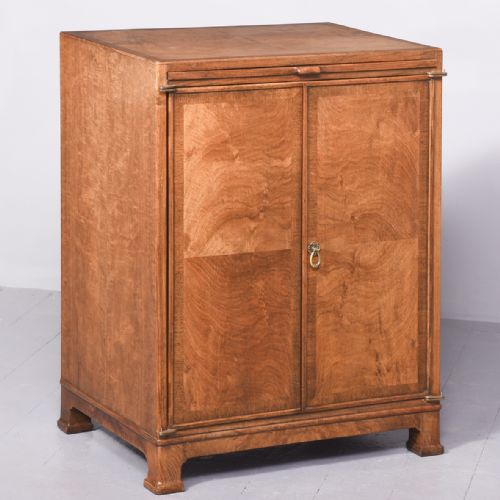


Warm Brown Walnut Sideboard
A warm brown walnut sideboard brings deep timber grain and generous storage to a room, ranging from 18th-century French provincial buffets to sleek 1930s Art Deco pieces.
Warm Brown Walnut Sideboard
When you search for a warm brown walnut sideboard, you encounter a varied selection of large dining room and living space furniture spanning several centuries. The forms include credenzas, side cabinets, commodes, and two-part dressers alongside traditional sideboards.
The material palette centres on walnut and burr walnut, sometimes enhanced by walnut veneer. These pieces emerge from 18th-century, 19th-century, Victorian, Edwardian, and 1920 to 1930 production periods.
Stylistically, the selection travels from French Provincial and Neoclassical to Arts and Crafts, Art Nouveau, and Art Deco. Pieces originate from British, French, Austrian, and Italian makers.
How they were made
Cabinet makers utilised solid timber and decorative burr walnut veneers applied over structural carcases to create rich figurative patterns on the front surfaces. Carved ornament appears on specific stylistic examples, while marquetry introduces intricate contrasting wood inlay.
Metal mounts in brass and ormolu furnish handles, keyplates, and decorative trims, particularly on continental commodes and credenzas. Glass doors feature on display cabinets and mirrored sections integrate into Edwardian mirror back sideboards.
Materials appearing across these pieces include solid walnut, burr walnut veneers, brass, ormolu, and glass.
What varies in quality
The calibre of a warm brown walnut sideboard rests upon the selection of the timber veneers and the precision of the cabinet work. Matched burr walnut figuring across large door surfaces requires exceptional skill from the maker.
The refinement of carved details, the quality of cast brass or ormolu mounts, and the integration of specialised elements like marquetry or mirrored backings distinguish exhibition quality work from standard production.
Hamptons of Pall Mall London·Pietro Ferrario·Whytock & Reid of Edinburgh
The Warm Brown Walnut Sideboard Glossary
- Burr walnut
- A figured wood grain obtained from the gnarled growth of a walnut tree, highly prized for its swirling patterns. It is sliced into thin veneers for cabinet fronts.
- Credenza
- A dining room storage piece or side cabinet, often low to the ground and enclosed by doors. 19th-century examples frequently incorporate glass panels and ormolu mounts.
- Commode
- A low French chest of drawers or cabinet with a finished top surface. 18th-century continental examples often display breakfront profiles and marquetry.
- Breakfront
- A piece of furniture whose central section projects forward from the flanking outer sections. This architectural arrangement creates depth and visual rhythm on large sideboards.
- Marquetry
- The art of applying thin pieces of wood veneer to a structure to form decorative patterns or pictures. It appears on early 20th-century sideboard designs.
Warm Brown Walnut Sideboard: Frequently Asked Questions
Where should I place a walnut sideboard?
These large storage pieces sit naturally in a dining room to hold tableware, or in a spacious hallway and living area. Their finished top surfaces provide an ideal display space for lamps, ceramics, or artwork.
Ensure you measure your wall space and allow adequate clearance for doors or drawers to open fully. Placing the timber away from direct heat sources protects the walnut grain over time.
How do I care for walnut timber?
Maintain the warm brown surface by dusting regularly with a soft, dry cloth. Avoid commercial silicone polishes, opting instead for traditional beeswax applied sparingly to nourish the wood.
Keep the piece out of direct sunlight to prevent the walnut from fading unevenly. Maintaining consistent room humidity prevents the timber and veneers from drying out.
What is the difference between a sideboard and a credenza?
While both serve dining and living spaces for storage, traditional sideboards often feature an arrangement of drawers flanked by cupboards. Credenzas historically lack legs or stand on very short feet, frequently featuring enclosed cabinet doors across the front.
Victorian credenzas sometimes incorporate curved glass side sections and elaborate ormolu mounts. Sideboards of the Edwardian era occasionally add upper mirror backs and display shelving.
How can I date an antique walnut sideboard?
Examine the construction methods, hardware, and stylistic vocabulary of the piece. 18th-century commodes and buffets display distinct regional continental joinery and proportions, while Victorian pieces often feature heavy timber mouldings.
Art Deco items from the 1920 and 1930 periods utilise streamlined geometric forms and dramatic burr veneers. Maker stamps or labels inside drawers also offer concrete evidence of origin.