
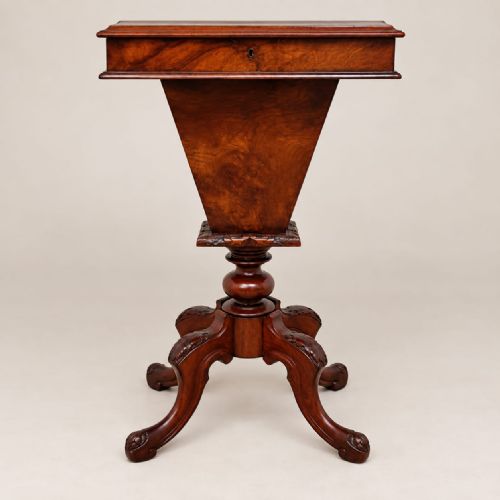


Walnut Work Table Well
A walnut work table well brings nineteenth-century craftsmanship into your home, offering ingenious hidden compartments for sewing and writing.
Walnut Work Table Well
A walnut work table well provides a dedicated surface with integrated storage beneath, designed during the nineteenth century for domestic crafts like sewing and writing. These pieces combine practical compartments with decorative timber finishes suitable for Victorian parlours.
You will most frequently encounter Victorian examples dating from the middle decades of the nineteenth century, often constructed from burr walnut with fitted interiors. These tables frequently double as occasional surfaces, games tables, or small writing desks.
How they were made
Cabinet makers utilised richly figured burr walnut veneers over solid timber carcasses to create striking patterned surfaces on the lids and tabletops. Marquetry and fruitwood inlay frequently embellish the main panels, showing meticulous hand-cutting and fitting.
Internal wells and compartments incorporate textile linings, sometimes paired with ceramic or brass fittings, whilst structural joints rely on traditional joinery. Folding mechanisms on game-combination versions allow the top to swivel and open over the storage cavity.
The listings exclusively feature Victorian pieces, predominantly utilising burr walnut combined with brass, ceramic, and textile elements.
What varies in quality
The refinement of the timber grain marks the distinction between ordinary pieces and superior examples, particularly in the selection of burr walnut veneers. Matching the grain symmetrically across the foldover tops demands exceptional skill from the cabinet maker.
The complexity of the interior fitments and the precision of any fruitwood inlay separate standard production items from truly ambitious work. Tables that successfully combine sewing storage with writing surfaces or game boards generally display higher execution standards.
The Walnut Work Table Well Glossary
- Burr walnut
- A prized timber harvested from walnut tree growths, featuring swirling, knotted grain patterns. It creates highly decorative veneer surfaces on Victorian furniture.
- Marquetry
- The art of applying small pieces of veneer to a structure to form decorative patterns or pictures. Craftsmen use various tinted woods and fruitwood inlay for contrast.
- Work table
- A nineteenth-century multi-functional piece incorporating a fabric bag, well, or box beneath the top for holding sewing materials. These items also serve as writing or occasional surfaces.
- Foldover games table
- A design featuring a hinged top that opens out to reveal a baize-lined playing surface. Beneath this top often lies a storage well for gaming pieces or sewing implements.
Walnut Work Table Well: Frequently Asked Questions
What is inside the well?
The well typically contains a fitted wooden compartment or a suspended fabric bag designed to hold sewing accessories, threads, and tools.
Many examples also include small subdivided trays and lids to keep delicate crafting items organised.
Can I use it as a desk?
Certain variations incorporate writing surfaces alongside the traditional sewing well, making them suitable for light correspondence.
Check the height and knee clearance before attempting regular daily desk work, as these tables were scaled for occasional parlour use.
How do I date these tables?
Most pieces originate from the Victorian era, spanning the mid to late nineteenth century, identified by timber choice and construction methods.
Burr walnut veneers and marquetry inlay became particularly fashionable during the eighteen-fifties and sixties.
Are they sturdy enough for daily use?
These tables were built to withstand active domestic service in nineteenth-century drawing rooms and parlours.
Their lightweight construction means they are best suited for gentle tasks like holding lamps or displaying decorative items.