

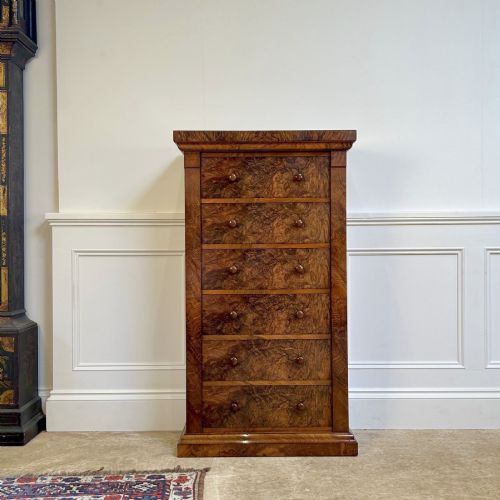


Walnut Locking Chest Drawers
These walnut locking chest drawers offer a secure and narrow vertical form, prized for keeping private papers safe.
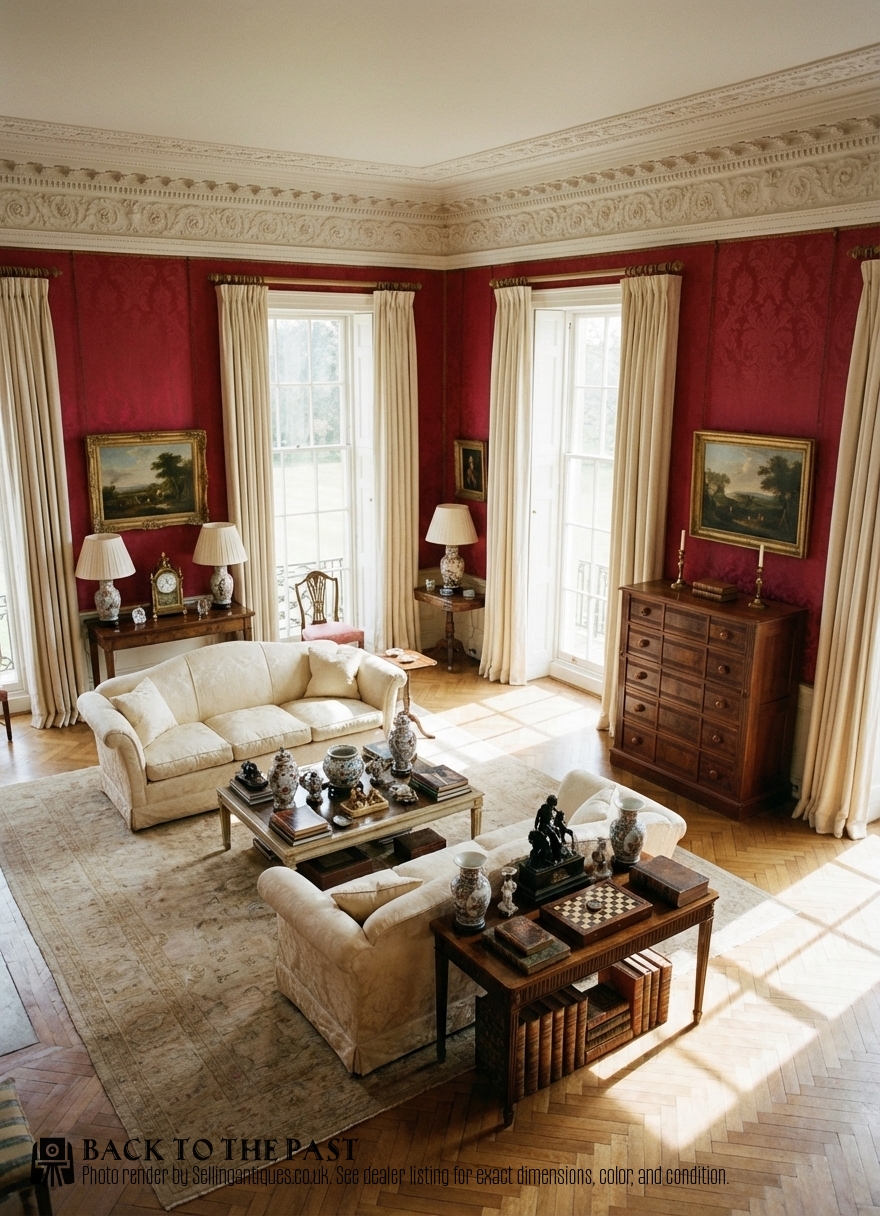
Walnut Locking Chest Drawers
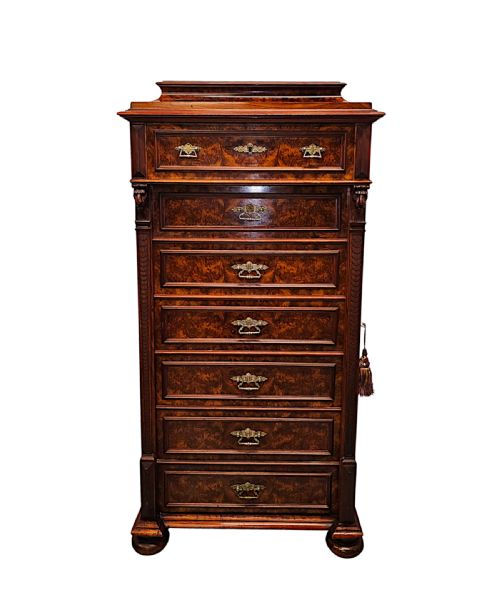
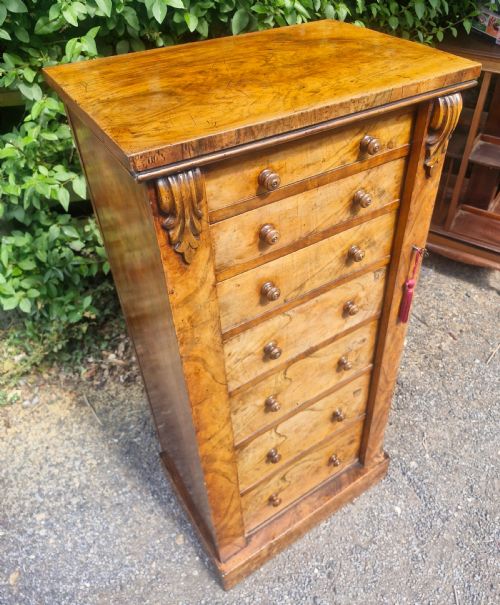
When searching for walnut locking chest drawers, collectors encounter tall vertical case pieces known primarily as Wellington chests. These items date predominantly from the nineteenth century and the Victorian period, featuring a distinctive single locking stile that secures all the drawers at once.
The format usually involves a narrow stack of several shallow drawers enclosed by a hinged right-hand pilaster. This locking mechanism often engages with a small key, safeguarding the contents within the timber framework.
Materials and construction methods
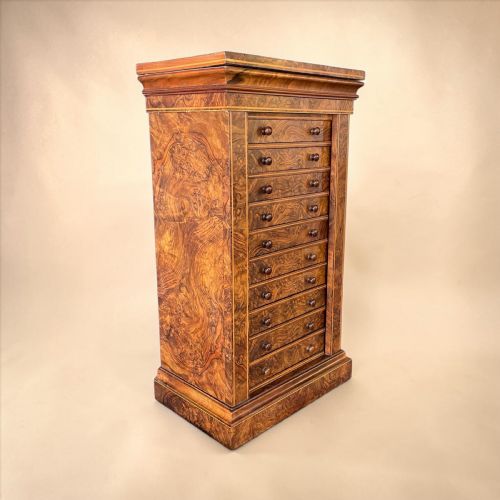
Cabinet makers utilised solid timber frameworks overlaid with figured walnut veneers, burr walnut, and occasional marquetry decoration. Secondary woods such as oak appear in the drawer linings, while brass fittings supply structural reinforcement and locking hardware.
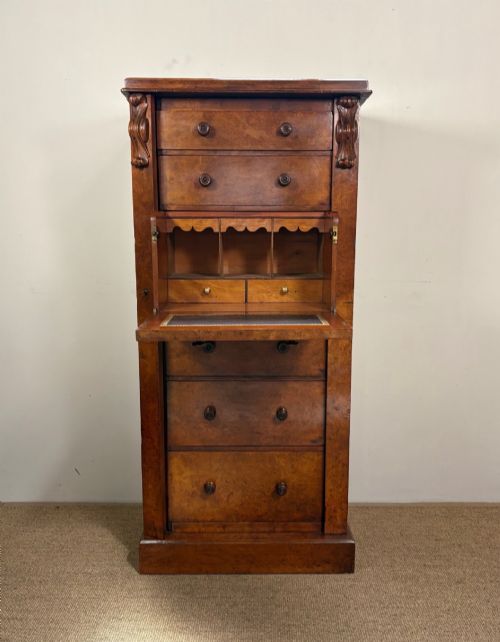
Surfaces frequently incorporate inset leather writing surfaces on secretaire variants or fine timber grains carefully matched across the drawer fronts. Construction relies on traditional joinery techniques suited to narrow proportions and heavy hardwood timber.
Walnut Locking Chest Drawers Retail Price Guide 2026
Typical asking prices for walnut locking chest drawers among the pieces listed under this phrase on Sellingantiques today, from the lower quarter to the upper quarter. They describe what is for sale here now, not the wider market.
Distinctions in craftsmanship
The hierarchy of quality rests on the choice of timber veneer figures, such as heavily marked burr walnut or intricate marquetry patterns. Finer examples display precise matching of grain across the entire front elevation rather than random timber selection.
Mechanisms also divide the standard examples from superior items, particularly sturdy locking stiles with smoothly operating brass locks and keys. Maker attribution through stamped signatures or paper labels adds further distinction to exceptional pieces.
Gillows of Lancaster·Holland & Sons·S. Mordan & Co
The Walnut Locking Chest Drawers Glossary
- Wellington chest
- A tall, narrow nineteenth-century chest of drawers featuring a locking pilaster bar down one side. This design secures every drawer simultaneously when the side piece is locked in place.
- Secretaire
- A desk drawer that folds down to reveal a writing surface and small internal compartments. It transforms a standard chest into a compact bureau.
- Burr walnut
- A prized timber harvested from walnut tree growths that produces swirling, highly decorative grain patterns. Cabinet makers used veneers of this wood on primary display surfaces.
- Pilaster
- A vertical architectural member applied to the front frame of the cabinet. On these chests, the right pilaster acts as the locking bar that holds the drawers shut.
- Marquetry
- Inlaid patterns formed by fitting small pieces of different veneers into a background panel. This technique creates pictorial or geometric designs on the top and drawer fronts.
Walnut Locking Chest Drawers: Frequently Asked Questions
What is a Wellington chest?
A Wellington chest is a tall, narrow set of drawers characterised by a hinged locking stile on the right side. This wooden bar fastens over the drawer edges and locks with a key.
Cabinet makers designed these vertical pieces during the nineteenth century to save floor space while offering secure storage for papers and valuables.
How does the locking mechanism work?
The mechanism relies on a vertical locking pilaster attached by hinges to one side of the carcass. When closed and locked with a key, a flange on the inside of this bar catches the edge of every drawer.
This prevents any single drawer from opening unless the main side bar is unlocked and swung clear of the drawer stacks.
Were these chests used as desks?
Certain variations include a secretaire drawer fitted with a drop-front writing flap and small pigeonholes inside. This middle section allows the piece to function as a compact writing desk.
When closed, the secretaire drawer locks securely behind the main pilaster bar just like the standard drawers above and below it.
What woods appear on these chests?
The primary visible surfaces feature walnut, burr walnut veneers, and decorative marquetry patterns. Secondary timbers such as oak provide sturdy framing and internal drawer construction.
Brass hardware and leather inserts also appear on specific filing or writing variants from the Victorian era.