






Walnut King Bed Frame
A walnut king bed frame brings generous proportions and rich timber grain to a bedroom, drawing on nineteenth and early twentieth century French and Italian designs.
Walnut King Bed Frame
When searching for a walnut king bed frame, buyers encounter large wooden bedsteads spanning from the late nineteenth century into the 1930s. The selection on this page leans heavily towards continental European craftsmanship, particularly French styles such as Louis XV, Louis XVI, Rococo Revival, and Neoclassical, alongside later Art Deco examples.
Most pieces take the form of substantial wooden bedsteads or complete bedroom suites that include matching bedside cabinets and marble top nightstands. Dating predominantly from the 1800s and early decades of the twentieth century, these frames accommodate standard modern king dimensions while retaining period carvings, upholstery, and panel construction.
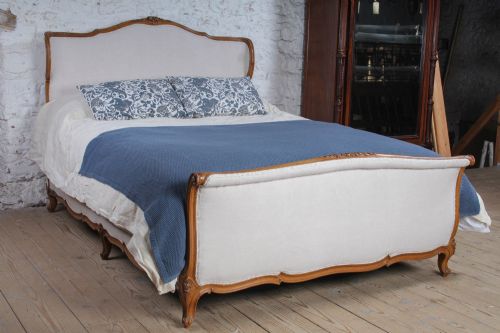
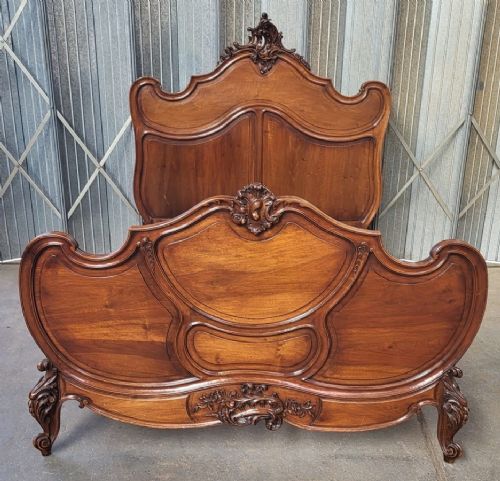
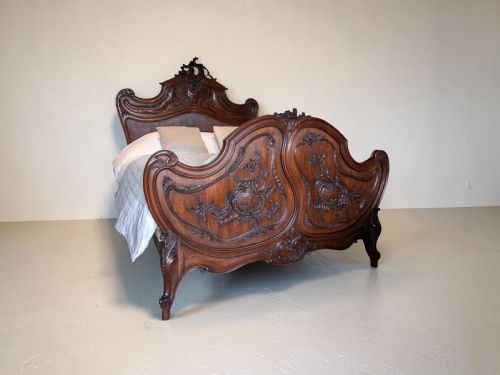
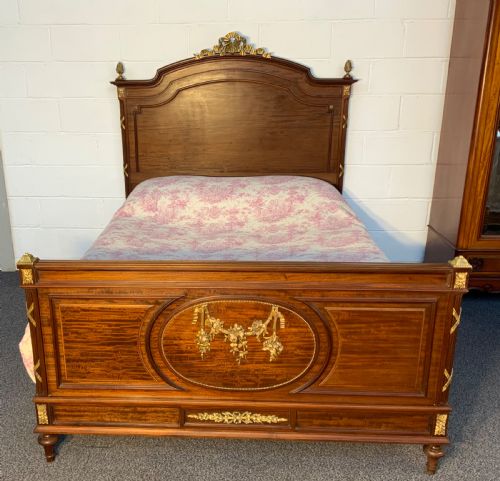
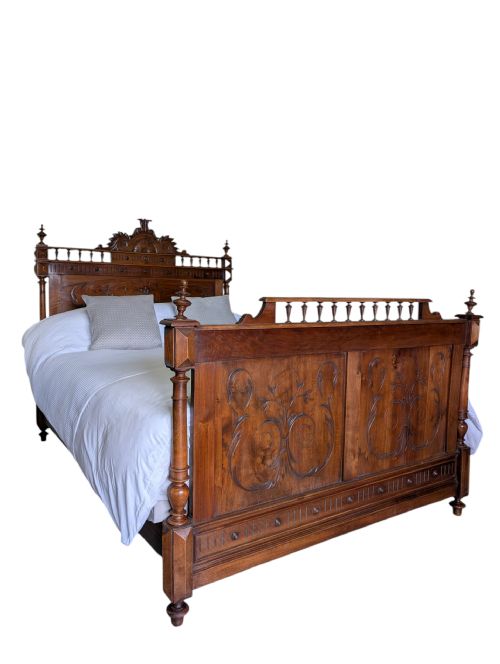
Originating largely from French workshops and Italian makers, these beds combine robust timber frames with decorative detailing such as brass and ormolu mounts. The forms range from ornate, heavily carved chateau beds to clean-lined, figured walnut pieces from the Art Deco era.
How they were made
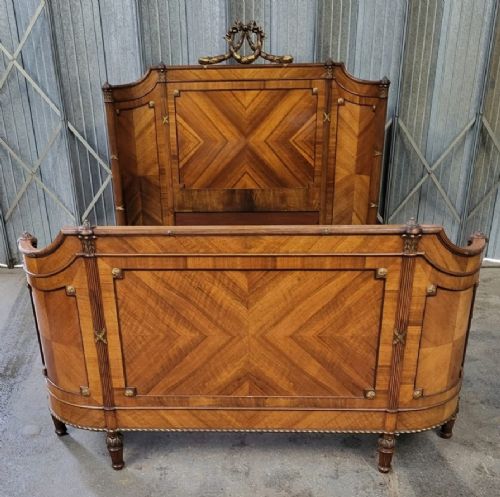
Makers constructed these bed frames using solid timber and decorative veneers, applying quarter veneering and figured walnut to create striking grain patterns across the headboards and footboards. Woodworking techniques of the period relied on sturdy internal framing combined with precise hand carving for floral and scroll motifs.
Metal components played a key role in the assembly and ornamentation, incorporating cast brass and ormolu detailing to accent the wooden structures. Upholstered sections utilised traditional padding and fabric covering methods suited to the Victorian and Edwardian periods.
The listings span the nineteenth and twentieth centuries, incorporating materials like walnut, mahogany, brass, ormolu, and burr walnut across French and Italian designs.
What varies in quality
The distinction between standard production and exceptional craftsmanship lies in the depth and crispness of the hand carving on the walnut timber. Superior pieces display intricate, well-defined motifs rather than shallow or mechanical milling.
Quality also rests in the selection of the wood itself, where highly figured walnut, burr walnut, and matched quarter veneers demonstrate superior material selection by the maker. The integration of original brass or ormolu mounts further elevates a piece above simpler timber constructions.
The Walnut King Bed Frame Glossary
- Quarter veneered
- Wood veneer slices arranged so that the grain patterns mirror each other across a central seam. This technique creates symmetrical and decorative geometric patterns on large flat surfaces.
- Ormolu
- Gilt bronze ornamentation applied to furniture for decorative effect. It provides a bright metallic contrast against dark walnut timber.
- Burr walnut
- Timber taken from a growth deformation on a walnut tree, yielding swirling, highly complex grain patterns. It is typically reserved for high-end decorative panels.
- Louis XV style
- A revival design characterised by asymmetrical curves, cabriole legs, and naturalistic carved foliage. It heavily influences many nineteenth-century French bed frames.
- Bedstead
- A framework of a bed designed to support the mattress and base without necessarily including bedding components. These structures form the architectural core of period sleeping furniture.
Walnut King Bed Frame: Frequently Asked Questions
What mattress size fits these beds?
These frames correspond to standard king and five-foot double dimensions seen across the listings. They accommodate modern mattresses while maintaining their historical proportions.
Buyers should verify internal slat measurements to ensure a snug fit for contemporary bases.
Do these beds come with bedside cabinets?
Certain listings include matching bedside cabinets or marble top nightstands as part of a larger bedroom suite. These coordinated pieces share the same walnut timber and carving style.
Individual bed frames are also common, standing alone without accompanying furniture.
How do I identify a French style bed?
French style beds feature distinct characteristics such as carved wooden scrolls, cabriole legs, and symmetry associated with Louis XV or Neoclassical designs. The use of walnut and quarter veneers is typical of these continental workshops.
Details like brass mounts and upholstered panels further point to nineteenth-century French manufacture.
Are these beds easy to assemble?
Period bed frames utilise traditional bolt-together side rails and heavy wooden head and footboards. Professional delivery and assembly are recommended due to the sheer weight of the solid timber.
Care must be taken with antique joints and decorative carvings during placement.
What is Art Deco walnut?
Art Deco walnut pieces from the 1920s and 1930s favour geometric lines and highly figured grain over traditional floral carvings. These beds showcase streamlined forms alongside symmetrical burr walnut panels.
Such designs represent a distinct shift away from nineteenth-century revival styles.