


Matching Walnut Bedside Cabinets
Matching walnut bedside cabinets bring warmth and symmetry to a bedroom, combining practical bedside storage with rich timber figure.
Matching Walnut Bedside Cabinets
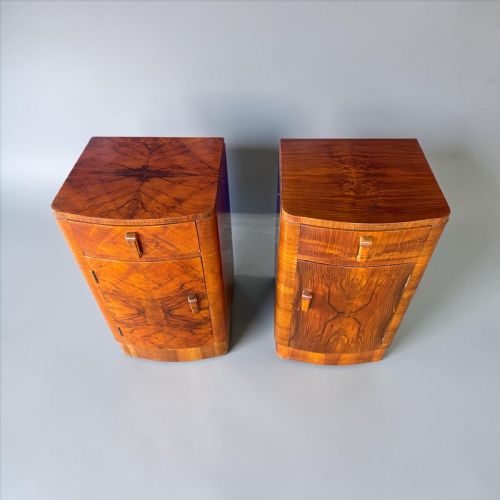
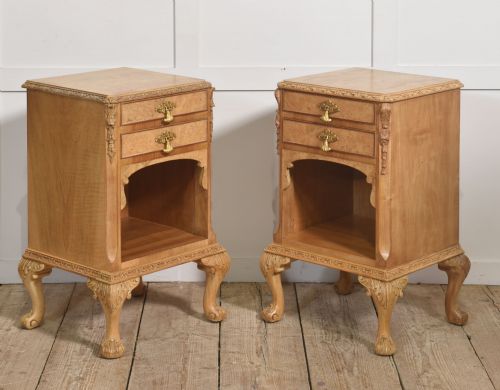
Matching walnut bedside cabinets unite functional night storage with balanced design, most frequently appearing as pairs designed to sit symmetrically on either side of a bed. When you search for matching walnut bedside cabinets, you encounter forms that range from compact night stands to drum-shaped cabinets and components of larger bedroom suites.
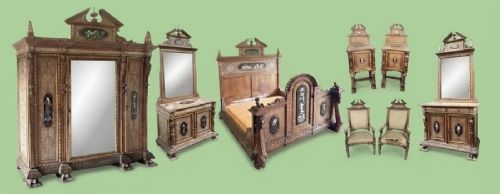
The selections span distinct periods, with Art Deco examples from nineteen thirty dominating alongside Victorian and Edwardian pieces dating back to eighteen sixty. French Rococo Revival and Italian designs also emerge, often featuring as part of larger suites that include matching beds.
Cabinets frequently incorporate matching grain patterns across the pair, utilising the natural figure of the wood to create visual harmony. Whether housing a single door or open shelving, these pieces serve as both practical bedside surfaces and decorative focal points.
How they were made
Craftsmen built these cabinets primarily using solid wood and wood veneer, frequently selecting burr walnut to display intricate, swirling grain patterns across the primary surfaces. Cabinetmakers applied thin veneers over stable secondary woods to achieve striking symmetrical patterns on drawer fronts and doors.
Hardware details typically include brass fixtures, whilst select pieces incorporate bevelled glass panels in doors or surfaces. Carved ornamentation appears on Victorian and French Rococo Revival pieces, contrasting with the clean, geometric lines characteristic of Art Deco design.
Some Art Deco pieces utilise bleached blonde walnut, proving that twentieth-century designers enjoyed a lighter palette just as much as deep Victorian tones.
What varies in quality
The articulation of the wood figure largely determines the distinction between standard and superior pieces, particularly in the selection of burr walnut veneer. Master cabinetmakers aligned the grain symmetrically across a pair, ensuring that the natural patterns mirror each other from one cabinet to the other.
Construction methods and hardware integration separate fine examples from routine production. Original brass fittings, precise door alignment, and the crispness of carved or moulded details reflect the skill invested during manufacture.
Waring and Gillow
The Matching Walnut Bedside Cabinets Glossary
- Burr walnut
- A specialised timber cut from growths on walnut trees that yields intricate, swirling grain patterns. Cabinetmakers prize this material for decorative veneer work on prominent surfaces.
- Art Deco
- A design style prevalent during the nineteen twenties and nineteen thirties characterised by sleek geometric shapes and streamlined forms. Pieces from this era often feature curved silhouettes and matching wood veneers.
- Bedside cabinet
- A small enclosed piece of furniture designed to stand next to a bed for storing personal items. These units typically feature a door or drawers, distinguishing them from open bedside tables.
- Veneer
- A thin layer of superior wood applied over a base timber to provide an ornamental surface. This technique allows makers to display striking grain figures without relying entirely on solid scarce woods.
- Rococo Revival
- A nineteenth century revival style inspired by French eighteenth century design, marked by asymmetrical curves and organic motifs. Cabinets in this style often incorporate elaborate carving and shaped panels.
Matching Walnut Bedside Cabinets: Frequently Asked Questions
What periods do these cabinets come from?
The pieces span from the mid-nineteenth century through the Edwardian era and into the nineteen thirties. Art Deco examples from nineteen thirty appear most frequently in the current selection.
Earlier Victorian pieces from eighteen sixty and eighteen eighty bring heavier carved details, whilst later Art Deco designs favour smooth, geometric veneered surfaces.
Are these cabinets always sold as pairs?
Most listings feature matching pairs designed to sit symmetrically on either side of a bed. This pairing creates a balanced look across the bedroom suite.
Occasionally, cabinets form part of a larger bedroom suite that includes a matching bed and dressing furniture.
How do I maintain walnut veneer?
Walnut veneer benefits from regular dusting with a soft, dry cloth to prevent the accumulation of abrasive particles. Keeping pieces away from direct sunlight and excessive heat sources protects the timber and finish.
Applying a quality furniture wax periodically helps nourish the wood and maintain its natural lustre without sealing the surface.
What is the difference between a cabinet and a table?
Bedside cabinets feature enclosed storage such as a door or drawers to keep items concealed. Bedside tables often provide open shelf space or simple flat surfaces without doors.
Both forms serve the same bedside function, but cabinets offer greater privacy for stored belongings.