
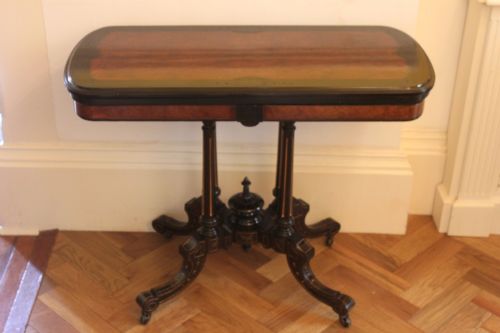
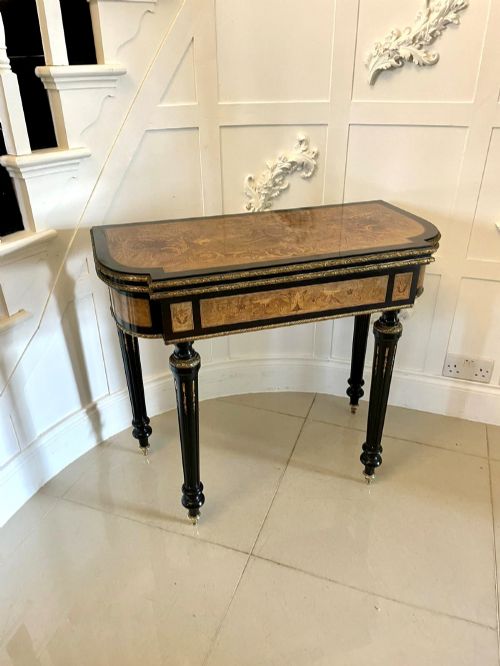
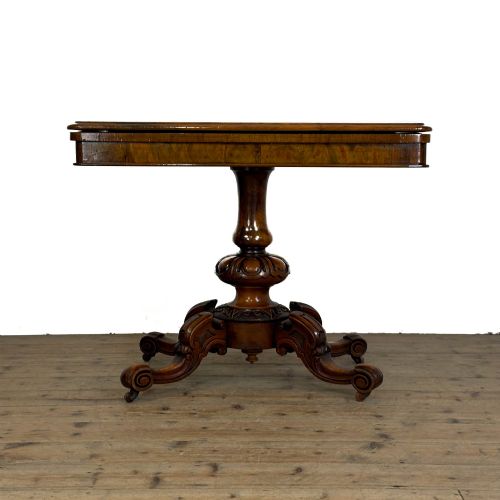
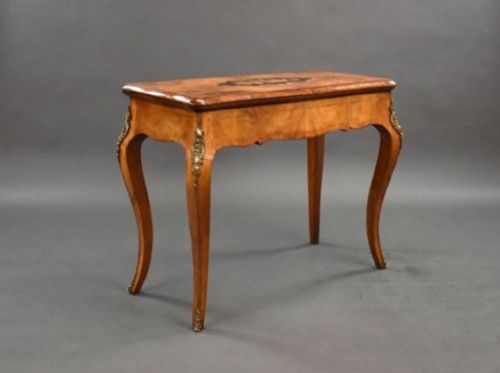




Walnut Foldover Games Table
A walnut foldover games table is a piece of social history that opens to reveal a green baize playing surface for card evenings.
Walnut Foldover Games Table
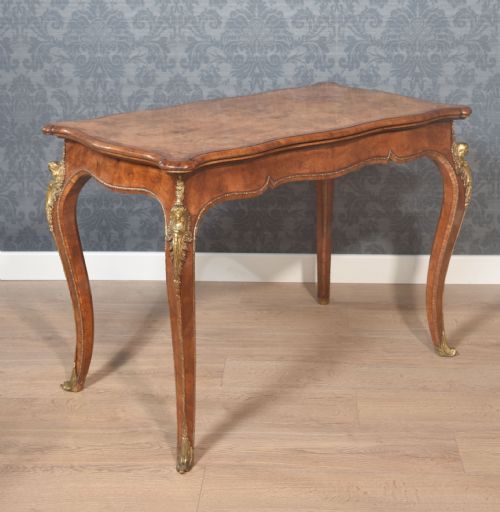
A walnut foldover games table is a dual-purpose item of furniture designed for leisure and parlour entertainment in period homes. The form centres on a hinged top that swings or rotates to double the surface area when guests arrive for cards, chess, or draughts.
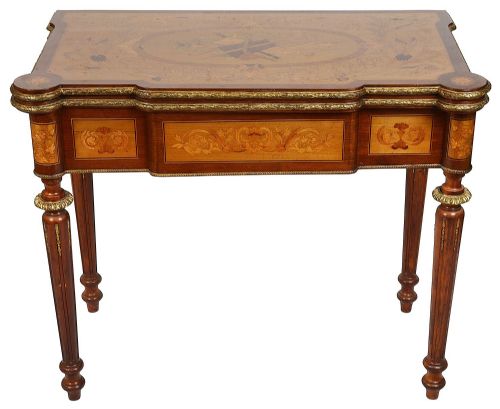
Most examples you encounter on this page date from the Victorian era, spanning burr walnut card tables with serpentine edges and marquetry inlay. Alongside these nineteenth-century pieces, you will discover eighteenth-century Dutch baroque models and later revivals inspired by Queen Anne designs.
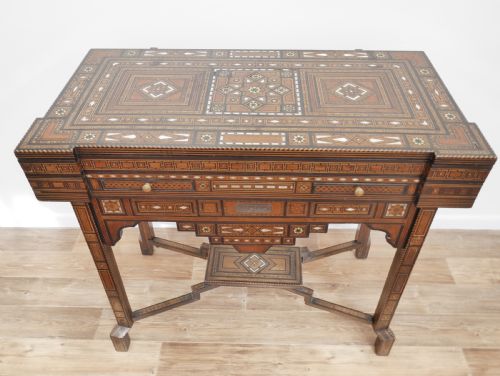
The woods utilised range from figured walnut and burr veneers to fruitwood accents, often complemented by boxwood inlay or ormolu mounts. Certain specialist variations incorporate chess and draughts boards directly into the playing surface or feature demi-lune folding configurations and butterfly shapes.
What varies in quality
Quality in a walnut foldover games table rests primarily on the depth of figure in the walnut veneer and the crispness of the marquetry inlay. Superior examples display a consistent, rich grain across the entire folding top rather than mismatched sections of timber.
The engineering of the pivot or folding mechanism dictates the daily usability of the table, separating master workshops from standard production. Cabinetwork involving complex serpentine shapes or hand-cut boxwood inlay demonstrates a higher tier of craftsmanship than plain veneered surfaces.
Listings feature walnut, burr walnut, fruitwood, and ormolu materials across Victorian, eighteenth-century, and Queen Anne styles.
Edwards & Roberts·S&H Jewell
The Walnut Foldover Games Table Glossary
- Burr walnut
- A prized timber harvested from walnut tree growths, producing dense, swirling grain patterns that catch the light. It was widely utilised on high-end Victorian card tables.
- Marquetry inlay
- A decorative technique where small pieces of contrasting wood, such as fruitwood and boxwood, are fitted into the veneer to create floral or geometric motifs. This ornamentation defines many nineteenth-century games tables.
- Serpentine
- A curved edge design featuring a convex centre flanked by concave sweeps, typical of finer Victorian cabinetwork. It adds fluid movement to the silhouette of a folding table.
- Demi-lune
- A half-moon shape characteristic of certain folding card tables designed to sit flush against a wall when closed. The straight edge forms the back while the curved section swings open.
- Baize
- A coarse woollen fabric, traditionally green, used to line the interior playing surface of card tables. It provides a soft, non-slip texture for dealing cards.
Walnut Foldover Games Table: Frequently Asked Questions
What are walnut foldover games tables?
These are dual-purpose pieces of furniture featuring a hinged or rotating top that opens from a compact console into a full-sized playing surface.
They were designed for parlour games and card evenings in domestic interiors, combining decorative cabinetry with practical utility.
How do you use a foldover table?
You lift and rotate or fold the top section over its base to reveal a baize-lined playing surface, often supported by a swing leg or a gateleg frame.
When not in use, the table folds back down to occupy minimal space against a wall or in a corner.
How do I identify a Victorian games table?
Victorian examples typically feature rich burr walnut veneers, serpentine edges, and sometimes elaborate marquetry inlay or boxwood stringing.
Many incorporate clever pivoting mechanisms and specific details like chess and draughts boards integrated into the playing surface.
How do I care for antique walnut?
Keep the wood away from direct sunlight and sudden temperature changes to prevent the delicate burr walnut veneers from drying out or cracking.
Apply a traditional wax polish occasionally and buff gently with a soft cloth to maintain the lustre of the timber.