


Walnut Floor Standing Mirror
A walnut floor standing mirror brings warmth and practicality to a room, offering full-length reflection framed in rich timber.
Walnut Floor Standing Mirror
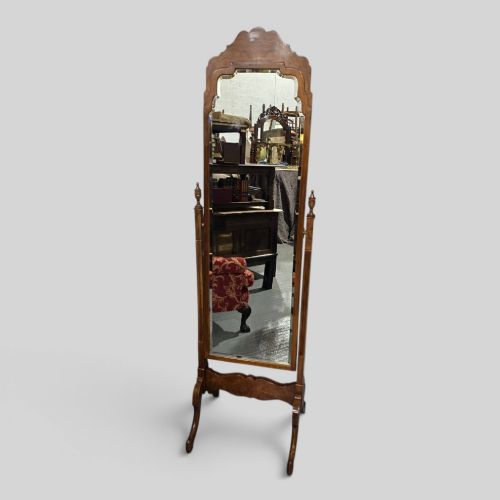
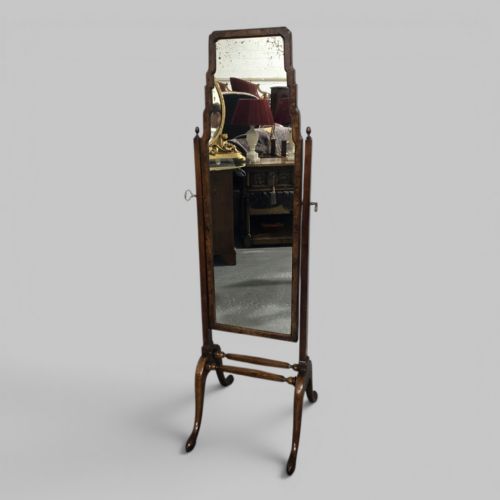
A walnut floor standing mirror is typically encountered as a cheval glass, designed to tilt within a stable frame for dressing.
The selections span distinct periods including the Victorian era, the Regency period, and the nineteen-twenties and thirties.
Many examples draw on earlier design traditions, featuring Queen Anne style elements alongside Louis XV curves and Georgian revival forms.
How They Were Made
Cabinet makers utilised solid walnut and decorative burr walnut veneers over secondary timbers to achieve rich grain patterns on the main frame.
Mirrors incorporated hinged side pivots, often with brass mounts, allowing the glass frame to tilt smoothly forward and back.
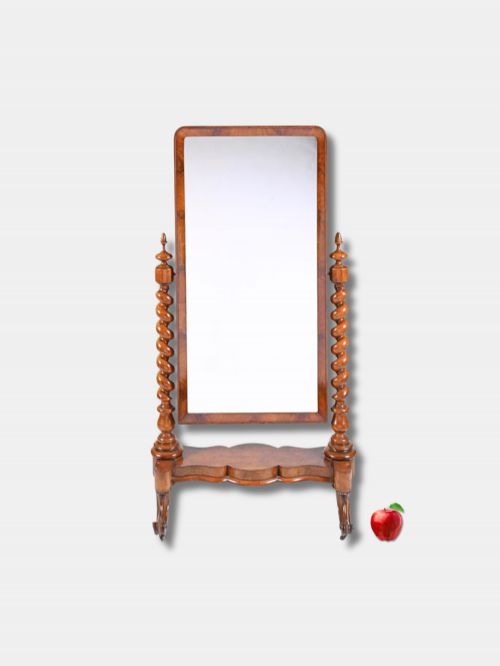
Structural details range from barley twist uprights to supportive floor stands and gilded bronze or giltwood accents.
Current listings feature walnut and burr walnut across periods from the nineteenth century through the nineteen-thirties.
What Varies in Quality
The choice of timber creates a distinct visual hierarchy, where striking burr walnut veneer elevates an ordinary frame into a showpiece.
The refinement of the carving and the presence of decorative details like gilded bronze distinguish standard production from exhibition pieces.
The Walnut Floor Standing Mirror Glossary
- Cheval mirror
- A large floor-standing mirror suspended on a frame with vertical pivots. This allows the glass to swing freely to different angles.
- Burr walnut
- A specific timber cut from the abnormal growth of a walnut tree, prized for its swirling grain patterns. It provides a highly decorative surface for furniture panels.
- Barley twist
- A carved spiral column resembling the shape of twisted barley sugar. It appears frequently as a support on Victorian stands.
- Gilt bronze
- Metal cast and coated with a thin layer of gold, used for decorative mounts and fittings. It adds metallic contrast to the dark timber.
Walnut Floor Standing Mirror: Frequently Asked Questions
How do I place a floor standing mirror?
These mirrors require a stable floor space and sufficient clearance to tilt the glass frame without hitting adjacent furniture.
Position the piece near natural light sources to brighten darker corners of a bedroom or dressing room.
What is a cheval mirror?
A cheval mirror is a full-length glass plate mounted in a frame that stands directly on the floor.
Pivoting pins on the side uprights let the user adjust the tilt of the mirror.
How do I identify a Victorian mirror?
Victorian examples often feature distinctive turned supports, such as barley twists, reflecting the revival tastes of the nineteenth century.
Heavier proportions and specific timber choices also help separate these pieces from later twentieth-century interpretations.
Are Art Deco mirrors different?
Art Deco versions lean towards streamlined geometry and simpler framing, stepping away from ornate revival styles.
They frequently originated in commercial or domestic dressing spaces of the early twentieth century.