

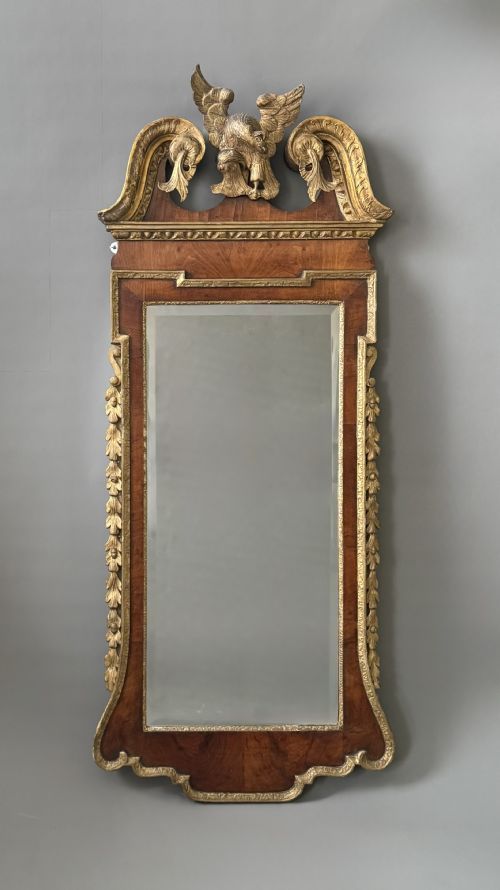


Walnut Eagle Carving
A walnut eagle carving brings the sharp focus of a bird of prey into domestic woodwork, combining deep timber grain with forceful avian form.
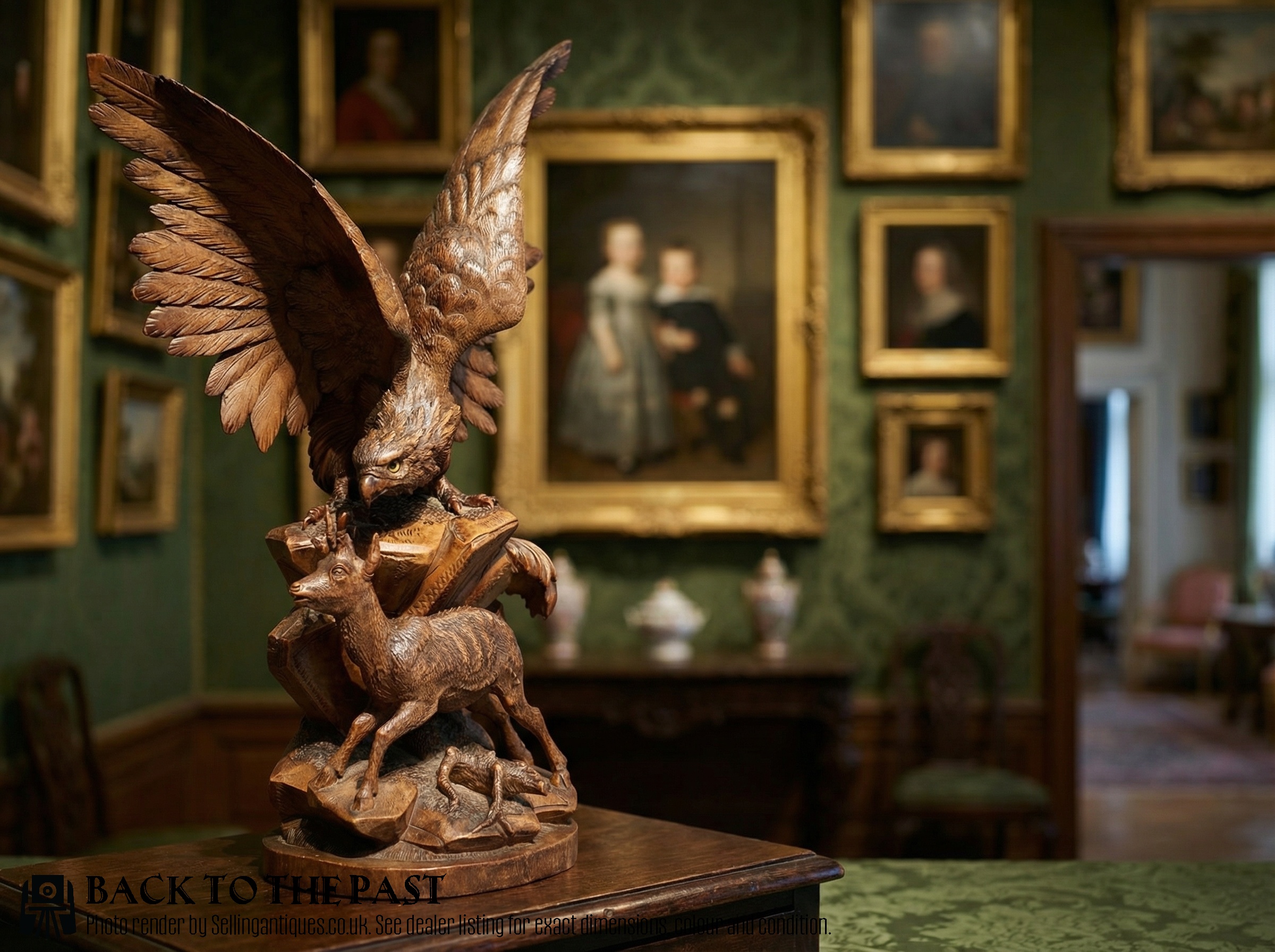
Walnut Eagle Carving
A walnut eagle carving appears most frequently across this selection as a wall mirror, a console table support, a wall clock, or a standalone sculpture. These pieces span the sixteenth century through to the early twentieth century, drawing on Georgian, Victorian, and Black Forest traditions.
The George II and George III revivals dominate the mirror and seating forms, whilst Black Forest makers excel at naturalistic bird sculptures. Walnut provides a rich, dark foundation for these powerful avian motifs, often accented with parcel gilt or combined with glass and brass.
Buyers encounter everything from large Baroque console tables supported by eagles to intricate wall clocks and detailed free-standing birds of prey. Each piece demonstrates how historical makers channelled the authority of the eagle into functional furniture and decorative art.
Assessing quality in carved walnut
Quality rests entirely in the crispness of the hand-carving and the anatomical conviction of the bird. Superior carvers define individual feathers and muscular tension in the talons, whereas lesser examples soften into vague, rounded wooden masses.
The choice of walnut timber also dictates the visual success of the piece, with well-figured grain adding depth to the polished surface. Furthermore, the integration of the eagle motif into the broader form - whether a mirror frame or a console table - separates pedestrian joinery from masterwork sculpture.
Walnut Eagle Carving Retail Price Guide 2026
Typical asking prices for walnut eagle carving among the pieces listed under this phrase on Sellingantiques today, from the lower quarter to the upper quarter. They describe what is for sale here now, not the wider market.
Eagles carved in the nineteenth century occasionally possess remarkably human expressions, as carvers projected their own moods onto the birds.
Luigi Frullini
The Walnut Eagle Carving Glossary
- Parcel gilt
- Woodwork decorated with applied partial gold leaf over portions of the carved surface. This technique highlights specific details like wings or beak tips against the dark walnut ground.
- Black Forest
- A nineteenth-century regional style known for hyper-realistic animal and bird carvings in walnut and linden wood. These pieces celebrate naturalism and deep sculptural relief.
- Vauxhall mirror
- An early type of British looking glass featuring bevelled edges and high-clarity glass set within a walnut or gilt frame. They represent a high standard of domestic mirror production.
- Console table
- A wall-mounted or freestanding table supported by decorative brackets, pedestals, or carved figures. In this context, eagles frequently form the structural support legs.
- Fretwork
- Thin wood panels cut through with decorative scroll patterns using a fretsaw. It appears on eighteenth-century and revival mirror frames.
Walnut Eagle Carving: Frequently Asked Questions
How do I identify a Black Forest walnut eagle?
Black Forest carvings distinguish themselves through intense naturalism, showing deep, feathered texture and lifelike poses that capture birds of prey in action. The walnut timber is typically finished to a rich, dark matte or satin sheen rather than a bright gloss.
These pieces focus purely on the sculpture of the animal itself, often independent of furniture function, though occasionally forming brackets or clock cases.
What periods do these carvings date from?
The pieces span from sixteenth-century European chests through eighteenth-century Georgian mirrors to nineteenth-century Victorian clocks and Black Forest sculptures. Revival periods also feature strongly, particularly nineteenth-century interpretations of George II and George III designs.
Matching the carving style to the known periods of walnut furniture production helps pin down the exact decade of manufacture.
Where should I place a large eagle console table?
A substantial eagle console table requires a prominent hallway or reception room where its structural carving can be viewed in the round. Because the bird forms the primary support, these tables demand clear space away from heavy foot traffic.
Pairing them with a matching walnut wall mirror creates the traditional eighteenth-century display effect.
How should I clean carved walnut furniture?
Maintenance requires a soft, dry brush to gently remove dust from the intricate recesses of the feathers and carved wings. Avoid modern liquid polishes, which build up in the carved crevices and dull the natural grain of the walnut.
Occasional application of pure beeswax preserves the moisture and historic lustre of the timber.