


Walnut Desk Organiser
A walnut desk organiser brings handsome organisation to your correspondence, offering sturdy timber and polished metal fittings to keep papers tidy.
Walnut Desk Organiser
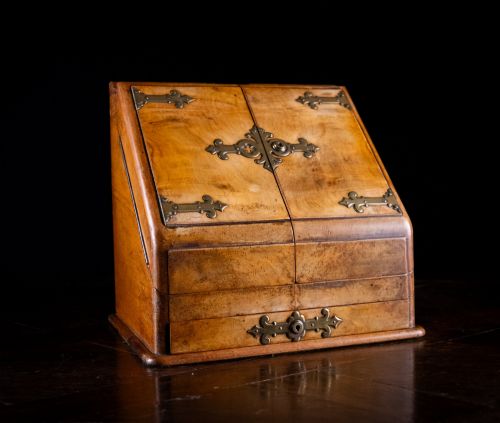
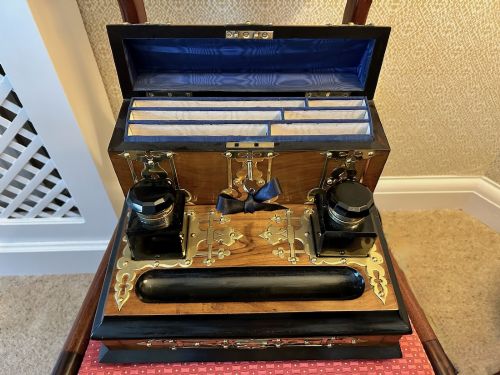
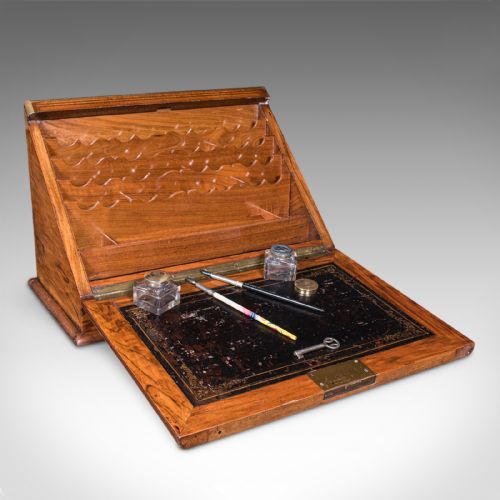
A walnut desk organiser encompasses a range of practical tabletop items designed to hold letters, books, and writing equipment. When you search for a walnut desk organiser, you encounter nineteenth-century stationery boxes, inkstands, and book slides.
The pieces appearing on this page span several periods, including Regency, Victorian, and Edwardian eras. Victorian examples frequently feature brass mounts and fitted interiors, whilst pieces from the early twentieth century introduce marquetry and carved details.
Forms vary from slope-front stationery cabinets to expandable book slides and heavy inkstands fitted with glass wells. Walnut timber provides the primary body across these objects, often enhanced by burr walnut veneers or boxwood inlay.
Materials and construction
Cabinet makers utilised solid walnut and decorative veneers like burr walnut to construct the main bodies of these pieces. Secondary woods and boxwood stringing frequently appear alongside the primary timber.
Metalwork played a structural and decorative role, with brass hinges, mounts, and handles fitted to secure compartments and drawers. Glass inserts formed the inkwells for desk stands, while silk and leather sometimes lined the internal writing surfaces or stationery dividers.
Listings feature walnut, brass, glass, and leather across Victorian, Regency, and Edwardian periods.
Assessing quality and craftsmanship
Quality rests in the selection of the timber and the precision of the joinery. Figured walnut and burr veneers demonstrate superior material selection compared to plain grain.
Hardware and patented mechanisms elevate particular pieces. Solid brass mounts, heavy hinges, and functioning patent mechanisms like those by Betjemanns distinguish finer stationery boxes and book slides.
Edmund Nye·Betjemanns
The Walnut Desk Organiser Glossary
- Stationery box
- A desktop cabinet designed to hold writing paper, envelopes, and correspondence. These boxes often feature sloping lids or drop-front doors.
- Inkstand
- A tray or stand holding one or more inkwells, often accompanied by pen troughs. They sit upon a desk to provide immediate access to writing materials.
- Book slide
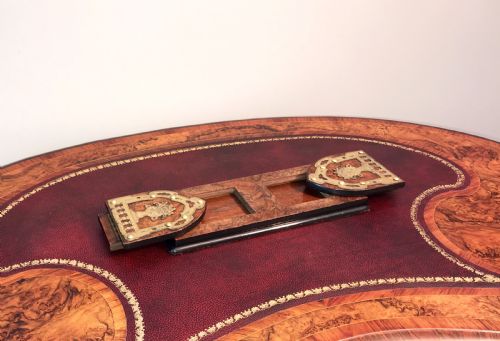
- An adjustable desktop rack designed to hold a row of books upright. Many examples feature extending wooden ends connected by a metal or scissor action.
- Marquetry
- The art of applying decorative veneer pieces to a structure to form geometric or floral designs. Edwardian pieces on this page utilise this technique.
- Tunbridge Ware
- A type of decorative woodwork characterised by tiny mosaic tiles formed from different coloured woods to create pictorial patterns. Edmund Nye produced notable examples of this craft.
Walnut Desk Organiser: Frequently Asked Questions
How were stationery boxes used?
Stationery boxes held writing paper, envelopes, and stamps upright within fitted compartments. The drop-front or sloping lid protected personal correspondence from dust and kept desks tidy.
Many Victorians kept these cabinets closed when not writing, displaying the figured walnut and brass mounts as decorative items in a study or drawing room.
How do I tell Victorian pieces apart?
Victorian desk accessories often display distinct styling cues, such as Gothic revival architectural motifs or heavy brass mounts applied around 1880. Figured walnut and burr veneers were popular choices during this period.
Later Edwardian examples tend to introduce lighter marquetry work and refined inlay, whereas Regency pieces predate the heavy ornamentation of the mid-nineteenth century.
How do book slides work?
Book slides feature an expanding mechanism that allows the wooden ends to move closer together or further apart. This design securely clamps a variable number of books between the two upright supports.
Patented versions, such as those by Betjemanns, utilised mechanical linkages to ensure smooth movement when adjusting the length of the slide.