


Wall Clock with Bracket
A wall clock with bracket pairs precision timekeeping with architectural presence, elevating a room through matched woodwork and coordinated metalwork.
Wall Clock with Bracket
When you search for a wall clock with bracket, you look for a timekeeper designed to sit securely upon its own dedicated support shelf. These pieces combine the function of a standard timepiece with the decorative harmony of a fitted console.
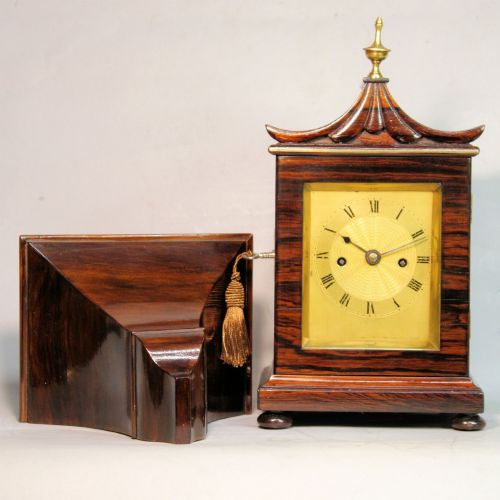
The selections here span the Georgian and Victorian eras, encompassing English fusee movements alongside French and Swiss creations. You encounter mahogany, rosewood, and ebonised timber casings paired with matching wall supports.
Certain examples arrive as unified sets where the clock and bracket share identical materials and ornamentation. Others pair a wall-mounted dial with built-in bracket supports or optional ledges.
Materials and construction
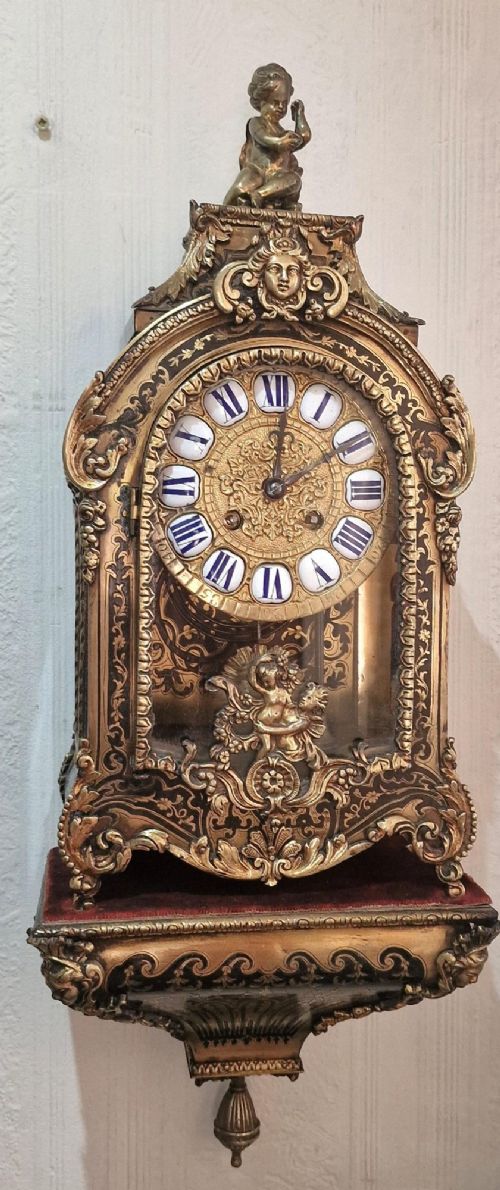
Cabinetmakers utilised rich timber veneers including mahogany, walnut, and tortoiseshell over solid wooden frames. Ormolu mounts and cast brass details were applied to corners, bezels, and finials to accent the polished wood.
Clockmakers fitted intricate mechanical systems such as fusee movements, pinwheel escapements, and quarter striking mechanisms. Dials frequently feature white enamel cartouches and protective glass panels set within brass bezels.
One exceptional timepiece carries a unique history directly linked to Holborn Town Hall and Library.
Distinctions in quality
The division between standard items and superior pieces rests in the integrity of the matching components and the complexity of the movement. Sets that retain their original corresponding wall bracket command higher regard than assembled pairings.
Finishing work on the timber case and the precision of the brass or ormolu mounts signal the workshop's standard. Engraved backplates and specialised escapements by known makers elevate the mechanical merit of the clock.
J. A. Wheatley Carlisle·John Seddon·Valiant Paris·Lenzkirch·Vincenti and Cie·F B Adams·Edward Fussell·William Coxhead
The Wall Clock with Bracket Glossary
- Bracket clock
- A portable timekeeper originally designed to sit on a bracket or table. Though many now hang upon walls or rest on shelves, the name persists from earlier centuries.
- Fusee
- A conical pulley used in spring-driven clocks to equalise the drive force as the mainspring unwinds. This mechanism helps maintain consistent timekeeping accuracy.
- Ormolu
- Gilded bronze ornamentation applied to furniture and clock cases. The technique involves a mercury-gilding process that imparts a bright golden finish.
- Boulle
- Marquetry technique employing tortoiseshell and brass inlay developed in France. It creates a rich, patterned surface across the clock case and bracket.
- Escapement
- The mechanical linkage that regulates the release of gear train power to the pendulum or balance wheel. Pinwheel and anchor variations appear frequently in these movements.
Wall Clock with Bracket: Frequently Asked Questions
How do I hang a wall clock with bracket safely?
Ensure the wall bracket is anchored directly into solid masonry or substantial wooden studs using heavy-duty fixings. The weight of the timber case and mechanical movement requires robust support to prevent shifting.
Place the clock centrally on the bracket shelf once the support is firmly secured. Check that the pendulum hangs plumb and the case rests level to ensure the escapement operates correctly.
Did all these clocks originally come with brackets?
Many period examples were manufactured alongside a matching wall bracket as a complete decorative ensemble. This ensured the timber grain, colour, and decorative mounts coordinated perfectly between the clock and its shelf.
Other pieces were designed primarily as mantel clocks with optional or later wall brackets supplied to accommodate different interiors. Reviewing the joinery and materials helps determine if the pairing is original.
What is a fusee movement?
A fusee movement utilises a conical drum connected to the mainspring via a fine chain or cord. As the spring loses tension, the chain moves to a wider section of the cone, maintaining steady power delivery to the gear train.
This mechanical refinement distinguishes high-grade English timepieces from simpler spring-driven clocks. It contributes directly to consistent timekeeping across the duration of the wind.
How do I tell French and English styles apart?
French examples often display elaborate ormolu mounts, boulle tortoiseshell inlay, and rounded architectural forms influenced by Rococo or Empire designs. They frequently utilise striking mechanisms tailored for decorative salons.
English pieces tend to feature clean mahogany or rosewood cases with fusee movements and restrained brass fittings. Their design prioritises architectural proportion and mechanical precision.