


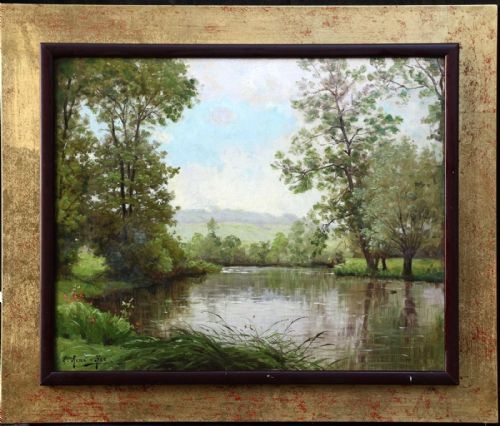


Vintage Woodland River Art
Vintage woodland river art captures quiet country water and shaded trees through oil and watercolour from the nineteenth and twentieth centuries.
Vintage Woodland River Art
Vintage woodland river art comprises painted scenes of rivers, streams, and wooded glens created across multiple decades from the nineteenth century into the mid twentieth century. These works capture natural settings, often featuring riverbanks, country water, and autumnal woodland views.
Buyers browsing this selection meet oil paintings on canvas alongside watercolours on paper. The pieces span Victorian naturalism, British impressionism, and early twentieth century realism, reflecting various regional landscapes from England, Wales, Ireland, Scotland, and Canada.
The assortment includes individual framed canvases, pairs of landscape paintings, and decorative prints. Common subjects range from cattle watering by a river to fishermen stationed near wooded riverbanks at sunset.
How vintage woodland river art was made
Artists applied oil paint and watercolour onto prepared canvas, wood, or paper supports. Many pieces utilise traditional mediums where pigments are bound with oil or suspended in water to achieve depth in foliage and water.
Frames frequently incorporate gesso and gold leaf finishes to complement the painted scenes. These traditional framing methods protect the canvas and paper substrates while framing the landscape composition.
Listings feature oil paintings and watercolours spanning the nineteenth century, nineteen ten, nineteen twenty, and nineteen fifties.
What varies in quality in vintage woodland river art
The handling of light and atmosphere distinguishes individual works, particularly in how artists render reflections on water and the density of woodland foliage. Superior examples demonstrate confident brushwork that conveys movement in rivers and texture in trees.
The skill of the composition and the definition of natural details elevate certain pieces above standard decorative views. Signed works attributed to recognised painters carry distinct artistic merit compared to anonymous topographical studies.
Arthur Herbert Rigg·Clarence Henry Roe·David Watts·Alfred Grey RHA·Walter Follen Bishop·William Mellor·Ernest Higgins Rigg·Charles Edmond Rene His·Everett W Mellor·George Neil
The Vintage Woodland River Art Glossary
- Oil on Canvas
- Pigment mixed with drying oil applied to a woven fabric stretched across a wooden frame. This medium allows for rich colour blending and textured impasto application.
- Watercolour
- Pigment ground in a water-soluble binder and applied to paper. It creates luminous, transparent washes of colour suited for atmospheric landscapes.
- Gesso
- A plaster-like mixture applied to wood or canvas as a base for painting or applied to wooden frames before gilding. It provides a smooth, stable surface for gold leaf.
- British Impressionism
- A painting style developed in the late nineteenth and early twentieth centuries focusing on everyday scenes, natural light, and loose brushwork. Artists working in this manner prioritized capturing fleeting atmospheric effects.
- Victorian Naturalism
- An artistic movement emphasising detailed observation of the natural world without idealisation. Works in this style depict flora, fauna, and rural topography with careful fidelity.
Vintage Woodland River Art: Frequently Asked Questions
What periods do these paintings come from?
The works span from the late nineteenth century through the mid twentieth century, covering Victorian, Edwardian, and later periods.
Most examples date between eighteen ninety and nineteen fifty, reflecting changing artistic approaches to landscape painting.
How should I care for oil and watercolour paintings?
Oil paintings on canvas benefit from stable indoor humidity and shelter from direct sunlight to prevent pigment degradation.
Watercolours require framing behind glass with acid-free mounts to protect the paper from moisture and light exposure.
Are these works signed by the artists?
Several pieces feature artist signatures or inscriptions detailing the specific geographic location depicted in the landscape.
Other works remain unsigned decorative examples or historical prints representing regional scenery.
What framing is typically found on these pieces?
Many paintings retain period frames finished with gesso and gold leaf that complement the age of the artwork.
Original frames provide context for the era in which the landscape was painted and exhibited.