
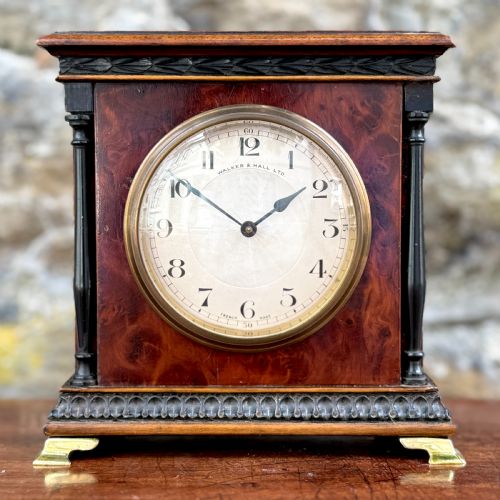


Vintage Wooden Hall Clock
A vintage wooden hall clock brings the measured tick of mahogany, oak and burr walnut straight into an entranceway.
Vintage Wooden Hall Clock
A vintage wooden hall clock encompasses tall floor-standing longcase and grandmother clocks alongside smaller mantel and wall pieces constructed from timber. These timepieces measure time through pendulum swings and gear trains housed in tall cases or smaller wooden boxes designed for domestic display.
Grandmother clocks and slim longcase varieties dominate the selection, offering tall vertical proportions suited to narrow hallways and corridors. Oak and mahogany form the primary carcasses, often enhanced with satinwood inlay or ebonised wood details.
Makers such as Walker and Hall and JJ Elliot appear among the larger floor-standing models and mantel pieces. The periods span from Georgian and Victorian eras through to Edwardian and early twentieth-century designs.
How they were made
Cabinetmakers constructed the tall wooden cases using solid timbers like mahogany, oak and burr walnut, frequently applying contrasting satinwood inlay for decorative borders. Movement makers fitted brass gear trains, enamel dials and glass panels to protect the pendulum and weights.
Movements utilise weight-driven or spring-driven mechanisms, incorporating quarter chiming and hour strike functions alongside musical capabilities in smaller grandmother clocks. Woodworkers shaped ebonised wood and carved classical or Gothic Revival details directly into the structural timber.
Horological forms span wall clocks, mantel pieces, longcase clocks and grandmother clocks driven by weights or springs.
What varies in quality
Superior examples demonstrate refined proportions in the timber case, particularly where Scottish mahogany or burr walnut grain is matched across the door and trunk. The integration of complex movements, such as twin fusee systems or quarter chiming Westminster mechanisms, elevates the construction standard.
The crispness of dial enamel, the precision of brass work, and the subtlety of satinwood inlay distinguish standard production pieces from finer workshop commissions.
Walker and Hall·JJ Elliot
The Vintage Wooden Hall Clock Glossary
- Longcase clock
- A tall floor-standing timepiece housed in a wooden trunk with a weighted pendulum. These are frequently referred to as grandfather clocks.
- Grandmother clock
- A smaller, more slender version of the longcase clock, typically produced during the Edwardian period and early twentieth century. They fit lower ceilings and narrower spaces than traditional grandfather clocks.
- Fusee
- A conical pulley used in clock movements to maintain even driving force as the mainspring unwinds. This mechanical device improves timekeeping accuracy.
- Enamel dial
- A metal clock face coated with fused glass powder to create a smooth white surface for painted numerals. They provide a durable and legible face.
- Ebonised wood
- Timber treated with a dark finish to imitate expensive ebony. Cabinetmakers utilised this technique on decorative mouldings and case highlights.
Vintage Wooden Hall Clock: Frequently Asked Questions
What is a grandmother clock?
A grandmother clock is a scaled-down version of the traditional tall longcase clock, usually standing shorter and narrower. These slender timepieces became popular during the Edwardian era and early twentieth century for domestic interiors with lower ceilings.
They share the weight-driven or spring-driven mechanisms of their larger counterparts, often featuring chiming functions while occupying a smaller footprint in a hallway or landing.
How do I tell oak from mahogany cases?
Oak exhibits a prominent, open grain with visible medullary rays, often showing a lighter golden-brown hue in Georgian and Victorian examples. Mahogany presents a tighter, smoother grain with a deep reddish-brown tone that deepens in colour over centuries.
Scottish mahogany longcase clocks and Edwardian inlaid pieces utilise the distinct reddish timber for smooth flat surfaces, whereas oak provides a robust, textured finish.
Where should I place a tall hall clock?
Tall hall clocks require a stable, level floor surface away from direct sunlight, central heating vents and damp exterior walls. Placing them in an entrance hall or wide corridor allows the pendulum to swing freely without interference.
Securing the tall wooden trunk to the wall using discreet brackets prevents accidental tipping in busy hallways.
What does twin fusee mean?
A twin fusee movement uses two conical pulleys and chains or cords to equalise the pull of the mainsprings on the timekeeping and striking trains. This complex mechanism ensures consistent power delivery to the gear train as the clock runs down.
Clocks featuring this setup represent a higher standard of mechanical engineering within antique longcase and mantel pieces.