


Vintage Turquoise Gold Ring
A vintage turquoise gold ring brings together vivid blue stones and precious metal in designs spanning the Victorian era to the mid-century.
Vintage Turquoise Gold Ring
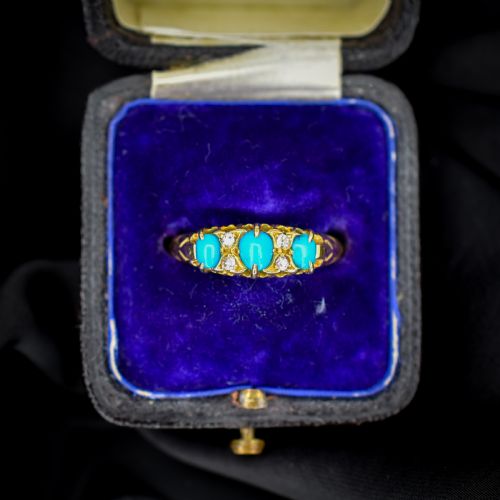
The most common examples you are likely to meet on this page hail from the Victorian and Edwardian eras, frequently combining turquoise cabochons with seed pearls, diamonds, and yellow or rose gold. These historic designs often feature symbolic motifs such as forget-me-nots, buckle bands, and scroll boat settings.
Later mid-century iterations introduce clean lines and textured rope twist details in both white and yellow gold settings. Alongside individual rings, the broader category occasionally encompasses matching jewellery suites featuring complementary earrings.
Materials and Construction
The construction of these pieces relies on precious metal alloys combined with natural turquoise stones. Workshops utilised 9ct, 15ct, and 18ct gold in yellow, rose, and white variations to mount the turquoise, frequently incorporating diamonds and seed pearls as accents.
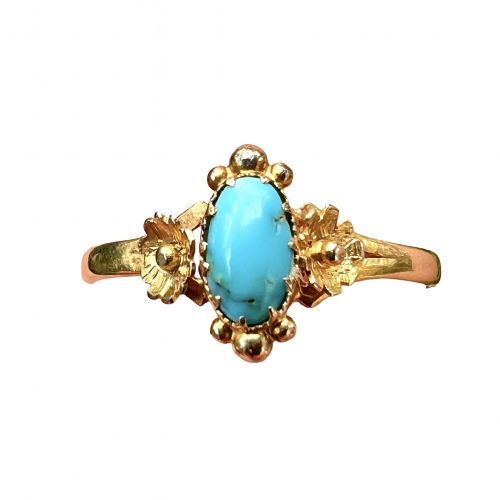
Gemstones are shaped into smooth cabochons or delicate small stones to form clusters, eternity bands, and floral motifs. Metalwork techniques range from precise scroll boat settings and star-burst engravings to robust rope twists and multi-row stacking bands.
Evil eye motifs make an appearance, guarding your finger against misfortune while sparkling with turquoise and pearls.
Distinctions in Quality
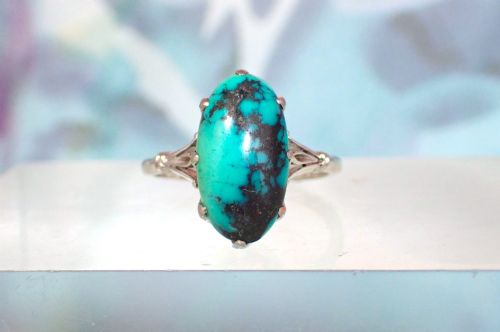
The distinction between standard examples and the finest pieces rests upon the saturation and matrix of the turquoise itself. Top-tier stones display a uniform robin-egg blue colour with minimal dark veining, securely set within substantial gold weights.
Craftsmanship and stone pairing elevate a piece further, particularly where diamonds or seed pearls accompany the turquoise. Well-preserved claw settings, clear hallmarks indicating origin and date, and intricate hand-engraved band details mark out superior examples.
Julius Cohen
The Vintage Turquoise Gold Ring Glossary
- Cabochon
- A gemstone shaped and polished with a smooth, convex upper surface rather than faceted. This cut is standard for turquoise to highlight its natural colour and opacity.
- Seed Pearl
- A very small, naturally occurring pearl often utilised in historic jewellery. These tiny pearls frequently border turquoise stones in Victorian and Edwardian cluster designs.
- Scroll Boat
- A specific boat-shaped mounting style popular in the Edwardian period. It curves gracefully to house central clusters of turquoise and diamonds.
- Hallmark
- An official stamp or marks impressed on precious metals. They indicate the purity of the gold, the maker, and the assay office or year of testing.
- Eternity Ring
- A band featuring a continuous line of identically cut gemstones. Examples in the evidence include multi-stone turquoise bands set in rose gold.
Vintage Turquoise Gold Ring: Frequently Asked Questions
What periods do these rings come from?
The available pieces originate primarily from the Victorian and Edwardian eras, alongside later Art Deco and mid-century designs. Each period brings distinct metal colours and decorative motifs.
Victorian and Edwardian examples often feature rose or yellow gold with pearls, while mid-century rings tend towards cleaner modern lines and yellow or white gold.
How do I care for turquoise jewellery?
Turquoise is a softer, porous gemstone that requires gentle handling compared to harder stones like diamonds. Avoid exposing your ring to harsh chemicals, ultrasonic cleaners, and prolonged immersion in water.
Clean the metal and stones gently with a soft, damp cloth and store the piece separately to prevent scratching from harder jewellery.
Are pearls commonly found with turquoise?
Yes, seed pearls frequently accompany turquoise in Victorian and Edwardian cluster and multi-stone rings. This pairing creates a classic historic contrast between the pale pearls and the bright blue turquoise.
These combination rings often take the form of floral clusters, star motifs, or delicate five-stone arrangements.