


Victorian Turquoise Dress Ring
A victorian turquoise dress ring brings together vibrant blue cabochons and warm gold in designs made to be worn and admired.
Victorian Turquoise Dress Ring
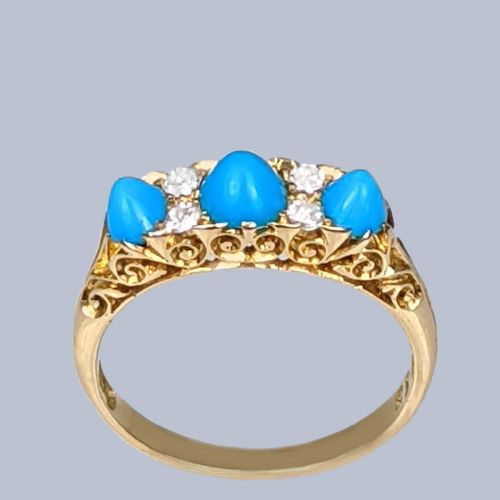
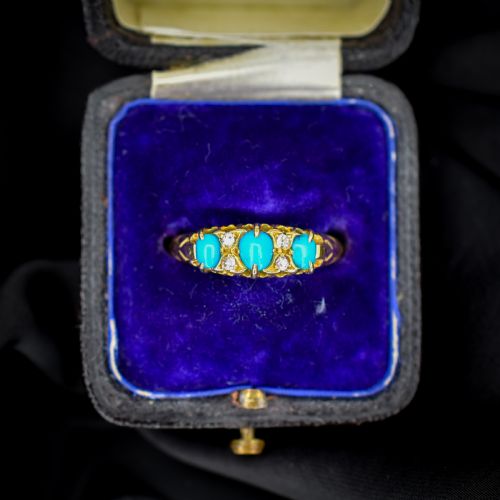
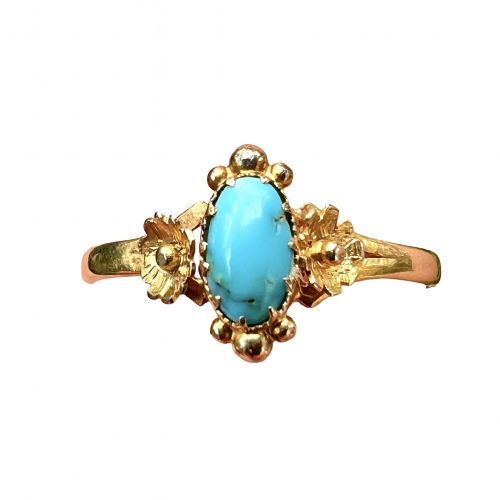
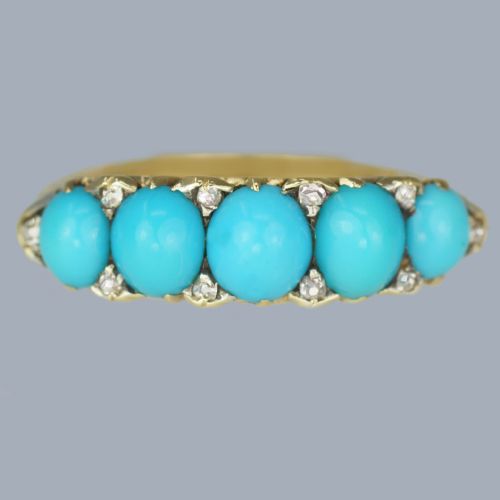
A victorian turquoise dress ring is a piece of antique hand jewellery designed for ornament rather than betrothal, appearing frequently in Victorian and Edwardian iterations. These rings showcase bright blue stones set alongside pearls and diamonds in formats such as clusters, scroll boats, and multi-stone bands.
The selection on this page centres heavily on Victorian examples, complemented by pieces from the turn of the twentieth century and the Edwardian period. Buyers encounter forms ranging from simple gold bands to complex star and navette motifs executed in yellow gold.
How they were made
Goldsmiths constructed these rings primarily using eighteen carat and fifteen carat yellow gold, alongside nine carat variants, shaping the metal to hold delicate gems. Stones were selected in smooth cabochon cuts to display the natural blue colour and matrix of the mineral.
Craftsmen paired the turquoise with old cut diamonds and split pearls, arranging them in clusters, trilogy settings, and flower designs. Scroll work and engraved details often embellished the shoulders and bands of these pieces.
Listings span the Victorian era, the year nineteen hundred, the Edwardian period, and nineteen twenty, utilising turquoise, diamond, pearl, and various carats of gold.
What varies in quality
The distinction between tiers rests upon the matching and colour consistency of the turquoise cabochons across the setting. Uniformity in the vibrant blue hue and the integrity of each stone elevate the overall execution.
Superior examples combine this stone selection with finer secondary gems, such as well-matched old cut diamonds and lustrous pearls, set in higher carats of yellow gold with crisp, deliberate detailing.
The Victorian Turquoise Dress Ring Glossary
- Cabochon
- A gemstone shaped and polished with a smooth, rounded surface rather than faceted. This cut suits opaque stones like turquoise by highlighting their colour and natural patterns.
- Navette
- A boat-shaped or marquise-shaped design that tapers to points at both ends. It creates an elongated silhouette across the finger when set with multiple stones.
- Trilogy ring
- A ring featuring three principal stones set in a row, often symbolising past, present and future. In these listings, turquoise is frequently flanked by diamonds.
- Old cut diamond
- A hand-cut diamond shape typical of the nineteenth century, characterised by a smaller table, higher crown and open culet. These stones catch candle and gas light with a softer gleam than modern cuts.
Victorian Turquoise Dress Ring: Frequently Asked Questions
How do I care for antique turquoise rings?
Turquoise is a softer, porous stone that absorbs oils, cosmetics and water easily. You should remove the ring before washing hands, applying lotions or undertaking manual work to protect the colour and setting.
Clean the metal parts gently with a soft cloth and avoid chemical jewellery dips entirely. Store the ring separately in a lined box to prevent scratching against harder diamonds.
Can I wear a turquoise dress ring daily?
While these rings were made for regular wear, their age and the delicate nature of turquoise require mindful handling. Occasional daily wear is suitable if you take precautions against knocks and moisture.
For heavy or constant wear, consider reserving the ring for special occasions to preserve the security of the stones and the integrity of the antique gold.
What is the difference between Victorian and Edwardian rings?
Victorian rings, dating from the reign of Queen Victoria, often lean towards heavier yellow gold settings, romantic motifs like stars and flowers, and rich colour combinations. They frequently employ fifteen or eighteen carat gold.
Edwardian pieces, made during the reign of King Edward VII, tend to show lighter, airier metalwork and a preference for graceful curves, scroll boats and delicate pearl pairings.
How are nineteenth century gold carats different?
Nineteenth century British jewellery frequently utilised fifteen carat and eighteen carat yellow gold, standards that differed from later manufacturing norms. Fifteen carat gold provided a distinct warm tone favoured by makers of the era.
You will also encounter nine carat gold in certain pieces, particularly from the Edwardian period or in specific regional workshops.